Heavy Hors d’Oeuvres: 12 Bites to Replace Dinner
 18 min read
Eight to twelve filling bites per guest, three bite-types on the table, and a sixty-forty hot-to-cold split, that is the entire bite-count rule for a cocktail party where heavy hors d’oeuvres replace dinner. Skip any one of those three numbers and the night reads as a long appetizer hour with dinner that never arrived. Hit all three and the room eats well for three hours without anyone asking when food is being served.
What makes a no-dinner cocktail party work is not more bites, it is the right mix of bites: a protein-forward anchor, a carb-anchor for grounding, and a veg-refresher to reset the palate between heavier hits.
By the end, you will have a three-hour cocktail-party menu, the running order from light to heavy, the pour plan, and the make-ahead schedule that lets the host stand at the door with a glass in hand when guests arrive.
At a Glance
- Heavy hors d’oeuvres replace dinner when guests get eight to twelve filling bites each across a three-hour reception, not the four to six light bites of a pre-dinner cocktail hour.
- Three bite-types carry the menu: protein-forward (sliders, meatballs, skewers), carb-anchor (mini-grilled cheese, polenta cups, flatbread), and veg-refresher (crudités, marinated vegetables, salad cups).
- The split tilts sixty-forty hot-to-cold so the oven stagger runs in twenty-minute waves and the cold platters cover the gaps between hot trays.
- Running order moves light to heavy and cold to hot across three hours, with a one-bite sweet at the end so the room knows the meal is closing.
- Pours that carry the evening: one pre-batched cocktail, two wines (a white or sparkling and a red), and two non-alcoholic anchors that read as full drinks, not afterthoughts.
What Are Heavy Hors d’Oeuvres?
Heavy hors d’oeuvres are filling appetizers served in volume across a three-hour reception, structured to feed guests fully without a sit-down dinner course. For a host, the working definition is operational: eight to twelve bites per guest, three bite-types on rotation, a sixty-forty hot-to-cold split, and a running order that lands the heaviest items closer to the second hour. Bon Appétit’s edit of seven cocktail-party menus treats this format as a standalone meal, not an extended snack break, and it is the closest reference point most home hosts have for the running order this article builds.
When Heavy Hors d’Oeuvres Actually Replace Dinner
Heavy hors d’oeuvres replace dinner only when the event signals a no-dinner cocktail party from the invitation forward. A cocktail-hour spread of four to six light bites does not replace dinner. A reception built around eight to twelve filling bites per guest, served standing for three hours, does. Three event shapes call for heavy hors d’oeuvres rather than a plated dinner:
- Standing reception, six p.m. to nine p.m. Guests circulate, food stations run continuously, and dinner is the spread itself.
- Engagement, milestone, or housewarming for sixteen to thirty guests. Too many to seat at one table, too long for a snack hour.
- Pre-show or pre-game dinner replacement. A three-hour reception compressed into two still uses the same bite-count math.
If the invite reads “cocktails and dinner” or “join us for dinner,” the table needs a sit-down. If the invite reads “cocktails and hors d’oeuvres” or “cocktail reception, six to nine,” the table reads heavy hors d’oeuvres correctly. Bon Appétit’s twelve stylish ideas for a cocktail party covers the invitation language that signals format without spelling it out, which is half of how guests show up either hungry-or-not-hungry. The scale question is its own logistics piece, well covered in our guide to food for large groups that feeds a crowd.
Once the format is named, the next decision is the only one that decides whether guests leave full or hungry, how many bites per guest the kitchen actually produces.
The Bite-Count Rule (Eight to Twelve Filling Bites Per Guest)
Eight to twelve filling bites per guest is the working number for a three-hour no-dinner cocktail party. Below eight, guests leave hungry. Above twelve, the kitchen produces leftovers for the week. The number holds across guest counts from twelve to forty as long as the spread keeps its bite-type mix.
Where eight versus twelve actually lands
- Eight bites per guest: for shorter receptions (two to two-and-a-half hours) or lighter event tone. Use this floor for early-evening events ending at eight.
- Ten bites per guest: the default for the standard three-hour cocktail reception, six p.m. to nine p.m., where guests treat the food as dinner.
- Twelve bites per guest: for longer events or heavier-pour evenings. Twelve also covers the buffer for the four or five guests who eat more than their share.
Heavy hors d’oeuvres quantities by guest count
Start at ten filling bites per guest, then split the total sixty-forty between hot and cold. The table keeps the menu at five items, so scaling up changes batch size instead of adding more recipes.
| Guests | Total bites | Hot and cold split | Budget lever | Equipment plan |
|---|---|---|---|---|
| 12 | 120 | 72 hot, 48 cold | Meatballs, focaccia, seasonal vegetables | One oven and one slow cooker |
| 20 | 200 | 120 hot, 80 cold | Split protein between meatballs and sliders | One oven, one slow cooker, two sheet pans |
| 30 | 300 | 180 hot, 120 cold | Choose two batch-cooked hot items | Two heating zones and four sheet pans |
For twelve guests, a complete 120-bite plan could be forty-eight meatballs, twenty-four polenta cups, twelve focaccia squares, twenty-four crudités cups, and twelve marinated-vegetable skewers. The meatballs and polenta make up the seventy-two hot bites. Focaccia, crudités, and vegetable skewers supply the forty-eight cold bites. Prep the meatballs, polenta, and vegetables the day before; assemble the cold pieces that morning and run the two hot items in separate oven waves.
Why bite size, not bite count, decides whether guests leave full
The rule only holds if the bites are filling. A salt-rimmed cracker counts as one bite, but it does not feed a guest the way a slider or a polenta cup does. The bites that earn the count are two-bite or three-bite items. Serious Eats’ edit of hot, cheesy, bubbly dips that disappear at parties is the strongest reference for the dip-and-bread in-between category.
- One-bite items (single cracker, single olive, single cheese cube) count as half a bite for the rule. Two of them equal one filling bite.
- Two-bite or three-bite items (sliders, polenta cups, meatballs, skewers) count as one filling bite each, the working unit for the math.
- Fork-and-knife appetizers (mini risotto cups, small bowls of pasta, ramekin pot pies) count as one-and-a-half bites and earn a slot in the heavier half of the running order.
With the count locked, the next question is which three bite-types carry the menu, because no host can produce ten different items for twenty guests, but every host can produce three categories of bites scaled by volume. For shopping-list and budget-side planning at this scale, our piece on ten potluck ideas for a crowd that make hosting effortless covers the scale-by-volume thinking that applies whether guests bring food or the host produces it.
|
Track The Spend Per Guest |
The Three Bite-Types (Protein-Forward, Carb-Anchor, Veg-Refresher)
A heavy hors d’oeuvres menu rests on three bite-types in rotation, not ten different recipes. Protein-forward bites carry the meal’s weight, carb-anchor bites give guests something filling to hold while they drink, and veg-refresher bites reset the palate. Build the menu so each guest gets roughly four of one type, three of another, and three of the third.
Protein-forward: the four bites that carry the most weight
- Sliders: beef, pulled pork, or chicken on small brioche buns. The single most filling cocktail-party item.
- Meatballs: Italian, Swedish, lamb-and-feta, or Asian-style. Holds in a chafing dish for two hours without quality drop.
- Skewers: shrimp, chicken satay, beef teriyaki, lamb kofta. Hot off the grill or oven, served in waves.
- Stuffed bites: stuffed mushrooms, deviled eggs with crab, bacon-wrapped dates. Epicurious’s elegant one-bite gallery is a strong reference for the stuffed-bite category.
Carb-anchor: the bite that prevents the room from drinking on empty
- Mini-grilled cheese: cut in half, served warm. The dark-horse winner of every cocktail party menu where it appears.
- Polenta cups with braised topping: creamy polenta set in cups, topped with mushroom ragu, short rib, or roasted vegetables. Holds at room temperature.
- Flatbread or focaccia squares: cut into two-inch squares, topped with cheese, herb, and oil. Bakes in batches; serves warm or room-temp.
Veg-refresher: the palate reset that keeps guests eating
The third bite-type does the quiet work, it gives guests something light to reach for between the slider and the meatball so the room does not slow down at the halfway mark. The veg-refresher category covers marinated olives, blistered shishitos, crudités with a single bold dip. Each one is a four-minute prep that holds for the full three hours.
For more on the veg-refresher slot in a wider menu context, our guide to cocktails and snacks pairing covers the dip-and-bite ratios that hold across event types.
Mix the three bite-types in roughly a four-three-three ratio (four protein, three carb, three veg of ten total per guest), and the spread feeds the room across the whole reception without any one category running out before the others.
Hot Versus Cold: The 60/40 Split That Saves the Kitchen
A heavy cocktail-party spread tilts sixty-forty hot to cold because hot bites read as the meal and cold bites cover the gaps between oven waves. Too much hot keeps the kitchen busy all evening. Too much cold reads like a hotel snack bar. How sixty-forty plays out across a ten-bite menu:
- Six hot bites per guest, split across three items (two each), staggered in twenty-minute oven waves so the kitchen produces one hot tray every twenty minutes for the first ninety minutes.
- Four cold bites per guest, split across two or three items (two of one, two across the others), plated continuously on a stationary platter that gets refilled every forty-five minutes.
- One sweet bite at the end, one per guest, plated at the two-hour-forty-five mark, signals the close of the reception without an explicit announcement.
The cold side does double duty. It covers the gaps between hot trays, and it gives the host something to plate during the busy first thirty minutes when guests arrive in waves.
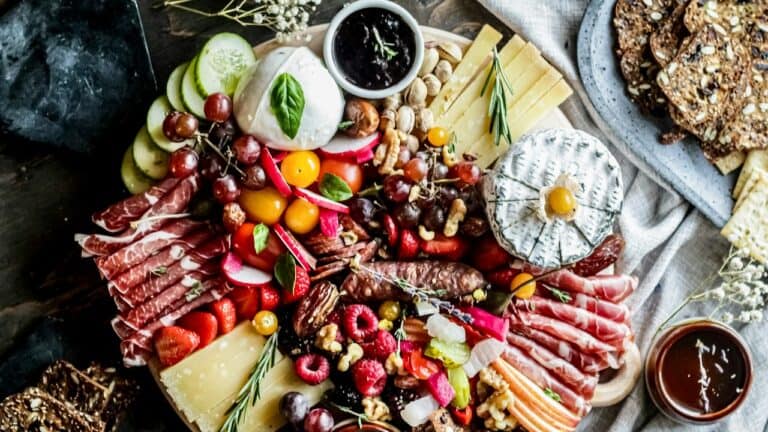
Taste of Home’s hors d’oeuvres collection maps cold-side options well, marinated olives, charcuterie boards, deviled eggs, shrimp cocktail, all of which plate in advance and hold for the full evening.
Epicurious’s quick and easy appetizer gallery is a strong second reference for the cold side specifically, especially the four-ingredient builds that hold for hours.
With the split set, the running order is the last structural decision before the kitchen builds the shopping list, and the order of service decides whether guests pace themselves or peak too early.
|
Hosting Tip: Delay the First Hot Tray |
The Three-Hour Running Order (Light to Heavy, Cold to Hot, Sweet at the End)
The running order moves light to heavy across three hours so guests pace themselves. Cold platters open the night, hot waves anchor the middle, a single sweet bite closes the meal. Spell out the three blocks in advance and the kitchen runs itself.
Hour one (six to seven): cold setup and the first wave
- Six to six-thirty: cold-only. Charcuterie, olives, deviled eggs, crudités.
- Six-thirty to seven: first hot wave. Sliders or stuffed mushrooms, the light end of protein-forward.
Hour two (seven to eight): the heavy middle
- Seven to seven-thirty: second hot wave. Meatballs or polenta cups, the highest-density window.
- Seven-thirty to eight: third hot wave plus cold refill. Skewers, more meatballs, refilled olive bowl.
Hour three (eight to nine): coast down and close
- Eight to eight-thirty: last hot wave. Heavier items that hold, like braised short rib polenta cups. Bon Appétit’s twenty-three one-bite recipes maps the late-evening category.
- Eight-thirty to nine: sweet bite, room-temp. Brownie bite, mini-tart, or chocolate truffle. One per guest.
Three rules across the order keep it on track: never stack two hot waves inside ten minutes (the kitchen breaks), never let the cold platters go empty (the room reads a lull as the party ending), and always plate the sweet at the same moment whether or not guests are leaving (the close cue matters more than the last guest’s appetite).
Serious Eats’ twenty-five cocktail appetizer recipes is the strongest single reference for matching item to evening hour. Bon Appétit’s seven cocktail-party menus also maps the running-order question well, especially for larger guest counts.
Make-Ahead and Reheat Strategy (What the Oven Can Stagger)
Almost everything on a heavy hors d’oeuvres menu can be made ahead, and the few items that cannot are the ones the host plates at the bell. Locking the schedule the day before is the difference between a kitchen that runs itself and one that holds the host hostage. The schedule works in three windows.
- Day before, make and refrigerate: meatballs cooked (sauce separate), polenta base set in sheet pans, deviled egg filling, marinated olives, cold dips. The full cold side is essentially done.
- Morning of, assemble and prep: slider buns toasted, polenta cups cut and topped, skewers threaded raw, mini-grilled cheese assembled. Most prep finishes by two p.m. for a six p.m. start.
- Last hour, final stage: oven preheated, hot trays loaded onto sheet pans. First cold platter on the table thirty minutes before guests arrive. Pours batched and ready.
Reheat strategy depends on the item. Meatballs hold in a 200°F oven for two hours in their sauce. Sliders should be assembled in batches, not stacked under foil. Skewers come off the broiler and serve immediately.
Serious Eats’ snack and appetizer collection covers reheat behavior item by item, which is what the make-ahead schedule depends on.
Once the kitchen is on auto-pilot, the next decision is where guests stand and what they hold, because plating stations decide whether guests circulate or cluster, and that decides whether the room feels like a party or a queue.
|
Assemble The Bite Menu Cleanly |
Plating Stations and the Pours That Carry the Evening
Plating stations and pour service decide the flow of a cocktail party more than the food itself does. Three stations spread across the room keep guests circulating; one centralized station turns the party into a queue. The pour plan (one batched cocktail, two wines, two non-alcoholic anchors) is the spine of the evening.
Plating stations: where guests stand, what they hold
- Station one (entry): cold platter only. Charcuterie, olives, crudités. Guests grab as they arrive.
- Station two (center): hot wave handoff. Kitchen brings hot trays here; guests refresh plates.
- Station three (back): bar plus the sweet plate at the close. Pours batched and self-serve where possible.
Pours that match heavy hors d’oeuvres
- Pre-batched cocktail: one signature pitcher (negroni, gin and tonic batch, or a low-ABV spritz). No shaker per drink. Guests pour their own.
- Two wines: one white or sparkling (Provence rosé or dry sparkling) and one red (light pinot noir or grenache). Bottles open, refill at the bar.
- Two non-alcoholic anchors: sparkling water with bitters and citrus, plus one zero-proof cocktail. Glassware that matches the alcoholic glasses, so the dry guest reads the room as inclusive.
Three stations across the room, three pour categories at the bar, and the food rotation already covered above: that is the entire structural plan for a no-dinner cocktail party.
For the after-dinner energy hold once the food slows, our list of best cocktail party games for fun adult nights covers what tends to land best across the eight-thirty to nine window. Common mistakes that break the plan are the closing section’s job.
Common Cocktail-Party Mistakes (And the Fix for Each)
Five patterns break a heavy hors d’oeuvres menu more often than any other. Each one has a one-sentence fix the host can apply the night before, or the night of.
- Too many one-bite items: the menu reads as ten varieties of crackers and cheese. Fix: swap at least two single-bite items for two-bite or three-bite ones.
- No carb anchor: guests drink fast on protein-only bites and the room is loud by hour two. Fix: at least one carb-anchor per guest.
- All hot, no cold: the kitchen runs continuously and the host never leaves it. Fix: keep the sixty-forty split.
- Pours not labeled: guests ask the host what is in every glass. Fix: a small printed card at the bar for the batched cocktail and the non-alcoholic anchors.
- No sweet at the close: guests linger past nine because the meal never signals it is over. Fix: one sweet bite at the two-hour-forty-five mark.
Avoid the five and the cocktail-party night runs the way the bite-count rule promised at the top: eight to twelve filling bites per guest, three bite-types in rotation, sixty-forty hot to cold, three hours from open to close. The food does the work the host planned it to do, and the host gets to be in the room.
The scaling logic in our piece on best appetizers for a crowd that scale to any guest count covers how to read the bite-count rule against larger or smaller guest lists when the format changes but the running order stays.
Frequently Asked Questions
What counts as heavy hors d’oeuvres?
Heavy hors d’oeuvres are filling appetizers served in volume across a three-hour reception, structured to feed guests fully without a sit-down dinner. The working count is eight to twelve filling bites per guest, mixed across three bite-types (protein-forward, carb-anchor, veg-refresher), with a sixty-forty hot-to-cold split. The spread reads as the meal, not as snacks before it.
How many heavy hors d’oeuvres per person?
Plan eight to twelve filling bites per guest across a three-hour reception. Eight covers shorter receptions or lighter event tones; ten is the default for a six-to-nine cocktail party where food replaces dinner; twelve handles longer events, heavier-pour evenings, or guest lists that skew hungry. Bite size matters as much as bite count.
Can hors d’oeuvres replace dinner?
Yes, when the format is named on the invitation and the spread hits the bite-count rule. Hors d’oeuvres replace dinner only when guests get eight to twelve filling bites each, across three bite-types, served continuously for three hours. A casual cocktail-hour spread of four to six light bites does not replace dinner.
What’s the difference between heavy and light hors d’oeuvres?
Light hors d’oeuvres are four to six small bites per guest served across a one-hour pre-dinner window before a sit-down meal. Heavy hors d’oeuvres are eight to twelve filling bites per guest served across a three-hour standing reception that replaces dinner entirely. The category names the format, not the recipes.
How long should a cocktail party with heavy hors d’oeuvres last?
A heavy hors d’oeuvres cocktail party runs three hours from open to close, typically six p.m. to nine p.m. or seven p.m. to ten p.m. Shorter formats (two to two-and-a-half hours) use the eight-bite floor; longer formats (three-and-a-half hours plus) use twelve. The three-hour middle is the format’s natural length.
What’s the order to serve heavy hors d’oeuvres?
Move from light to heavy and cold to hot across three hours. Open with cold platters only (charcuterie, olives, crudités) for the first thirty minutes. Run hot waves in twenty-minute staggers across the middle hour (sliders, meatballs, polenta cups, skewers). Close with one sweet bite per guest at the two-hour-forty-five mark.
Continue Reading:
More on Hors d’Oeuvres
- Hors d’Oeuvres Menu Planning (A Host’s Playbook)
- Canapés Guide (A Host’s French Single-Bite Plan)
- Tapas Ideas (A Host’s Spanish Small-Plates Plan)
- French Hors d’Oeuvres (Apéritif-Hour Host Guide)
- Japanese Hors d’Oeuvres (An Izakaya Host Guide)
- Chinese Hors d’Oeuvres (Dim Sum Cocktail Bites)
- Gluten-Free Dairy-Free Hors d’Oeuvres (Host Plan)
More from The Gourmet Host
- Funny Jokes for Toasts That Get Every Guest Laughing
- Italian Drinks: Aperol, Spritz, and Crodino (Host)
- Party Food Platters: Build Boards for Any Gathering
- Bar Signs for Home Bar: Custom Pub Decor Guide
- Small Gifts That Will Make Your Dinner Party Guests Feel Special
Explore TGH Categories
- Set the Scene
- Drinks and Bar
- Plan the Meal
- Engage with Guests
- Games and Toasts
- Tools and Techniques
- Why We Gather