Canapés for Hosts: 4 Bases and 6 Classic Builds
 16 min read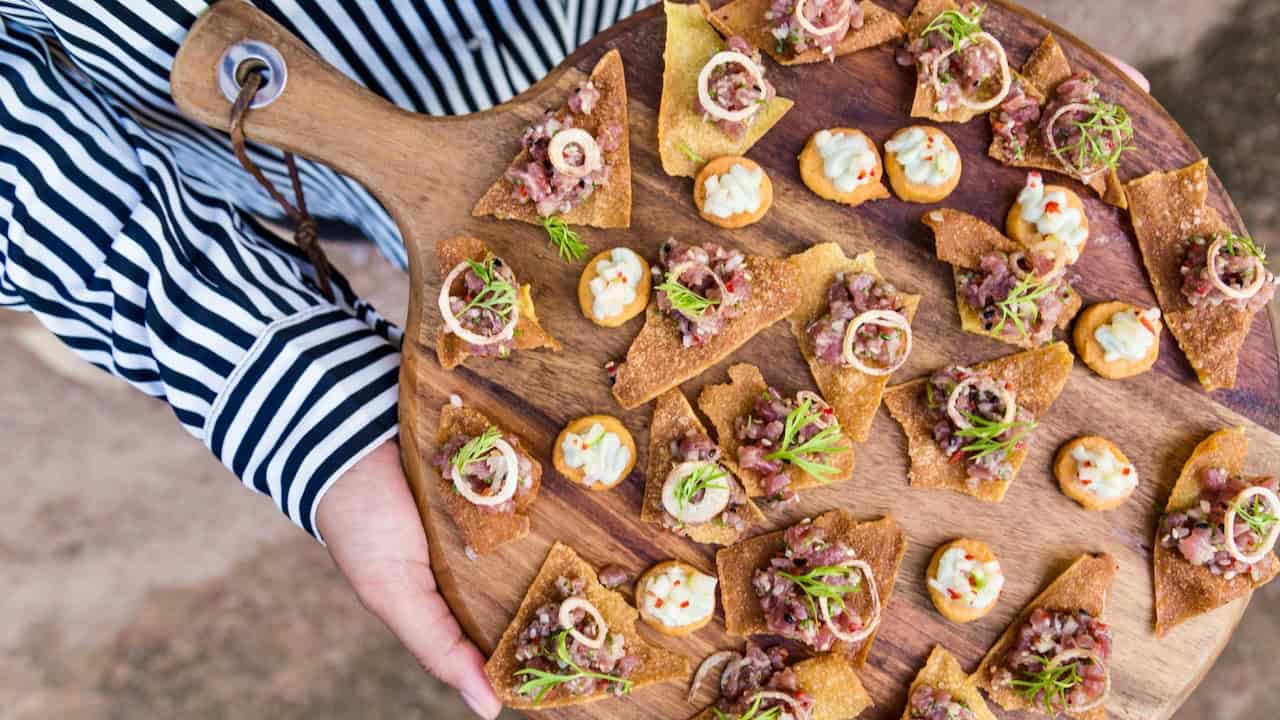
Canapés look intimidating until you notice they are all built on the same four-part structure: a base, a spread, a topping, and a garnish. That is the entire formula. Once that clicks, every canapé you have seen at a French apéritif hour becomes a variation on the same idea, and the planning math drops to a single page.
Four bases (toast, cracker, cucumber, endive). Six spread-and-topping pairings. One per-guest count.
By the end of this guide, your canapé menu for an apéritif hour, a dinner-party opener, or a 12-guest cocktail tray is something you can sketch in under fifteen minutes.
At a Glance
- A canapé is a French single-bite hors d’oeuvre built on a sturdy base with a spread, a topping, and one garnish. Four parts, one bite, no fork.
- Four classic bases handle almost every menu: toasted baguette, sturdy cracker, cucumber round, and endive leaf. Each has its own holding window.
- Six spread-and-topping pairings (cream cheese plus smoked salmon, goat cheese plus fig, herbed butter plus radish, and three more) cover most occasions.
- Plan three counts per guest: 4 for a pre-dinner apéritif, 8 for a cocktail hour, and 12 for a no-dinner spread that doubles as the meal.
- Champagne, Crémant, and two non-alcoholic anchors (sparkling cider and a citrus shrub) cover the pour for a French-leaning canapé tray.
What Is a Canapé (Base, Spread, Topping, Garnish)
Canapés are a French category of single-bite hors d’oeuvres built on a small, sturdy base that holds a spread, a topping, and a single garnish through to the moment a guest picks it up. Unlike American party appetizers that range from a dip with crackers to a skewer to a slider, a canapé is defined by its architecture: one self-contained bite, eaten with one hand, that delivers a complete flavor in two chews. The host who treats canapés as four-part construction rather than a recipe list can plan a tray for six guests and a tray for sixty using the same formula, the same shopping list logic, and the same plating math.
Building the Bite, Step by Step (Base, Spread, Topping, Garnish)
Four parts, in order, every time. The base is the structural floor (toast, cracker, cucumber, endive). The spread is the fat layer that holds the topping in place and protects the base from going soggy. The topping is the headline ingredient. The garnish is the single accent that finishes the bite. Skip one and the bite reads as incomplete. Stack two toppings and it stops being one bite.
Why the four-part architecture exists
The French apéritif tradition treats every part of the bite as load-bearing. BBC Good Food’s canapés and cocktails guide builds dozens of canapés on this same base-spread-topping-garnish logic. The spread is not decoration; it is the engineering that keeps moist toppings from soaking the base and dry toppings from sliding off.
The single-bite, no-fork rule
- Width: the base should be no wider than a quarter so the bite clears the mouth in one go.
- Height: the stack sits under one inch from base to garnish. Higher than that, the topping falls off on the lift.
- Eat order: build the bite so the first taste hits the topping and the last taste hits the spread. The base carries but should not lead the flavor.
- Hands: a canapé that needs a fork is an appetizer, not a canapé.
The single-bite rule is what separates canapés from the broader category of party appetizers. The diner does not put the bite down between chews. The four-part formula shows up everywhere from Bon Appétit’s 15-minute appetizers gallery to home-bakery walkthroughs like David Lebovitz’s sesame baguette technique, because a thinly sliced toasted baguette is the most versatile canapé base in the French kitchen. Once the architecture is clear, the next decision is which base to stand on.
The Four Classic Canapé Bases (Toast, Cracker, Cucumber, Endive)
Four bases cover almost every canapé a home host needs. Each has a different sturdiness profile, a different make-ahead window, and a different topping it flatters. The base decision comes first because it determines how long the tray can sit on the counter before guests arrive.
Toast and cracker: the sturdy bases
- Toasted baguette: thin rounds (half an inch), brushed with olive oil, toasted at 375°F for 8 to 10 minutes. Holds 30 minutes once topped with a fatty spread. Best for smoked salmon, goat cheese, mushroom, anything moist.
- Sturdy cracker: a water cracker, a rye thin, or a sturdy whole-grain crisp. Holds 45 minutes once topped if the spread is properly insulating. Best for fig and goat cheese, prosciutto, anything with a drier profile.
Cucumber and endive: the fresh bases
- Cucumber round: a half-inch round of English cucumber, patted dry. Holds 20 minutes once topped before the cucumber starts weeping water onto the tray. Best for cream cheese plus smoked salmon, herbed labneh plus radish.
- Endive leaf: a single Belgian endive leaf used as the boat. Holds 60 minutes once filled because the leaf does not weep. Best for blue cheese plus pear, goat cheese plus fig, anything chunky.
Cucumber is the base home hosts overuse and caterers underuse, and the reason is timing. A cucumber canapé built more than 20 minutes ahead leaks water through the spread. Endive is the inverse: caterers love it because the leaf does not weep. Serious Eats’s quail egg canapé walkthrough uses cucumber for immediate service; for guests arriving in waves, endive holds a full hour and its bitterness pairs with sweet and salty toppings.
|
Save Your Best Canapé Builds |
Six Spread-and-Topping Combinations That Always Land
Six pairings cover almost every guest preference. Two smoked salmon, two cheese, two vegetable-forward. A tray of three of these six lands cleanly with a six-to-twelve-guest mix.
The two smoked salmon canapés
- Cream cheese plus smoked salmon on cucumber: plain cream cheese on a cucumber round, a folded ribbon of cold-smoked salmon, one dill frond, a twist of pepper. The original smoked salmon canapé and still the first to disappear.
- Dill labneh plus smoked salmon on rye cracker: dill-and-lemon labneh on a rye thin, smoked salmon, one caper. Labneh holds the cracker dry longer than cream cheese, buying 15 extra minutes of tray time.
The two cheese pairings
- Goat cheese plus fig on toasted baguette: fresh goat cheese, fig jam, sea salt, a small thyme leaf. The fig-and-cheese combo lands at every French-leaning apéritif. For a cured-meat parallel, BBC Good Food’s ham and stem ginger thins.
- Blue cheese plus pear on endive leaf: a quarter-teaspoon of crumbled blue (Roquefort if you can find it), a thin slice of ripe Bosc pear, garnished with one toasted walnut piece. The endive bitterness gives the blue cheese room to breathe.
The two vegetable-forward pairings
- Herbed butter plus radish on toasted baguette: cultured butter with chives and Maldon, a round of French breakfast radish, a flake of sea salt. The French apéritif staple, drawn from BBC Good Food’s antipasti skewers collection.
- Wild mushroom on polenta crisp: cooled wild mushroom ragout on a polenta round, shaved Comté. Bon Appétit’s wild mushroom ragout on crispy polenta with Comté is the source recipe; canapé-sized, it covers the vegetarian guest without flagging vegetarianism.
Three pairings let the guest see the choice; five turns the tray into a buffet. Bon Appétit’s salmon tartare technique is the pattern to copy: one headline ingredient, one garnish, one bite. The next decision is how many of each to make.
How Many Canapés to Plan per Guest (Three Counts for Three Occasions)
Three counts cover the three canapé occasions: pre-dinner light bites, full cocktail hour, no-dinner reception. Build the per-guest count first, multiply by guest count, and let that number set the recipe scale.
The three per-guest counts
- Pre-dinner apéritif: 4 canapés per guest. The job is to set the tone, not feed the room. Two cold, two hot if you are running hot canapés at all.
- Full cocktail hour: 8 canapés per guest. The canapés are the food until dinner, roughly one bite every seven minutes across a 60-minute window. Three pairings on the tray.
- No-dinner reception: 12 canapés per guest, plus a second category of heavier bites. The canapés are the meal, which means more variety (4 pairings) and a substantial fill alongside.
Working the math backwards
For 10 guests at a pre-dinner apéritif, that is 40 canapés total. Three pairings means roughly 14 of each. Round up to 15 to absorb the inevitable second-helper. A 12-bite recipe (most online canapé recipes assume this yield) is one and a quarter batches. Make two and the extras carry over as breakfast.
For 12 guests at a full cocktail hour, that is 96 canapés total. Resist the urge to over-produce. Three pairings at 32 each is the right scale; five at 20 each turns the tray into a buffet and the host into a short-order cook. TGH’s make-ahead appetizers guide covers the broader appetizer-planning framework; the count above is the canapé-specific subset.
|
Hosting Tip: Build Canapé Trays in Threes |
Make-Ahead Strategy (What Holds and What Wilts)
Make-ahead canapés separate a host who plates a tray five minutes before guests arrive from one still slicing baguette at the doorbell. The rule: components hold overnight, assembled canapés do not. Build components the day before, assemble within 30 minutes of service.
The 24-hour build plan
- Day before, afternoon: toast the baguette rounds (cool fully, store airtight at room temperature). Mix the spreads (cream cheese, goat cheese, herbed butter, dill labneh). Slice the fig jam, segment the radishes, toast the walnut pieces. Cover each component separately.
- Day before, evening: wash and dry the endive leaves, store wrapped in a damp paper towel inside a sealed container. Slice cucumber rounds and pat bone-dry, refrigerate single-layer on a fresh paper towel.
- Day of, 30 minutes before guests: spread the bases (toast and cracker first, then cucumber and endive). Add the toppings. Hold uncovered in a cool spot. The tray is now plated and the host is now free.
- Day of, plating: garnish the last 5 minutes before the tray hits the table. Dill, capers, sea salt flakes, and herb leaves wilt fast once they touch a moist spread.
Components that hold and components that wilt
Hold overnight: toasted baguette, sturdy crackers, cheese spreads, butter spreads, jams, toasted nuts, cured meats. Hold for hours but not days: smoked salmon, prepared labneh. Hold only briefly: assembled canapés, fresh herb garnishes, sliced vegetables.
TGH’s easy cold appetizers guide covers the broader cold-appetizer make-ahead logic; canapés are the time-sensitive subset because assembly is where the bite reads as fresh or stale.
Plating the Tray (Spacing, Garnish, and the Reload)
Plating decides whether a canapé tray reads as elegant canapés or a sheet pan with food on it. The three variables are spacing, grouping, and reload strategy. None is hard; all three get skipped at home because they read as restaurant-level concern when they are actually a five-minute decision.
Spacing, grouping, and the reload
- Spacing: leave half an inch of negative space between bites. Touching canapés smudge garnishes and read as a buffet.
- Grouping: cluster by pairing, not by base type. Three rows of one pairing each, or a triangle layout for three pairings. Guests scan left to right; a pattern reads as a menu.
- Tray choice: a long rectangular tray for a sit-down apéritif, a round wooden board for a cocktail-hour pass (round trays move more easily through a crowd).
- Reload: build two identical trays for a party of more than 10. When tray one is half empty, refill it in the kitchen and swap it for the fresh one.
Garnish placement and the last 30 seconds
Garnishes go on last and they go on individually: one dill frond per salmon canapé, one caper per labneh canapé, one flake of Maldon salt per radish canapé. Batch-added garnishes pile up at one end of the tray.
Bon Appétit’s puff pastry recipes gallery is the reference for hot canapés, which always go on a separate heated tray.
Shoot a photo of the tray from a 30-degree angle before guests touch it. The photo doubles as the reload reference. After three reloads at a 12-guest cocktail hour, a host’s eye drifts; the reference photo brings the spacing and grouping back to the original plan.
|
Plan The Whole Canapé Spread At Once |
Pairings (Champagne, Crémant, and Two NA Anchors)
Canapés ask for a pour that cuts fat and resets the bite between rounds. The French apéritif tradition built canapés around Champagne and dry sparkling wine for that reason. The pours below cover a 10 to 12 guest tray with one alcoholic anchor, one alternative, and two non-alcoholic anchors.
The four pours
- Champagne (non-vintage Brut): the textbook canapé pour. Cuts the fat in cheese, refreshes between salmon bites. One bottle pours six flutes; plan a bottle for every four guests.
- Crémant de Loire or Crémant d’Alsace: the everyday Champagne substitute French households actually drink. Same dryness profile, roughly half the price. Right call for a weekly apéritif or midweek dinner-party opener.
- Sparkling cider or sparkling pear: the non-alcoholic anchor that mirrors Champagne’s structure. Look for a French-style cider (Normandy or Brittany) with no added sugar. Dryness matters because sweet cider clashes with savory canapés.
- Citrus shrub on tonic: a homemade or store-bought citrus shrub (lemon, orange, or grapefruit) poured over ice and topped with tonic. The acidity does the work Champagne does. TGH’s French non-alcoholic drinks guide covers the shrub builds the apéritif hour needs.
Service notes
Pour Champagne and Crémant into flutes (not coupes); flutes hold the bubble longer. Pour the non-alcoholic anchors into the same glass shape so the guest who skips alcohol does not get a visually different drink.
TGH’s classic aperitifs guide covers the broader pre-dinner pour framework when the apéritif hour leads into a sit-down meal.
Plan one ice-cold bottle for every six guests, a second in an ice bucket within sight, a third in the fridge. Stock two glasses per guest across two hours, wash nothing during service, and the apéritif hour runs itself.
Common Canapé Mistakes (Soggy Bases, Over-Stacked Toppings)
Five mistakes show up on home canapé trays repeatedly. None require expensive ingredients to fix. All of them come from skipping a step in the four-part formula or confusing a canapé with a broader appetizer.
The five mistakes and their fixes
- Soggy bases. The spread is too thin, or the topping went on too early. Fix: a quarter-inch spread layer plus assembly within 30 minutes of service.
- Over-stacked toppings. Two ingredients on top instead of one. Fix: one headline topping plus one garnish. Two toppings turn the bite into a tasting flight.
- Wrong base for the topping. Cucumber under hot mushroom (cucumber wilts), endive under runny cream cheese (the leaf will not close around it). Fix: match base sturdiness to topping moisture.
- Skipped garnish. The bite reads as incomplete. Fix: garnish every canapé individually with one accent. Garnish is seasoning the eye notices first.
- Too many pairings on one tray. Five or six on one tray reads as a buffet. Fix: three pairings maximum per tray. Run two trays of three if you need six total.
The biggest canapé mistake is treating the tray as a recipe project instead of a planning project. The hard part is per-guest count, make-ahead timing, and tray spacing. Epicurious’s best appetizer recipes gallery is useful for individual recipes, but the gallery format tells you what to make, not how many.
TGH’s dinner party menu planning guide covers the planning math the galleries skip. Plan the math first, shop the recipes second, and the apéritif hour leaves nothing to do but pour.
Frequently Asked Questions
What is the difference between a canapé and an hors d’oeuvre?
A canapé is a specific type of hors d’oeuvre: a single-bite item built on a sturdy base with a spread, a topping, and a garnish. Hors d’oeuvre is the broader French category, which also includes dips, skewers, and gougères. Every canapé is an hors d’oeuvre; not every hors d’oeuvre is a canapé.
How do you make canapés that don’t get soggy?
Build a thick enough spread layer (a quarter inch) so it acts as a moisture barrier between the topping and the base, and assemble within 30 minutes of service. Toast the baguette properly, pat cucumber rounds bone-dry, and store assembled canapés uncovered in a cool spot. The moisture problem is timing, not ingredients.
How many canapés do you serve per person?
Plan 4 canapés per guest for a pre-dinner apéritif, 8 per guest for a full cocktail hour, and 12 per guest for a no-dinner reception. Multiply by guest count and divide by the number of pairings on the tray. Three pairings is the sweet spot for one tray; five pairings reads as a buffet.
What’s the best base for a canapé?
Toasted baguette is the most versatile base: sturdy enough for moist toppings, neutral enough for almost any pairing, and holds 30 minutes once topped. Endive is the best base for chunky toppings (holds 60 minutes), cucumber for cold cream-cheese toppings (holds 20 minutes), and sturdy crackers for drier pairings.
Can you make canapés the day before?
Build the components the day before but never assemble. Toast the baguette, mix the spreads, segment the radishes, and store everything separately. Assemble within 30 minutes of service. Components hold beautifully overnight; assembled canapés do not. The garnishes go on last, in the final five minutes before service.
What drinks do you serve with canapés?
Champagne or Crémant for the alcoholic pour (both cut fat and reset the palate between bites), and a French-style dry sparkling cider plus a citrus shrub for the non-alcoholic anchors. Match glassware across alcoholic and non-alcoholic pours so the guest who skips alcohol does not get a visually-different drink.
Continue Reading:
More On Hors d’Oeuvres Menu Planning
- Hors d’Oeuvres Menu Planning (A Host’s Playbook)
- French Hors d’Oeuvres (Apéritif-Hour Host Guide)
- Heavy Hors d’Oeuvres (A No-Dinner Host Playbook)
- Tapas Ideas (A Host’s Spanish Small-Plates Plan)
- Japanese Hors d’Oeuvres (An Izakaya Host Guide)
- Chinese Hors d’Oeuvres (Dim Sum Cocktail Bites)
- Gluten-Free Dairy-Free Hors d’Oeuvres (Host Plan)
More from The Gourmet Host
- Brunch Setup Ideas: Creative Table Setting Decor for Home
- How to Throw a Surprise Birthday Party That Actually Works
- 5 Types of Potatoes and Which to Pick for Each Dish
- 3 Easy Ambience Tips For The Perfect Dinner Party Mood
- Holiday Icebreaker Questions for Festive Gatherings
Explore TGH Categories
- Set the Scene
- Drinks and Bar
- Plan the Meal
- Engage with Guests
- Games and Toasts
- Tools and Techniques
- Why We Gather