Wedding Party Speeches: Order, Tips, and Examples
 18 min read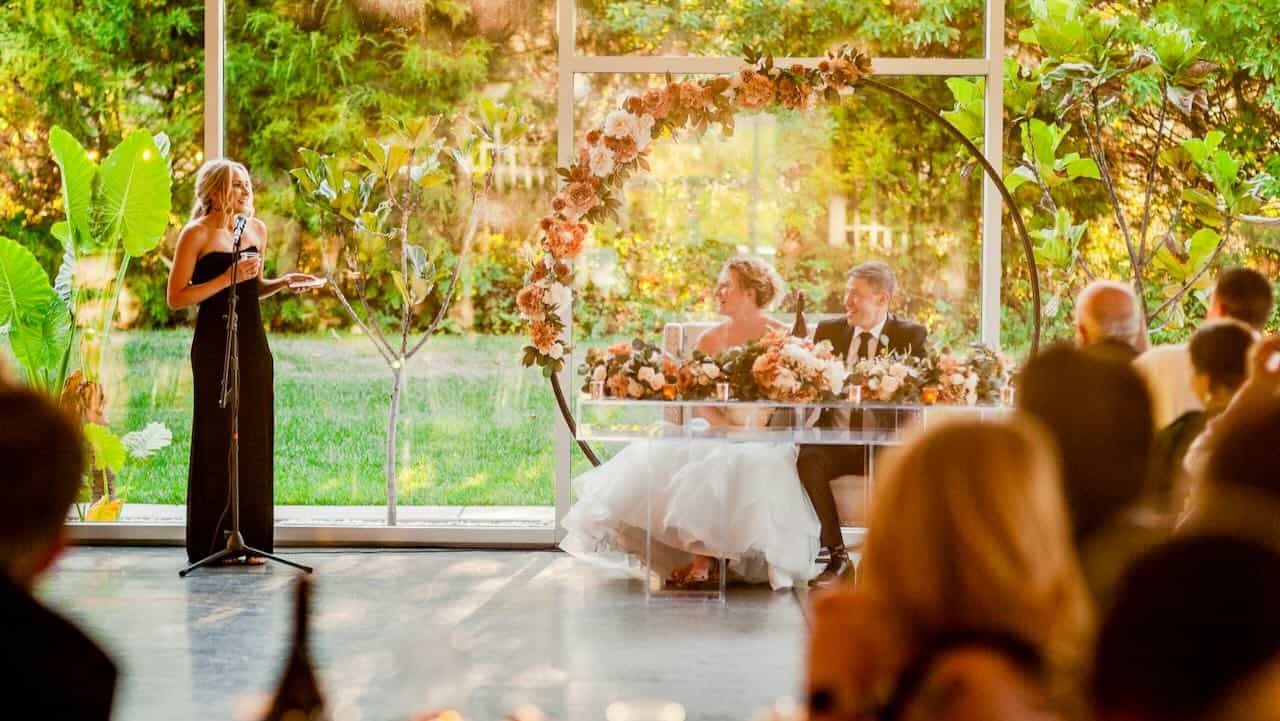
Who speaks, in what order, and what each voice says: the full running order for wedding party speeches, built as one rising arc.
Write three names on a card before you write a single line of any toast: the father of the bride, the groom, and the best man, in that order. Hand that card to whoever runs your reception and you have already fixed the most common reason toasts stall.
Speeches drag when nobody agreed on the sequence, so speakers overlap, repeat the same thank-yous, and lose the room before the best stories arrive. Settle the order first and every speaker relaxes, because each one knows exactly which beat belongs to them.
Get the running order right and the toasts carry the night from the first welcome to the last raised glass. Here is the full sequence, the timing, and what each person actually says when it works.
At a glance:
- Classic order: father of the bride, then the groom, then the best man, with a parent or a sibling added as you like.
- How many: three to five speeches total, since past five guests start to fidget.
- When: after the meal, glasses filled, usually before dessert or the first dance.
- How long: two to five minutes each, with the best man closer to five than to two.
- Shared shape: open, one or two true stories, a warm line, then a toast.
- Notes are fine: reading from a card beats memorizing under pressure every time.
Wedding Party Speeches in One Short Answer
Wedding party speeches are the short set of toasts given at the reception by the people closest to the couple, traditionally the father of the bride, then the groom, then the best man, with more voices added as the couple sees fit. They usually happen after the meal, once every glass is filled, and the whole set runs three to five speeches. The set lands best as one rising arc across the evening rather than a stack of separate speeches: a curve that opens on welcome, warms through story, and closes on a toast.
Hold that number and that order in your head, and every other choice gets simpler.
The order of wedding speeches is really the order of one emotional curve. Someone opens the room, someone carries the gratitude, and someone lands the biggest laugh right before the closing toast.
That single decision, who holds a glass and when, shapes how the whole set lands. Fix it early and the speakers stop competing for the same thank-yous, because each one already knows which part of the night is theirs.
Who belongs in the speaking lineup
Who belongs in the speaking lineup can stretch past the trio, and that is fine. A maid of honor, a bridesmaid, or the parents of the groom all have a claim, as long as the total still lands inside three to five voices.
The guiding question is simple: does this voice add a beat the others cannot? If the answer is yes, make room, and if the person would only repeat a thank-you already covered, move them to the rehearsal dinner instead.
- Who speaks: the father of the bride, the groom, and the best man form the core, with a sibling or a second parent added by choice.
- How many: three to five toasts, since a reception loses its pulse once the speeches stack past five.
- Where it lands: after the meal and before the dancing, when glasses are full and the room is seated.
Everything after this serves that order. Timing, length, and what each person says only matter once the sequence is settled, so start there and treat the rest as fine-tuning.
That three-to-five range is not arbitrary. The etiquette editors at Who Gives Speeches at Weddings and the planners behind this guide to who makes speeches at weddings land on the same window for the same reason: attention thins fast once the toasts run long.
Read the Reception as One Rising Curve
Read the night as a shape, not a schedule. You are not slotting five separate speeches into a timeline, you are building one curve, and each speaker holds a different stretch of it.
The father of the bride opens the room with welcome and warmth, setting the floor the others build on. The groom or the couple carries the gratitude, thanking the families and the guests who traveled to be there.
The best man brings the lift, the laugh, and the peak of the night, then turns sincere for the closing toast. Add a mother of the groom or a sister and you extend the curve with another beat rather than a competing headline.
It works the way a good playlist builds. You would not open on the slowest song or close on a jarring one, and a reception full of toasts follows the same instinct from welcome to peak to send-off.
Why the curve beats a flat list
A flat list treats every speech as the same job, so speakers pile on identical gratitude and the humor scatters across the night. A curve gives each voice one clear task, which is why the set feels shaped instead of repetitive.
The rising shape also tells each speaker how much room they get. An opener does not need the biggest laugh, and a closer does not need to cover every thank-you, so the pressure on any single toast drops and people write shorter, truer ones.
Humor timing is easy to get backwards. A big laugh too early leaves nowhere to climb, and a sincere note in the best man’s slot lands harder because the room just laughed, so the order protects both the joke and the sentiment.
- Welcome: the opener settles the room and lowers the stakes for every speaker who follows.
- Gratitude: the couple or groom thanks the families, the guests, and anyone who traveled far.
- Lift: the best man raises the energy, then drops into one sincere line before the toast.
Planning by curve instead of by list fixes the two things that tire a reception: repeated thank-yous and humor that lands in the wrong place. For the craft of writing and delivering one strong toast inside that arc, our guide to the best wedding speeches and how to give them breaks the delivery down line by line.
|
Keep the Reception Plan Together |
Decisions That Set Your Running Order
Every good running order comes down to a handful of decisions made in sequence. Make them in this order and the speeches almost write themselves.
Here is the classic running order at a glance, with the timing and the job each voice does.
| Order | Speaker | When | Length | What the speech does |
|---|---|---|---|---|
| 1 | Father of the bride | After the meal, glasses filled | 2 to 4 min | Opens the room, welcomes guests |
| 2 | The groom | Right after the father | 2 to 4 min | Carries the gratitude, thanks both families |
| 3 | Best man | Before dessert or the first dance | 3 to 5 min | Lands the biggest laugh, closing toast |
| \+ | Parent, sibling, or maid of honor (optional) | Slotted to keep the total at 3 to 5 | 2 to 3 min | Adds a beat the core three cannot |
Cap the list of speakers first
Start with the traditional trio: father of the bride, groom, best man. Then add, deliberately, no more than one or two extra voices, because every additional speaker flattens the curve a little.
Couples increasingly reorder or expand the set, and that is welcome, but three to five total keeps the energy high. The editors behind The Ultimate Guide to Wedding Speeches and Toasts reach the same range, and if you want the reception-timing variations spelled out, our companion pieces on the order of wedding toasts and who makes toasts at a wedding settle the details.
A common move keeps the reception tight without cutting anyone. Place the extra sibling and parent voices at the rehearsal dinner the night before, and the reception then holds three or four speeches while the people who wanted a moment still get one.
Lock the order, then confirm it with the venue
The traditional sequence runs father of the bride, groom, best man, and it exists because it rides the curve: welcome, gratitude, lift. Whatever you choose, write the final order on a card and confirm it with your venue and toastmaster, since the person filling glasses needs to know who is next.
Confirmation matters more than it sounds. The person filling glasses and the band both work off that card, so a running order nobody shared is exactly how a toast collides with the cake or the first dance.
Give every speaker the same simple shape
You do not need a script so much as a shape. Every strong toast, from the father’s to the best man’s, follows the same four beats, and the writers at Vogue lay out how to write a wedding speech around a structure much like it.
- Open: say who you are and how you know the couple, in a single line.
- Story: one or two true, specific memories, since specific beats general every time.
- Turn: shift from the story to a sincere word about the marriage.
- Toast: ask the room to stand and raise a glass on one clear wish.
That shape scales cleanly. A two-minute sister’s speech and a five-minute best man’s speech use the same four beats at different lengths, so the toast never sprawls into a ramble.
The four beats also keep nerves down. A speaker who knows the shape can lose their place and still land the toast, because the structure carries them even when the words wobble for a moment.
Match the length to the role
Timing shifts a little by role. Parents and siblings suit two to four minutes, the best man and any headline voice can stretch toward five, and nobody should run past that, since even a warm room tires when a toast overstays.
Length is where good speeches go to die, so time each one out loud before the day, because emotion slows delivery and a three-minute draft often runs four aloud. Skip inside jokes only a few guests understand, references to exes, and crude humor, and lean on the rules for making a wedding toast for a final glance before anyone stands.
Voices That Carry Each Part of the Curve
The curve stays abstract until you hear it in voices. Here is how each slot sounds when it works, with the kind of lines that carry the room.
The father of the bride, opening the room
He welcomes, he remembers, and he blesses. A father might thank the guests, move into one tender memory of his daughter, then widen to embrace the couple, and a browse through curated wedding speech examples gives you a feel for the warm, plain register that suits the opener.
The opener works when it stays plain. One tender memory of his daughter, a self-aware line such as writing it in large type in case the tears win, then a widening toast to the couple, and he has set the floor for everyone after him.
The couple, carrying the gratitude
A joint thank-you reads as a team moment, with the couple trading lines or speaking together and keeping it short. A bride speaking for herself can borrow the structure the specialists at Bride Speech Examples and this collection of a bride’s wedding speech lay out, and a worked sample wedding toast for the bride shows the same beats in full.
Keeping it short is the whole trick for the couple. Thank both families, name the people who traveled, then step back, because a long gratitude list stalls the curve at the exact moment it should be warming.
The best man, bringing the lift
This is the peak of the night. Affectionate stories, one running gag kept clean, then a hard pivot to sincerity and the closing toast, so the room laughs hardest here and, done right, goes quiet a beat later.
The turn from funny to sincere is the hinge of the whole evening. Build the laugh from one true story, keep the gag clean, then drop into a single honest line about his friend, and the room settles before it stands for the toast.
- Father of the bride: welcome, one tender memory, a blessing, then a toast, kept to two or three minutes.
- The couple: a shared thank-you to both families and the guests, traded line by line and kept short.
- The best man: affectionate stories and one clean running gag, then a hard turn to sincerity and the toast.
- Added voices: a sister or a second parent who extends the curve without reaching for the headline.
Each added voice earns its place by carrying a beat no one else can. A sister brings the sibling view, a mother of the groom brings pride and a welcome to the new family, and both widen the curve without competing for the biggest laugh.
Give those extra voices a clear lane too. A sister leans on shared childhood, a mother of the groom leans on pride and welcome, and neither should try to out-joke the best man, since that beat is already taken.
Emotion is not a problem to hide on this night. A cracked voice or a pause to breathe reads as sincerity, so plan for it, print the speech in large type, and let the feeling show rather than racing past it.
A mother of the groom, for one, can open on a small memory of her son at six, then turn outward to welcome the couple and the family now joined to hers. That outward turn keeps a proud speech from tipping into a monologue.
|
Hosting Tip: Keep Each Speech Brief |
Copy This Short, Warm Speech Set
Short works. When couples want to keep speeches tight, a set of three two-minute toasts often outperforms five long ones, and a well-chosen sixty-second toast from Perfect Short and Sweet Wedding Toasts proves how much a tight speech can carry.
The instinct to cram in more is the one to resist. A reception rewards restraint, because a tight toast leaves the room wanting the next voice instead of glancing at the time.
- Father: welcome, one memory, a blessing, about ninety seconds.
- Couple: a shared thank-you to both families, about two minutes.
- Best man: one story, one laugh, one sincere line, about three minutes.
That is under ten minutes total, and the party never loses its pulse. The trick is not saying less of everything, it is cutting the setup and keeping the one true story and the one warm line.
Expand to five without breaking the arc
For the fuller traditional version, add two beats and keep the shape intact. Slot a mother of the groom after the couple and a sister of the bride before the best man, and you have five voices across the curve, still under fifteen minutes if each holds to their length.
The rule holds at any size. Welcome opens, sincerity anchors the middle, and the biggest laugh lands last, just before the toast that sends the room to the dance floor.
Cutting is what makes a short set feel generous rather than rushed. Drop the second story, trim the throat-clearing, and keep the one line only you could say, and two honest minutes will do more work than five padded ones.
A guest remembers one clean line far longer than a rambling five minutes. Aim for the line, not the length, and the short set will read as the generous choice it is.
Signs the Toasts Are Landing
Signs of a set that works are easy to feel from the head table. Nobody reaches for a phone, and one story pulls a second story out of a guest across the room.
The quiet cousin you worried about is already three sentences into an answer, and you did not have to coax it. The food still matters, but it stops being the main event, because the people are.
That ease is not luck, and it is not about being a naturally charming host. It comes from a few small, repeatable habits any host can run, and the same sequencing instinct behind essential event planning steps carries straight into a reception timeline.
What a well-toasted room has in common
The habits are small and repeatable, which is the point. Any host can run them, whether you are naturally outgoing or would rather listen than lead, because they turn on sequence and restraint rather than charisma.
None of this needs announcing. Guests never notice the sequence, they only notice that the night felt easy, and that ease is the whole product of putting the right voice in the right slot.
- The opener keeps it small, so every later speaker feels safe going a little deeper.
- Each toast matches its slot, so nothing heavy lands too early in the night.
- A comfortable pause between courses reads as ease, not a gap someone must fill.
Treat the toasts as one act inside the evening and they stop feeling like an interruption. Our ultimate dinner party planning checklist translates cleanly to a reception, since the toasts sit inside a meal, a schedule, and a room full of moving parts.
|
Share Every Toast Detail Clearly |
Bring the Running Order Together
Wedding party speeches work when you treat them as one rising arc: welcome, gratitude, lift, toast. Settle that shape and the toasts become the part of the reception people quote for years, not the part they wait through.
The payoff is not fancier writing. It is a room that stays with you from the first welcome to the last toast, then rises to celebrate, because the order did the quiet work of keeping everyone in the same conversation.
- Cap the set: three to five voices, so the energy never sags between toasts.
- Fix the order: welcome first, the biggest laugh last, sincerity anchoring the middle.
- Time it aloud: since emotion slows delivery and a three-minute draft often runs four.
Start with the order, hand each speaker their beat, and let the room carry from the first welcome to the last raised glass. Do that once and the toasts stop being a hurdle and start being the point of the night.
There is no secret beyond that. Cap the voices, ride the curve, and time each toast aloud, and your reception will earn the kind of speeches guests actually quote on the drive home.
Frequently Asked Questions
Should the bride and groom give their own wedding speech?
Yes, many couples now give a joint thank-you speech, and guests welcome it warmly. Use it to thank both families, the wedding party, and everyone who traveled to attend. Keep it short and shared, trading lines or speaking together, so it feels like a genuine team moment rather than a formal address.
What is the correct order of wedding speeches?
The classic order runs father of the bride first, then the groom, then the best man. At the reception this usually happens after the meal, once glasses are filled. Couples increasingly reorder or add speakers, so confirm your running order with the venue and toastmaster beforehand.
How many speeches should a wedding have?
Three to five speeches keep a reception lively without stalling the party. The traditional trio of father of the bride, groom, and best man forms the core, and couples often add one or two more voices. Beyond five, guests grow restless, so cap the list and space the toasts across the meal.
How do you close a wedding speech?
End by raising your glass and inviting everyone to toast the couple with a short, warm wish. Signal it clearly by asking guests to stand and lift their drinks. A sincere one-line blessing for the marriage lands better than a long sign-off, and it gives the room a clear cue to celebrate.
Do you need to memorize a wedding speech?
No, reading from notes or cards is completely acceptable and safer than relying on memory under pressure. Print your speech in large type, mark natural pauses, and practice enough that you can glance up and hold eye contact. Notes free you to be present rather than panicking about the next line.
What should you avoid in a wedding speech?
Avoid inside jokes only a few guests understand, references to exes, crude humor, and anything that could embarrass the couple in front of family. Keep it inclusive and kind. Read the room, respect the grandparents present, and end on a sincere toast rather than a punchline that could fall flat.
Continue Reading:
More On Wedding Speeches
- Father of the Bride Speech: Examples and Timing Tips
- Sister of the Bride Speech: Ideas, Tips, Examples
- 7 Best Man Speech Examples: Funny and Heartfelt
- Wedding Ceremony Script: Examples and Templates
- Mother of the Groom Speech: Examples, Tips, Ideas
More from The Gourmet Host
- Holiday Dinner Party Planning Guide: Menus, Budget, and Timeline
- Fall Dinner Party Menu: Harvest Recipes, Cocktails, and Décor
- Easy Virgin Mojito Mocktail Recipe for Hot-Day Hosts
- Home Bar Essentials: Every Bottle and Tool You Need to Start
- Spring Table Decor Ideas That Feel Fresh
Explore TGH Categories
- Set the Scene
- Drinks and Bar
- Plan the Meal
- Engage with Guests
- Games and Toasts
- Tools and Techniques
- Why We Gather