The Chili Bar Checklist: Pots, Toppings and Bases
 15 min read
You can run a chili bar for game day on two pots of chili, set out in the order guests walk the line. Twelve toppings carry the variety, and three bases decide how each bowl gets eaten.
You will hear one question as soon as the lids come off a chili bar: “Which one is the spicy one?” A guest stands over two slow cookers, empty bowl in hand, unable to tell the pots apart.
That pause is the design problem, and it repeats at the toppings, where chopped onion and chopped jalapeno look alike from a step back. Label every pot and bowl, keep the heat in the toppings, and the station answers the question first.
Scoped to what a guest reads in one pass, the build-your-own bar format carries over to chili.
At a Glance
- A chili bar runs on two slow cookers, one meat chili and one bean chili, each labeled with its heat level.
- Twelve toppings in three groups of four (crunch, cool, and heat) let every guest balance a bowl.
- Cornbread, baked potatoes, and tortilla chips are the three bases, each served alongside the chili.
- Both pots hold at 140F or above, with a stir on a set schedule so neither one scorches or runs dry.
- Plan 1 to 1.5 cups of chili per adult when chili is the meal, and about 1 cup when sides are plentiful.
What Is a Chili Bar?
A chili bar is a self-serve station where guests ladle their own bowl, finish it from a row of labeled toppings, and pick a base, so the host leaves the stove before kickoff. At a Super Bowl party at home, the work sits in the checklist rather than the recipe: two pots that cover both appetites, twelve toppings a guest can read at a glance, and bases that hold up on a lap. Set those three parts well and the station keeps serving from the first quarter to the last.
The mechanism behind that answer starts at the head of the line, with the order guests walk.
Station Order: Bowls, Pots, Toppings, Then Bases
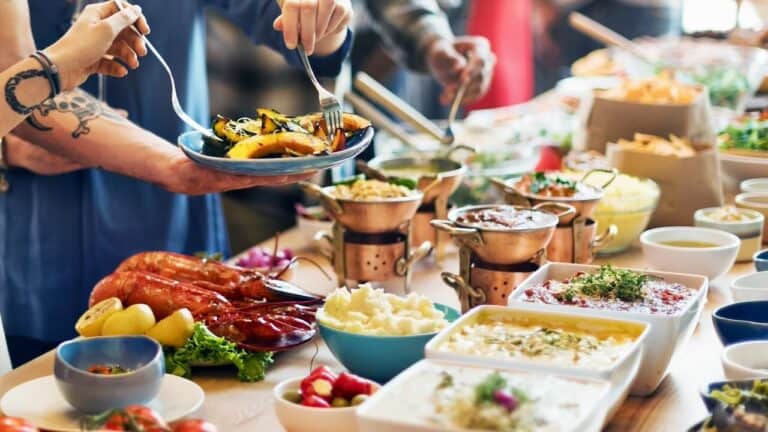
Set the station in the order a guest fills a bowl, because every backtrack on a buffet line stalls the people behind. The layout runs in one direction along a single table or counter.
- Bowls, spoons, and napkins: at the head of the line, so guests collect everything before their hands are full.
- The two chili pots: meat chili first and bean chili second, each with its own ladle resting on a small plate.
- Cool toppings: shredded cheddar and sour cream right beside the pots, so the cheese lands on steaming chili and melts.
- Crunch and heat toppings: grouped and labeled along the middle of the table.
- The bases: cornbread and chips at the end of the line, where a guest decides how to eat the bowl they built.
This layout for chili bar toppings follows the same logic: chili beside the stack of bowls, toppings next to it, dippers after that, and napkins and cutlery on the far side. It is the one-direction line that keeps a build-your-own burger bar moving at a backyard cookout, too.
A line only flows when the gear is already in place, so the next list is everything to pull out the day before.
Equipment the Station Needs Before the Chili Goes In
Pull out every piece of equipment the day before, since a missing ladle is easy to find on Saturday and hard to find at kickoff. The whole kit fits on one counter.
- Two slow cookers, one per chili, set within reach of an outlet so no cord crosses the walkway.
- Two ladles and two small plates or spoon rests to catch drips between scoops.
- One bowl and one spoon per guest, plus a tall stack of napkins.
- Twelve small topping bowls, each with its own spoon, so the jalapeno spoon never lands in the sour cream.
Labels do the quiet work. A chili bar party setup with small cards in front of each topping bowl spares guests the guessing, and two more cards name the pots.
- Fourteen label cards: twelve for the toppings and two that name each chili and its heat level.
- A rimmed tray under the topping bowls, which catches drips and lifts out in one piece for refills.
- A trivet or heat-safe mat under each slow cooker to protect the table.
With the gear out, the first real decision is what goes into those two slow cookers.
|
Let Guests Claim Pots and Toppings |
Two Pots Beat One: A Meat Chili and a Bean Chili
One pot of chili asks every guest to eat the same thing, while two pots let the station match the room. Pick the pair by who is coming, not by which recipe sounds best.
- A mix of meat eaters and vegetarians: a beef chili plus a bean chili covers both without a special request.
- Kids or spice-shy guests: keep both pots mild and let the heat toppings do the rest.
- Heat seekers: keep the pots mild anyway and point them to the four heat toppings, which reach any spice level bowl by bowl.
Labels matter more with two pots than with one. These chili bar ideas include marking each pot clearly with its heat level, a small habit that ends the hover over the ladles.
Pot One: The Meat Chili, Kept Mild
Ground beef or turkey chili anchors the station and fills the guests who arrive hungry. Keep the spice gentle enough for a child, since heat is easy to add at the toppings and impossible to take back out of a pot.
Pot Two: The Bean Chili for Everyone Else
A meatless chili of black, pinto, or kidney beans gives vegetarian guests a full bowl instead of a plate of toppings, and a meat eater can take a scoop of each. Give it its own ladle and label, so no spoon carries beef into the vegetarian pot.
Offering two choices at the bottom of the bowl is the same move a build-your-own pasta bar makes with more than one sauce.
Two mild pots only work when the toppings carry the range, which puts the real variety of the bar in twelve small bowls.
Twelve Toppings, Grouped by Crunch, Cool, and Heat
These twelve toppings for chili bar guests come in three groups of four, so balancing a bowl is simple: one from crunch, one from cool, one from heat. Grouping also tells a guest where to look.
Crunch toppings add texture to a soft, spoonable bowl.
- Crushed tortilla chips: broken by hand so they scatter across the top.
- Corn chips: a thicker, saltier crunch for scooping.
- Oyster crackers: small enough to drop in by the handful.
- Diced red onion: a sharp bite that cuts through a rich meat chili.
Cool toppings calm the spice and add creaminess.
- Sour cream: a spoonful in the center of the bowl.
- Shredded cheddar: set nearest the pots so it melts on contact.
- Diced avocado: cut just before guests arrive so it stays green.
- Sliced green onions: a mild, grassy finish for either pot.
Heat toppings let each guest set their own spice level.
- Sliced fresh jalapenos: bright heat, seeds in or scraped out.
- Pickled jalapenos: a tangy heat that stays crisp.
- Hot sauce: one bottle on a small plate to catch drips.
- Crushed red pepper flakes: a dry heat in a small shaker.
For swaps inside each group, this list of the best chili toppings for any bowl sorts options from cheesy to crunchy to spicy, and a chili toppings board shows the same bowls gathered on one platter.
Once a bowl is built, the guest still needs something to eat it with, and that is the job of the bases.
|
Hosting Tip: Keep the Heat in the Toppings |
Bases: Cornbread, Baked Potatoes, and Chips
Each base changes how a guest eats the bowl, so offer at least two and let the seating decide. Chips suit a guest balancing a bowl on the couch, while a split potato needs a table and a fork.
- Cornbread: cut into squares and served on the side for dunking, with softened butter and honey nearby.
- Baked potatoes: split open and kept warm in a covered dish beside the bowls, because the potato becomes the bowl and the chili goes on top.
- Tortilla chips: in their own bowl for scooping, kept apart from the chili so they stay crisp until the moment they are used.
The build-your-own thinking behind a mashed potato bar carries straight over to split baked potatoes, with chili as the richest topping on the line. Chips can even replace the bowl: one approach to setting up a chili bar hands out small bags of corn chips that guests fill with chili and toppings and eat from the bag.
A plate of chips under chili and cheese is close cousin to a crowd-pleasing nacho bar, and the same twelve toppings work on both.
Pots, toppings, and bases all sit out for hours on game day, which raises the real question of how to keep the hot food hot and the chilled food chilled.
How Do You Keep Chili Hot From Kickoff to the Final Whistle?
Keep both pots at 140F or above for as long as they sit out, the hot-holding line in USDA food safety guidance. A slow cooker on low or keep warm holds finished chili steady, and the lid traps heat between servings.
This walkthrough on how to set up a chili bar keeps the chili warm in slow cookers or in pots over low heat, and makes the chili ahead of time so party day is assembly.
- Bring each chili fully hot before guests arrive, then turn the slow cookers to low or keep warm.
- Check each pot with an instant-read thermometer at kickoff and confirm it reads 140F or above.
- Stir both pots every 30 to 45 minutes so the bottom does not scorch or dry out.
- Add a splash of water or broth if a pot thickens too far during the game.
- Keep the lids on between servings to hold in heat and moisture.
That stir schedule comes from these chili bar ideas for game day, which also aim for a safe holding temperature around 140F.
Chilled toppings need the opposite care. USDA food safety guidance limits perishable food to 2 hours at room temperature, or 1 hour above 90F, so set out sour cream, cheese, and avocado in small bowls and swap in fresh ones from the fridge rather than topping off a bowl that has been sitting.
Those game-day notes also put portions at 1 to 1.5 cups of chili per adult, and that one figure is where the math for your guest count begins.
|
Count Bowls From a Real RSVP List |
Portioning for Your Guest Count, Pot by Pot
Portioning starts from that 1 to 1.5 cup figure per adult, then shifts with the rest of the spread. At a full Super Bowl party at home, the chili bar is the savory anchor, with a menu board of snacks, team-color desserts, a squares grid, and a run of games built around it.
- When chili is the main meal, plan toward 1.5 cups per adult.
- When a full spread of snacks and sides is out, plan closer to 1 cup per adult.
- Split the total evenly across the two pots unless you already know how many guests skip meat.
Sides do real work here. Hosting a chili bar with at least one side dish makes each pot stretch further, which is why the lower figure pairs with a fuller table.
Scaling past a dozen guests follows the same math as a taco bar for a big crowd: count the bowls each guest will fill, then shop to that number rather than to a recipe.
The checklist table runs the numbers for 12 guests. Chili figures follow the linked portion plan, and the bowl, topping, and base rows are this checklist’s own serving plan.
| Item | Per guest or shared | For 12 guests | Make-ahead note |
|---|---|---|---|
| Chili, both pots combined | 1 to 1.5 cups, or about 1 cup with plenty of sides | 12 to 18 cups: two pots of 6 to 9 cups | Make a day ahead, reheat until hot, hold at 140F or above |
| Serving bowls and spoons | 1 bowl and 1 spoon | 12 bowls and 12 spoons | Stack at the head of the line the day before |
| Crunch toppings | Shared | 4 bowls: crushed tortilla chips, corn chips, oyster crackers, red onion | Dice the onion the morning of |
| Cool toppings | Shared | 4 bowls: sour cream, shredded cheddar, avocado, green onions | Dice the avocado just before guests arrive |
| Heat toppings | Shared | 4 bowls: fresh jalapenos, pickled jalapenos, hot sauce, pepper flakes | Slice the fresh jalapenos the morning of |
| Cornbread | 1 square | 12 squares | Bake the day before and wrap tightly |
| Baked potatoes | 1 potato | Up to 12 potatoes: one for each guest who wants one | Bake before guests arrive and hold covered |
| Tortilla chips | Shared | 1 large bowl: refilled from a sealed bag | Open the second bag only when the bowl runs low |
| Ladles and label cards | Shared | 2 ladles and 14 label cards | Write the cards the day before |
Numbers set the opening spread, and a plan for refills and cleanup is what keeps it looking full in the fourth quarter.
Refills and Cleanup: Small Swaps That Keep the Line Moving
A station that looked generous at kickoff can look picked over by halftime, and the fix is a few small swaps rather than a second round of cooking. Plan them the day before, and the bowls stay full without the host missing a quarter.
- The day before: bake the cornbread, prep any sides, and fill a backup container for every chilled topping.
- Three to four hours out: start the chilis in the slow cookers on low, or one to two hours on high, so both are piping hot when guests arrive.
- At the two-hour mark: swap each chilled topping bowl for a fresh one from the fridge, and stir both pots.
- After the final whistle: turn off the slow cookers and move leftover chili into shallow containers in the fridge within two hours.
The walkthrough on how to make a chili bar runs on the same clock, cooking the chili in the crockpot on low for 3 to 4 hours so it is hot when guests arrive and prepping the side dishes the day before.
Set it up this way once and the checklist repeats at every game-day gathering: two labeled pots, twelve small bowls, three bases, and a fridge shelf of backups waiting for halftime.
Frequently Asked Questions
What all goes on a chili bar?
A chili bar includes two pots of chili, toppings sorted by crunch, cool, and heat, and a base like cornbread, baked potatoes, or chips. Slow cookers keep both pots warm through the game without drying out. Labels in front of each topping bowl let guests build a bowl without asking what is inside.
Can a chili bar serve guests with different spice preferences?
A chili bar serves guests with different spice preferences by keeping the base chili mild and letting hot toppings like sliced jalapenos or hot sauce sit separately on the side. This lets each guest control their own heat level bowl by bowl. Offering one meat chili and one bean chili also covers dietary preferences alongside spice level.
How do you set up a chili bar for a party?
A chili bar sets up in a line: bowls first, then the two chili pots, then toppings grouped by texture, and the bases last. Placing heavy toppings like cheese and beans near the chili keeps the line moving in order. A few inches between each slow cooker keeps guests from bumping ladles together.
What toppings work best for a chili bar?
Toppings that work best for a chili bar span three groups: crunch, such as crushed tortilla chips or diced onion, cool, such as sour cream or shredded cheese, and heat, such as jalapenos or hot sauce. One topping from each group lets every guest balance their own bowl. Six to twelve toppings gives variety without crowding the table.
What common mistakes should you avoid with a chili bar?
A chili bar’s biggest risk is letting one pot simmer dry while guests are still serving themselves, so both pots need a steady slow cooker temperature. Skipping labels on toppings is a second frequent mistake, since guests often cannot tell onion from jalapeno at a glance. Running short on bowls before the chili runs out is the third.
What bases pair well with a chili bar?
Cornbread, baked potatoes, and tortilla chips all pair well with a chili bar because each soaks up the chili differently: cornbread on the side, a potato split and topped, or chips used for scooping. Offering two bases instead of one gives guests a choice without much extra prep. A separate bowl for chips stops them going soft early.
Continue Reading:
More On Super Bowl Party at Home
- Super Bowl Food on One Mix and Match Menu Board
- Super Bowl Squares: A Printable Grid and House Rules
- Super Bowl Desserts Decorated in Your Team’s Colors
- Games for a Super Bowl Party, Kickoff to Last Whistle
More from The Gourmet Host
- Build-Your-Own Burger Bar Ideas for a Backyard Crowd
- 14 Pasta Bar Ideas for a Fun Build-Your-Own Dinner
- 16 Mashed Potato Bar Toppings and Easy Setup Ideas
- 15 Nacho Bar Ideas to Build a Crowd-Pleasing Spread
- 21 Taco Bar Food Ideas to Feed an Easy Big Crowd
Explore TGH Categories
- Set the Scene
- Drinks and Bar
- Plan the Meal
- Engage with Guests
- Games and Toasts
- Tools and Techniques
- Why We Gather