Knife Skills for Hosts (5 Cuts That Look Like a Pro)
 18 min read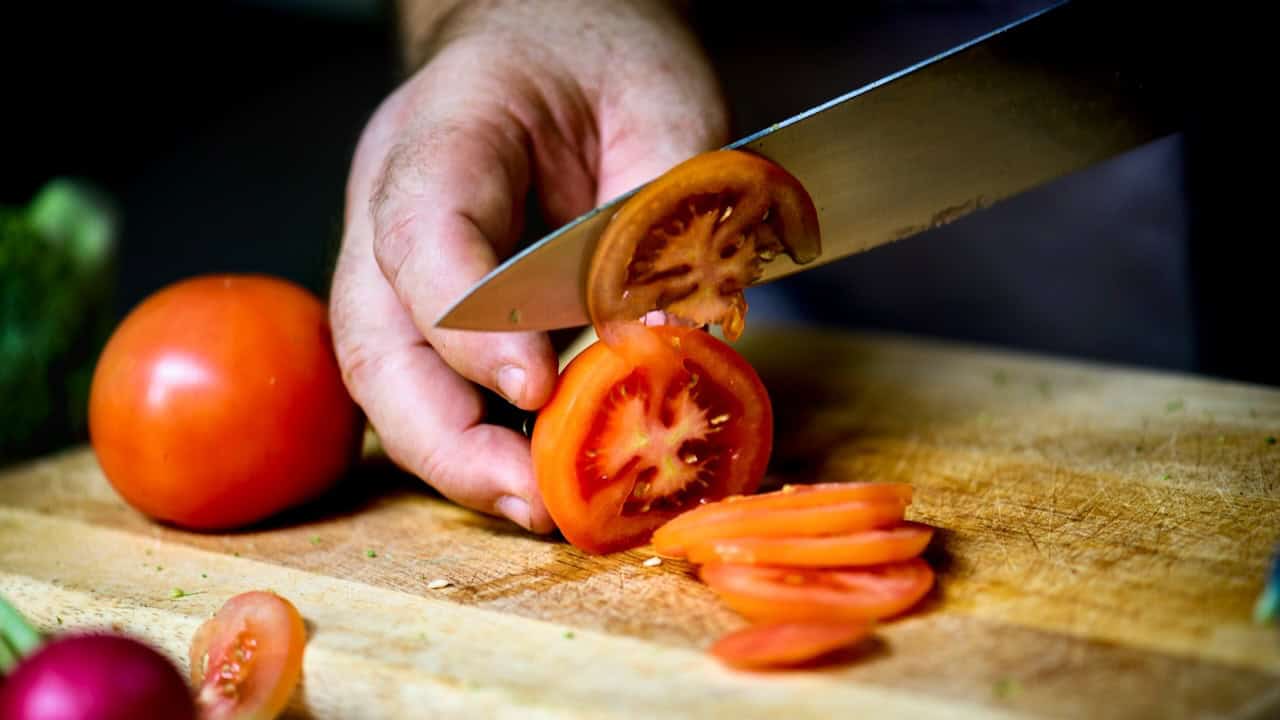
Which five cuts, learned once, change the read of a host at the cutting board from amateur to assured? Julienne, brunoise, chiffonade, dice, and mince – five named cuts a guest can identify by sight, even if they could not name them out loud.
A guest standing at the kitchen island registers the difference within ninety seconds of walking in, because the cutting board is the kitchen’s most visible surface and the knife is the kitchen’s loudest tool.
These are kitchen knife skills framed as confidence signals rather than technique homework – the visible part of cooking that guests interpret as competence whether or not they cook themselves.
What follows is the cut-by-cut walk-through: dimensions, technique, the move that goes wrong most often, and the pinch grip and claw hand that hold the whole system together.
By the end, you have a one-hour practice drill that locks the five cuts into muscle memory before the next dinner party.
At a Glance
- Five named cuts – julienne, brunoise, chiffonade, dice, mince – cover most of what a home host does in front of guests.
- Uniformity, not speed, is the cut that reads as professional from across the kitchen island.
- Two physical habits – the pinch grip on the blade and the claw hand on the food – prevent nearly every common cut and triple cutting speed.
- Sixty minutes of focused practice with a five-pound bag of carrots is enough to lock in the five cuts.
- The cut a guest registers first is the one on top of the plate – chiffonade ribbons and brunoise cubes do more for presentation than any sauce.
What Are Basic Knife Skills?
Basic knife skills are the small set of repeatable knife techniques – grip, hand position, and a handful of named cuts – that a home cook uses to convert any vegetable, herb, or protein into uniform pieces ready for the pan. For the host specifically, knife skills function as a visible confidence signal: guests read the rhythm of a cutting board the way they read a handshake, and a steady, uniform pile of brunoise on a wooden board reads as competence before the food is even tasted. Unlike chef-school knife skills built for an eight-hour brigade shift, host-side knife skills focus on the five cuts that show up most often at a dinner-party prep counter.
Why Knife Skills Are the Host’s Most Visible Confidence Signal
Guests read a kitchen the way they read a room. The first thing they see when they walk into the open-plan kitchen – the apartment kitchen island, the suburban peninsula – is whoever is cutting. The cutting board is at counter height, the knife catches the under-cabinet light, and the rhythm of the chopping is audible across the room. Within about ninety seconds, the guest has formed an impression of whether the host knows what they are doing.
That impression rarely turns on speed. Speed is a chef-line metric. The guest is reading uniformity – whether the carrots in the pile look like siblings or strangers – and the steadiness of the hand on the knife.
As the Culinary Institute of America’s writing on knife skills for chefs notes, consistency is the visible part of competence; raw speed comes later, and most home cooks never need it.
The three things a guest is actually reading:
- Are the pieces the same size? Uniform cuts say the host has done this before. Uneven cuts say the host is improvising.
- Is the off-hand tucked into a claw? A claw hand says trained. A flat hand or splayed fingers says nervous.
- Is the rhythm consistent? Steady three-beat chopping signals confidence; jerky stop-start signals doubt.
Building host-side knife skills is therefore less about kitchen athletics and more about a small set of cuts performed with composure. The same logic that powers our preparation-builds-anticipation guide applies at the cutting board: the host who prepped quietly an hour earlier looks composed when guests arrive.
The cuts themselves are next – five of them, each with the dimension a professional would name, the move that produces it, and the failure point to watch for.
Cut #1: The Julienne – Long Matchsticks for Plate Lift
Julienne is the long matchstick – 2 to 3 inches long, about 1/8 inch wide and 1/8 inch thick. Carrots, peppers, zucchini, daikon, snow peas: anything firm enough to slice and stack without crushing.
The cut shows up on slaw plates, in stir-fries, in the cold appetizer course, and as the lift on top of a finished entree – exactly the kind of visual move our food presentation techniques guide recommends for plate height. It is the first of the cooking knife skills a host should drill because the geometry is forgiving and the visual payoff is high.
The three-step julienne
- Square the vegetable – slice off the rounded sides until you have a rectangular plank about 1/4 inch thick. The flat face stops the carrot rolling under the knife.
- Stack two or three planks and slice lengthwise into matchsticks. The pinch grip on the blade does the work; the claw on the off-hand sets the spacing.
- Square the ends. Trimmed ends read as deliberate; ragged ends read as rushed. Save the trim for stock or the cook’s snack.
The failure point on a julienne is width drift – the first matchstick is 1/8 inch, the tenth is 1/4 inch, and the pile loses its visual rhythm. Two fixes work. First, set a finger-width gauge with the claw hand and move it the same distance after every slice.
Second, as Made In’s essential knife cuts guide points out, julienne sits inside a family of stick cuts – fine julienne at 1/16 inch, batonnet at 1/4 inch – so the home host should pick one width and commit to it for the whole pile, not drift mid-board.
Drilled twice a week on a single carrot, the julienne becomes automatic in about a fortnight. The pile of squared trim, by the way, slots straight into the storage system in our kitchen-organization hacks guide – batch-prepped vegetables hold for three to four days in a sealed glass container.
From there, brunoise – the next cut – is essentially a julienne sliced one more time.
Cut #2: The Brunoise – Tiny Cubes for Sauce, Garnish, and Show
Brunoise is the 1/8-inch cube, built directly from julienne matchsticks by slicing across the bundle at the same 1/8-inch spacing. The result is a uniform pile of perfect little cubes that reads as classically trained kitchen output the moment a guest sees it.
Brunoise sits on top of a finished plate as garnish, gets folded into vinaigrettes, builds the base for a clear consomme, and finishes a chilled summer soup with visible color.
Brunoise in three moves
- Cut a clean julienne first: brunoise quality follows julienne quality – drift in step one becomes failure in step two.
- Bundle the matchsticks: gather them under the claw hand and slice across at 1/8-inch intervals. The pinch grip stays on the blade; the rocking motion stays short.
- Sweep and inspect: the 90 percent that look identical go to the plate; the 10 percent oddballs go to the stock pot.
Brunoise lives in the family of small dice cuts – Dalstrong’s reference on all things brunoise also describes the brunoisette at 1/16 inch and the macedoine at 1/4 inch, the broader vocabulary of cube cuts a host occasionally needs.
For dinner-party plating specifically, the standard 1/8-inch brunoise of carrot, celery, and bell pepper on top of a roast or beside a fish course is the highest-leverage knife move a home host can master.
The failure point is impatience. A rushed brunoise produces irregular cubes that read as confetti rather than craft. Three minutes of slow work outperforms ninety seconds of fast work every time on this cut – the photo on the TGH plating-techniques guide shows the difference at a glance.
|
Keep Your Prep Cuts Handy |
Cut #3: The Chiffonade – Herb Ribbons That Look Tossed, Not Hacked
Chiffonade is the leafy cut: basil, mint, sorrel, sage, romaine, or any other broad, soft leaf rolled into a tight cigar and sliced across into fine ribbons. The cut lands on top of caprese, on top of pasta al limone, on top of a chilled cucumber soup. Done well, the ribbons fall onto the plate looking tossed by hand. Done poorly, they look hacked with kitchen shears.
How to chiffonade basil without bruising
- Stack 6 to 10 clean, dry leaves with the smallest on top. Wet leaves bruise on contact with steel; dry the leaves first with a paper towel.
- Roll the stack into a tight cigar from the stem end toward the tip. The tighter the roll, the finer the ribbon.
- Slice across the cigar at 1/16 to 1/8 inch with a sharp blade. Push the knife forward as it cuts down, like a paper-cutter motion – a rocking chop bruises soft herbs.
Two failures show up most. The first is dull-blade bruising: a dull knife crushes the cell walls of basil before it cuts them, which is why the ribbons turn black around the edges within ten minutes.
As Escoffier’s reference on knife cutting techniques explains, every soft-leaf cut starts with a freshly honed edge – a steel rod pass before the first slice is non-negotiable. The second failure is over-rolling. Past a certain tightness, the cigar shreds rather than slices; the ribbon falls apart into wet confetti instead of holding its shape.
Chiffonade is also the cut most often improvised from a different tool – a guest may not notice torn basil on top of a margherita pizza, but they absolutely notice ribbons. The visual signature is unmistakable and disproportionately high-leverage for the effort.
Cut #4: The Dice – Small, Medium, and Large for Different Cooking Times
Dice is the all-purpose cube – and unlike the brunoise, it ranges across three working sizes. Small dice is 1/4 inch (mirepoix for stocks, salsa, sofrito); medium dice is 1/2 inch (vegetables for sautes, garnish for a chili); large dice is 3/4 inch (roasted root vegetables, stew chunks, hearty winter braises).
Picking the right dice size for the cooking method is what separates uniform doneness from a plate of half-burned, half-raw cubes.
Matching dice size to the dish
- Small dice (1/4 inch): mirepoix base for soups and stocks, sofrito for rice, salsa for tacos. Cooks in 4 to 6 minutes in a hot pan and reads as fine background texture in a sauce.
- Medium dice (1/2 inch): vegetable saute, chili, grain bowl topping. Cooks in 8 to 12 minutes and holds its shape on a plate without disappearing into the dish.
- Large dice (3/4 inch): roasted root vegetables, beef stew, ratatouille. Cooks in 25 to 40 minutes and contributes both texture and visible color on the plate.
Uniformity is the host-visible variable here as well. Eight medium-dice carrots in a saute pan hit doneness at the same minute; a mixed pile of eighth-inch shards and inch chunks will burn the small ones while the big ones stay raw. The classic dinner-party miscalculation – “some of the potatoes are still hard” – is almost always a dice problem, not an oven problem.
The Michelin Guide’s piece on knife cut types calls dice the most useful cut for the home cook because it scales across every cooking method. For a host setting up a Sunday roast or a weeknight chili, picking a single dice size and cutting an even pile is the single change that makes the dish land at the same time the rest of the meal does.
|
Hosting Tip: Hone Before You Practice |
Cut #5: The Mince – Garlic, Shallot, and Ginger Without the Smash
Mince is the smallest of the named cuts – pieces fine enough that the aromatic almost disappears into the dish while still releasing its oils. Garlic, shallot, ginger, lemongrass, fresh herbs: anything pungent that needs to dissolve into a sauce rather than register as a discrete bite.
A clean mince adds a sharp, even bloom of flavor; a smashed mince adds a bitter, raw note that takes over the dish.
The rock-chop mince in three passes
- Peel and roughly chop the clove or shallot into pea-sized pieces. The first pass exists only to break the aromatic into manageable bits.
- Lay the flat of the blade across the pile, pinch the tip with the off-hand, and rock the heel up and down across the pile in short, fast strokes. The blade should pivot on its tip, not lift fully off the board.
- Sweep the pile back together with the spine and rock-chop again. Two or three sweep-and-chop cycles produces a fine, even mince in about thirty seconds per clove.
The cardinal error here is the press-and-smash. A garlic clove crushed under the flat of the knife releases sulphur compounds that turn bitter the moment the garlic hits hot oil – a problem the Forks Over Knives reference on basic cutting technique flags as the single most common amateur mistake.
A rock-chop instead slices cleanly through each piece without bruising, which is why a properly minced clove tastes sweet and nutty in a sauce while a smashed clove tastes acrid.
For shallot and ginger, the same rock-chop works but with a different first pass: shallots are halved and sliced longitudinally before the mince, ginger is peeled with a teaspoon and sliced across the grain.
The rock-chop motion is identical for all three aromatics, which is part of why the technique is worth drilling once and applying everywhere. For the broader set of small wins that compound this way, see our kitchen hacks for cooking round-up.
The Pinch Grip and the Claw Hand – Set Once, Use Forever
The five cuts above all depend on two physical habits that have nothing to do with the cuts themselves: the pinch grip on the blade and the claw hand on the food. Master those two positions and every cut gets faster, safer, and more uniform. Skip them and every cut takes twice as long and produces twice as many trips to the bandage drawer.
The pinch grip on the blade
Pinch the blade itself between thumb and index finger, just above the bolster – not the handle. The remaining three fingers wrap loosely around the handle for balance. This grip puts the cutting force directly above the edge of the blade, which is where the knife wants to pivot. As the chef knife skills walkthrough at the Culinary Pro describes it:
- Thumb on one side of the blade, index finger on the other, knuckle of the index finger touching the bolster.
- Wrist relaxed, elbow slightly out, shoulder loose – tension in any of the three slows the cut down.
- Fingers off the spine. A finger pressed on the top of the blade for “control” actually fights the natural pivot and produces uneven cuts.
The claw hand on the food
The off-hand makes a claw: fingertips curled under, knuckles forward, thumb tucked behind the fingers. The flat of the blade slides against the knuckles, which guides the cut to the same spot every time. Move the claw backward in the same finger-width increment after each slice, and uniformity becomes automatic.
The Culinary Pro’s chef-knife handling reference demonstrates the claw with photos worth bookmarking.
These two habits, once set, transfer to every cut and every vegetable for the rest of the host’s cooking life. Drill them on a soft target – a stick of celery, a peeled onion – until they feel less awkward than a fork.
Speed vs Precision: When Uniformity Matters and When It Doesn’t
Knife speed and knife precision are not the same skill, and a home host should optimize for precision in roughly four contexts out of five. Speed is a restaurant metric driven by ticket volume; precision is a guest-visible metric driven by what lands on the plate. The two diverge fast, and confusing them is how home cooks burn out chasing professional cadence they will never need.
Where precision wins
- Anything visible at the table: brunoise garnish, chiffonade ribbons, julienne lift – all guest-facing.
- Any dish with uniform cooking time: a pan of medium-dice carrots either lands evenly or not at all.
- Aromatics that bite back when crushed: garlic and shallot mince cleanly only when the cut is patient.
Where speed wins
- Stock vegetables: mirepoix gets strained out; uniformity is invisible.
- Anything pureed: tomato sauce, hummus, soup – the blender erases knife work.
- Bulk family-meal prep: a weeknight dinner for two does not need brunoise carrots.
For the host preparing a dinner party, the practical rule is to spend precision on the courses guests will see, and speed on the prep that disappears into a pot. NYT Cooking’s basic knife skills guide makes the same point in its opening – competent knife work is mostly about knowing when to slow down, not how to chop faster. The result is a kitchen that runs smoothly without rushing, which is the rhythm a guest reads as composure.
|
Plan Which Courses Get Precision |
Practice Drill: One Focused Hour That Locks In the Five Cuts
Knife skills become muscle memory faster than most home cooks expect – in about sixty minutes of focused, slow practice with a five-pound bag of carrots and a freshly honed eight-inch chef knife. The drill that follows runs through all five cuts in the order they share geometry, so each previous cut teaches the next.
Done once, the cuts hold for life with occasional reinforcement at the dinner-party prep counter.
The 60-minute drill, step by step
- Minutes 0-5: hone the knife (ten passes per side on a steel rod) and square ten carrots into rectangular planks. The setup teaches the pinch grip and the claw hand before any “real” cuts happen.
- Minutes 5-20: julienne all ten carrots. Aim for 1/8-inch matchsticks 3 inches long. The reps build width consistency – the most-failed variable for a beginner.
- Minutes 20-35: brunoise the julienne pile. Bundle three matchsticks, slice across at 1/8 inch, sweep into a pile, repeat. By the third bundle, the cubes look uniform.
- Minutes 35-45: switch to a bunch of basil and run two chiffonade reps – one with a tight roll, one looser, so the eye learns the ribbon-width relationship.
- Minutes 45-55: dice an onion in small, medium, and large successively. The same onion in three sizes teaches the visual difference faster than three different recipes ever will.
- Minutes 55-60: rock-chop a head of garlic into a fine mince, then a few inches of ginger. End on the smallest cut so the pinch-grip refinement carries forward.
The pile at the end of the hour goes into the freezer as a mirepoix-and-garnish stash for the week’s cooking – nothing wasted, and a built-in incentive to repeat the drill. Most home cooks reach 70 percent of professional cleanliness on the five cuts within a single session and the remaining 30 percent within ten dinners of conscious use, which lines up with the rough timeline Oishya’s writing on the four basic knife cuts offers for serious amateurs.
The kitchen work that gets done in front of guests then changes character. Brunoise lands on the plate as a deliberate garnish; chiffonade tops the caprese without bruising; the host stays composed at the cutting board because the cuts have already been practiced. The five cuts become the visible shorthand for everything else the host has bothered to learn.
Frequently Asked Questions
What are the five basic knife cutsevery home cook should learn?
Julienne (long matchsticks at 1/8 inch), brunoise (1/8-inch cubes built from julienne), chiffonade (rolled herb ribbons), dice (small, medium, and large cubes for different cooking times), and mince (the fine rock-chop for garlic and shallot). Together these five basic knife skills handle every preparation a dinner-party host runs, from sauce base to plate garnish.
How do I hold a chef knife correctly for better knife skills?
Pinch the blade just above the bolster between your thumb and index finger, letting the other three fingers wrap loosely around the handle. Curl the off-hand into a claw, fingertips tucked under the knuckles, so the blade’s flat rides against them as you cut. This pinch grip and claw hand prevent most kitchen cuts and speed up your work.
How long does it take to learn basic knife skills as a home cook?
About one focused hour of practice with a bag of carrots locks in the five named cuts, and roughly ten dinners of conscious use turns them into muscle memory. The barrier is not talent, it is slowing down enough to cut uniformly while your hand learns the geometry of each cut.
Why does uniformity matter in knife cuts for cooking?
Uniformity matters because uneven pieces cook unevenly. Small cubes burn while large cubes stay raw, so the dish lands underdone in some spots and overdone in others. A consistent brunoise or dice means every piece reaches doneness at the same moment. On a guest-facing plate, uniform cuts also read as care, while ragged cuts read as rushed.
What’s the difference between mincing and dicing garlic?
Mincing cuts garlic small enough to nearly disappear into a dish while releasing its oils, while dicing keeps visible cubes that hold their shape on the plate. Mince when you want garlic to dissolve into a sauce or vinaigrette, and dice when you want it to bite back in a salsa or topping. The rock-chop keeps a mince clean.
Can a home cook really get to professional-level knife speed?
Yes, most home cooks reach about 70 percent of professional knife speed after a few months of practice. The rest comes from cutting eight hours a day on a restaurant line, which a dinner-party host does not need. That level is enough to prep a dinner for eight in about fifteen minutes with the five named cuts holding their geometry.
Continue Reading:
More on Knife Skills
- Kitchen Knife Guide: 3 Knives Every Home Host Needs
- How to Sharpen a Kitchen Knife (Hone, Sharpen, Test)
- Cutting Board Guide: Wood, Plastic, or End-Grain
- Tableside Carving: How to Carve a Roast for Guests
- 5 Chef Knives Under $100 Reviewers Keep Recommending
More from The Gourmet Host
- Epicurean Evenings: Traditional Dishes from Alsace, Marseille, and Morocco
- Best Batch Cocktails for Effortless Entertaining
- Charcuterie Board Ingredients: 15 Host Essentials
- Holiday Party Themes for Every Celebration
- Japanese Non-Alcoholic Drinks: A Host’s Tasting Guide
Explore TGH Categories
- Set the Scene
- Drinks and Bar
- Plan the Meal
- Engage with Guests
- Games and Toasts
- Tools and Techniques
- Why We Gather