How to Sharpen a Kitchen Knife (Hone, Sharpen, Test)
 17 min read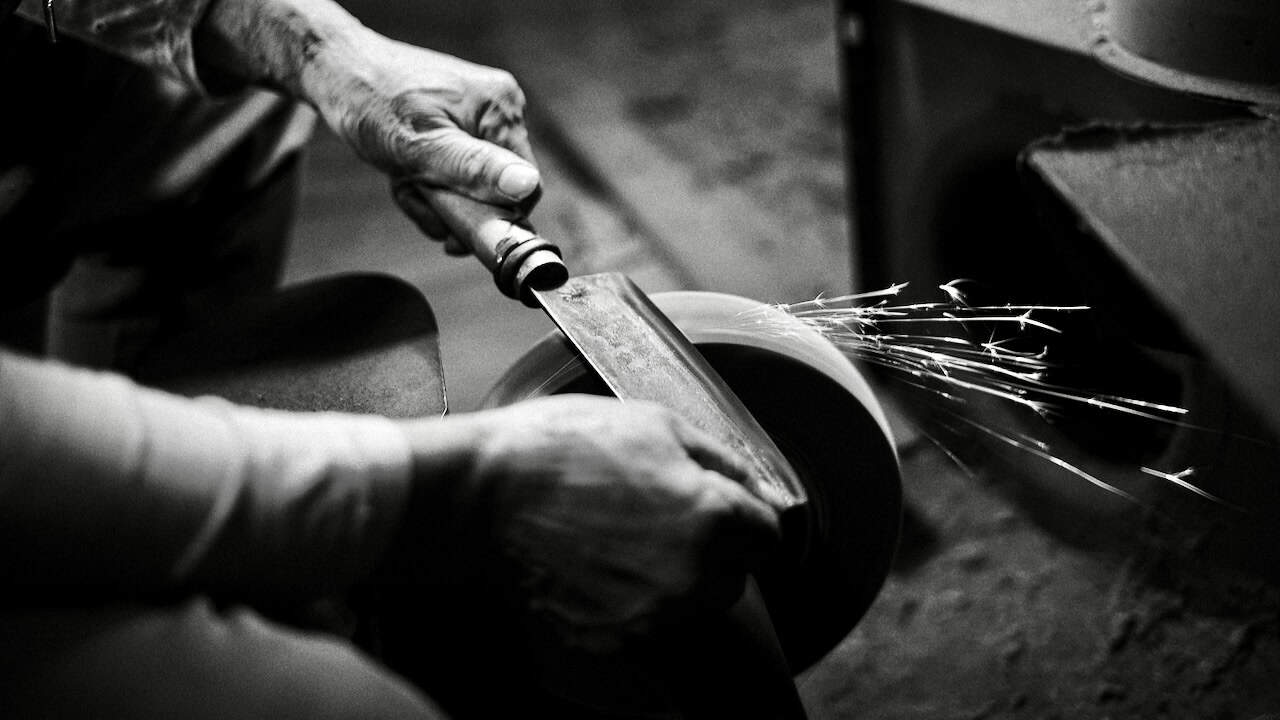
Three of our knives went three years without ever touching a stone. They lived in the drawer, they got hand-washed, they got used most nights, and at some point each one quietly went from sharp to dull without the host noticing.
The bread knife was the giveaway: a tomato that should have parted with one push instead caved in like a sponge. That moment is the one most home cooks have and then file away as a knife problem, when it is almost always a routine problem.
Hone weekly, sharpen yearly. Two rituals end the problem.
The rest of this piece walks through the sixty-second honing pass, the fifteen-minute whetstone reset, the right kitchen knife sharpening angles for German and Japanese steel, and the three at-home tests that tell a host whether the edge actually got fixed.
At a Glance
- Honing realigns the edge in 60 seconds; sharpening removes metal once a year. Most home cooks invert the two and wear knives down faster.
- Knife sharpening how to, in two passes: ten strokes per side on a honing rod weekly, ten strokes per side on a whetstone yearly.
- Kitchen knife sharpening angles by steel type: 20 degrees for German blades, 15 degrees for Japanese blades, 17 degrees for hybrids.
- Pull-through carbide sharpeners shorten a forged knife’s life by years; the whetstone or a professional service is the answer.
- Three at-home sharpness tests (paper, tomato, onion) tell a host within thirty seconds whether the edge needs honing or sharpening.
- Storage and once-a-year audit preserve the work between the weekly hone and the annual stone.
What Is Knife Sharpening?
Knife sharpening is the process of removing a small amount of steel from a kitchen blade’s edge to restore the geometry that does the cutting work. For the home host, sharpening is the yearly reset — a fifteen-minute job done on a whetstone or sent to a professional, paired with weekly honing on a steel rod that realigns the edge without removing material. Unlike pull-through sharpeners that grind aggressively, the hone-then-stone protocol keeps a forged knife performing for twenty years instead of five.
Honing vs Sharpening: Why Most Home Cooks Have It Backwards
Knife sharpening how to starts with a vocabulary problem. Honing and sharpening sound interchangeable; they are not. Honing realigns the existing edge. Sharpening removes steel to create a new edge. Most home cooks reach for the stone when the knife dulls — when ten passes on a steel rod would have brought the edge right back. Over years, that habit grinds a forged blade down to a stub.
The split, in plain terms:
- Honing. Done weekly. Takes 60 seconds on a steel rod. Realigns the microscopic edge that bends to one side after a week of cutting. Removes no measurable steel. Free, after the rod.
- Sharpening. Done annually. Takes 15 minutes on a whetstone or shipped to a professional. Removes a small amount of steel to grind a fresh edge. Should change the blade’s profile only slightly over the knife’s full life.
- The inversion. Home cooks skip honing because nothing feels broken yet, then sharpen aggressively when the knife finally feels dull. Both halves of that pattern shorten the knife’s life.
Made In’s honing vs sharpening explainer runs the same distinction with a manufacturer’s vocabulary. The headline test for the home host: pick up the knife you use most. If it slices a printed page cleanly, hone it this weekend. If it tears the page, the annual sharpening is overdue. The next section walks through the weekly hone.
The Weekly Honing Routine That Takes 60 Seconds
How to use a knife sharpening rod is the most-Googled half of this article and the most-skipped half of most home kitchens. The routine takes a minute. Pick a day — Sunday after the dishwasher runs is the standard — and hone every knife that saw use that week. Ten strokes per side, alternating, light pressure. The rod does the work.
- Stand the honing rod tip-down on a cutting board, your non-dominant hand on the handle for stability. The rod’s spine — not the kitchen counter — takes any downward force.
- Hold the knife at the same 20-degree angle as the blade’s existing edge. A useful eye trick: imagine slicing a 1/4-inch-thick stack of paper off the rod.
- Draw the blade down and across the rod from heel to tip in one smooth motion. Light pressure, steady angle, finish off the rod’s tip.
- Alternate sides. Ten passes per side total — five passes per side is enough for a knife used twice that week.
- Wipe the blade with a damp towel before returning it to storage. Realigned steel sheds a faint metal residue that is easier to remove now than later.
MasterClass’s how-to-hone-a-knife explainer breaks the same sequence down with a video that’s worth the four minutes. The point isn’t perfection — it’s the habit. A weekly hone keeps a $100 Wüsthof feeling like new for the entire decade between major sharpenings. The reason a knife needs that weekly attention is in the next section.
|
Turn the Weekly Hone Into a Task |
Why a Kitchen Knife Goes Dull (and It Is Not What You Think)
Edge folding versus edge erosion
A kitchen knife rarely dulls the way most home cooks picture it — the cutting edge does not erode in the way a pencil tip wears down. What happens is microscopic: after a few days of cutting, the thin edge folds and rolls to one side. Under a microscope it looks like a wave that has curled over. The blade is still sharp; it is just no longer pointing straight down. That bent edge is what feels dull when the knife stops biting into a tomato skin.
The four culprits behind a bent edge
The four culprits, in roughly the order they bend the edge:
- Hard surfaces: cutting on glass, granite, ceramic, or marble bends the edge in a single pass. Always use a wood or HDPE plastic board.
- Bones and pits: a chef knife hitting a chicken bone or an avocado pit instantly folds the edge. Use a paring knife for pit work; use a cleaver or boning knife for bone.
- Dishwasher cycles: detergent acid eats the edge over hundreds of cycles, and blade-on-rack contact during the wash nicks the edge against everything in the basket.
- Wet storage: a still-damp blade returned to a wood block traps moisture against the edge and corrodes the steel slowly.
ChefSteps’ honing vs sharpening guide walks through the metallurgy of edge folding with the rigor most cooking sites skip. The takeaway for the home host is simple: hand-wash the knife after each use, towel-dry it on the spot, and return it to a magnetic strip or in-drawer guard.
For a broader maintenance ritual that includes the boards and tools around the knife, our cleaning hacks for the kitchen round-up covers the wash-and-dry routine that protects every blade in rotation.
Edge folding is reversible until it is not. Catch it weekly with a hone, and the knife never crosses into the territory where it actually needs metal removed. Skip the hone for six months, and the only fix becomes the whetstone.
Whetstone Sharpening: The Annual Reset in 15 Minutes
Knife sharpening with whetstone work is the once-a-year reset that earns its place in the host’s kitchen. The standard kit is a dual-grit water stone — 1,000 grit for sharpening, 6,000 grit for polishing — plus a damp towel to keep the stone from sliding. Soak the stone in water for ten minutes before starting.
Sharpening a knife with a water stone is forgiving once the rhythm clicks. Fifteen minutes per blade, once a year, keeps a forged kitchen knife performing for two decades.
The 1,000-grit sharpening pass
Set the soaked stone on a damp towel, coarse side up. Hold the knife at the manufacturer’s edge angle — 20 degrees for German steel like Wüsthof, 15 degrees for Japanese steel like Shun. Place the heel of the blade at the far edge of the stone, edge facing away from you.
Push the blade forward and across the stone in one continuous stroke, sweeping from heel to tip while maintaining the angle. Ten strokes per side. Knifewear’s super simple whetstone techniques video is the visual reference most home cooks need on first attempt.
The 6,000-grit polishing pass
Flip the stone to the fine side. Repeat the same motion at the same angle, five strokes per side. The polishing grit removes the microscopic burr left by the coarser stone and brings the edge to a finishing shine.
Made In’s whetstone sharpening guide covers the burr-removal step in detail; Ethan Chlebowski’s beginner’s guide to whetstone sharpening is the friendliest video tutorial available.
What to expect after the first attempt:
- A knife that wasn’t tomato-sharp before is tomato-sharp after; the test in the next section confirms it in thirty seconds.
- A small amount of metal slurry on the stone, which rinses off in cold water. That slurry is the work that happened.
- A slight learning-curve dip on the first knife; by the third knife, the rhythm is automatic and the angle stays consistent.
If the prospect of buying a stone feels like one tool too many, sandpaper plus a flat surface gets a working edge in five minutes. The next section covers the angle question that decides whether any of this work goes right.
|
Hosting Tip: Mark the Bevel Before Sharpening |
What Angle to Sharpen a Kitchen Knife (the 15 vs 20 Question)
What angle to sharpen kitchen knife questions get answered with one number too often, and it is the wrong number. The right kitchen knife sharpening angle depends on which knife is on the stone. German steel sharpens at 20 degrees; Japanese steel sharpens at 15 degrees; modern hybrids settle near 17. Using a 15-degree edge angle on a German knife thins the blade too far and makes it chip; using a 20-degree angle on a Japanese knife wastes the harder steel that earned the 15-degree spec.
Angles by steel type
- German-style (Wüsthof, Henckels, Mercer, Zwilling). 20 degrees. Softer steel, heavier blade, rocking-cut bias. The wider angle resists chipping under home-cook pressure.
- Japanese-style (Shun, Global, Tojiro, Miyabi). 15 degrees. Harder steel, lighter blade, slicing-cut bias. The narrower angle delivers the cleaner cut Japanese knives are bought for.
- Hybrid Japanese/Western (Made In Sukoku, MAC). 17 degrees. Splits the difference. Check the manufacturer’s spec sheet — most ship with the angle printed on the box.
- Stamped budget knives (Victorinox, Mercer Millennia). 20 degrees. The softer European-style steel responds better to the wider angle.
Lansky’s which angle to use when sharpening guide keeps a manufacturer-by-manufacturer index that beats memorization. For the deeper geometry, Sharpening Supplies’ detailed discussion on knife sharpening angles, Knives and Tools’ sharpening angles explained primer, and Misen’s best blade angle for a knife article each cover the same numbers from a different angle. Find your knife once; the angle stays constant for the knife’s life.
The best angles for knife sharpening, ultimately, are the ones the manufacturer specified. Get that number right and the actual stone work follows naturally.
Pull-Through and Electric Sharpeners: Where Each One Belongs
Two convenience tools dominate the home market, and they get reviewed together for the wrong reason. Carbide pull-through sharpeners and ceramic-wheel pull-throughs look identical from the outside — both are V-shaped slots you draw the blade through. They do very different things to a knife. Electric sharpeners add a third category with its own narrow use case.
The honest breakdown:
- Carbide pull-through. The aggressive option. Tungsten carbide blades scrape steel off in obvious ribbons. Useful only for the cheapest stamped knives that were never going to last anyway. Avoid for any knife over $40.
- Ceramic-wheel pull-through. The tolerable option. Ceramic wheels are softer and remove less steel. Works as a short-term fix for stamped knives. Still not the long-term answer for a forged blade.
- Electric sharpener (Chef’sChoice). The exception. The Chef’sChoice Trizor XV uses three angled diamond stages and reproduces a 15-degree edge on Japanese-style knives reasonably well. Most other electric sharpeners ruin edges.
- The verdict. For any knife the host plans to keep, the whetstone or a professional service. The hundred dollars saved on the pull-through becomes the cost of replacing the knife three years sooner.
TOG Knives’ honing rod overview makes the case for skipping pull-throughs entirely; Lansky’s sharpening rod primer makes the parallel case for the rod over any convenience gadget.
Both point to the same conclusion: convenience tools are bought once and regretted slowly. The next section is the test that tells the host whether any of these tools actually worked.
|
Keep Your Best Recipes Close |
The Paper, Tomato, and Onion Tests for a Sharp Edge
Sharpness is testable in thirty seconds with materials already on the counter. Three home tests, scaled from easy-pass to hard-pass, tell the host whether the knife needs honing tonight, sharpening this weekend, or neither. Run all three on every knife at the same time once a quarter — the comparison across blades is more useful than any single result.
- The paper test. Hold a sheet of printer paper vertical by one corner. A sharp knife slices straight down through the held edge with no tear and no sawing motion. A dull knife crumples the paper. The 60-second hone usually passes this.
- The tomato test. Set a ripe tomato on a cutting board. Lay the blade against the skin and let the knife’s own weight start the cut. A sharp knife breaks the skin instantly. A dull knife requires sawing pressure and crushes the first quarter-inch of flesh.
- The onion test. Halve an onion through the root. A sharp knife passes through the layers in one push with no crushing. A dull knife forces the layers apart, which is what releases the eye-burning compound.
The diagnostic that follows the tests is the useful part. A knife that fails the paper test alone needs a hone. A knife that fails the tomato test needs the whetstone or the professional.
A knife that fails the onion test was overdue six months ago. Keep an honest log — even three lines in the Notes app — and the annual sharpening date stops being a guess.
Pair the test routine with the broader maintenance habits in our kitchen cooking tools every host needs guide and the per-knife condition becomes a five-minute Sunday read.
Storage and Sending Out: Preserving the Edge Between Resets
The work between the weekly hone and the annual stone is mostly storage. Knife blocks look tidy and dull edges quietly. Every time a blade slides across the wood slot, the cutting edge meets a hardwood surface designed to support the spine — and the edge takes the impact.
The three storage options that protect the edge are magnetic strip, in-drawer blade guard, and individual blade socks.
The host’s storage rules:
- Magnetic strip. Mounted on backsplash or pantry wall. Knives attach by the spine, never the edge. Visible, accessible, and edge-friendly. The right answer for most home kitchens.
- In-drawer blade guards. Slotted bamboo trays that hold each knife in its own channel. Hides the blade and frees counter space. The right answer for households with small kids.
- Blade socks. Slip-on edge protectors for knives that travel — to a vacation rental, a friend’s kitchen, a tableside carving job. Buy three; lose one a year.
- The block exception. If you already own a block, store knives spine-down — most blocks accept the blade with the cutting edge facing up. Cumbersome but edge-preserving.
When yearly maintenance fails, sending out is the right call. Most cities have a sharpening service that charges $5–10 per blade and turns around in a week. The mail-in options (Knife Aid, Seattle Knife Sharpening, several boutique smiths) charge $8–15 per blade plus return shipping.
Time the send-out for September. Knife-sharpening services run slammed in November and December, and a knife shipped in early fall returns before the holiday push begins.
For the broader kitchen calendar around hosting, our kitchen set-up tips for a successful dinner party maps the prep-ahead jobs the host can stack with the knife send-out so a single afternoon clears the path to a full hosting season.
The Annual Knife Audit: One Hour, Once a Year
Picking the right week for the audit
The annual knife audit closes the loop. Pick the same week every year — the last weekend in August is the host’s standard, before the autumn entertaining season starts — and run every kitchen blade through the same routine in a single hour.
The audit is the ritual that keeps the three-knife kit performing year after year, and it doubles as the reminder to replace the honing rod that has finally worn smooth.
The hour-long audit, step by step
Run each step in order; the full kit takes about an hour:
- Lay every knife out on a clean towel. The chef knife, the paring knife, the bread knife, plus any specialty blade that saw use that year.
- Run the paper, tomato, and onion tests on each. Note which knives passed and which need attention.
- Sharpen the knives that failed the tomato test on the whetstone, ten strokes per side at the manufacturer’s angle. Hone every blade afterward.
- Inspect handles for loose rivets, cracked wood, or hairline gaps between bolster and handle. Loose rivets get tightened or the knife retired.
- Replace consumables: honing rod (if the abrasive feels smooth), magnetic strip mounting tape, blade socks. Budget about $35 a year for the kit.
For the host who runs into a major nick in the edge — a chipped tip, a deep ding from accidentally hitting bone — the recovery playbook in our hosting SOS guide covers the day-of fix while the professional service handles the long-term repair.
Even the home bar gets its own version: our bar tools every home host needs round-up names the citrus knife that lives outside the main kitchen rotation and needs its own audit slot.
An hour a year, sixty seconds a week. That is the entire protocol. Knife sharpening with whetstone work and weekly honing together cost less than a single replacement knife, and the kit that came out of the wedding registry ten years ago keeps cutting like the day it was unboxed. The drawer that started this article — three knives, three years of neglect, one collapsed tomato — never has to happen again.
Frequently Asked Questions
How often should I sharpen my kitchen knife?
Hone weekly and sharpen once a year. A 60-second pass on a steel rod realigns the edge after a week of cooking, while an annual session on a whetstone or a professional sharpening removes steel to rebuild a fresh edge. Most home cooks reverse this, sharpening too often and honing too rarely.
What angle should I use when sharpening my knife?
Twenty degrees for German-style knives like Wüsthof, Henckels, and Mercer. Fifteen degrees for Japanese-style knives like Shun, Global, and Tojiro. Hybrid Japanese/Western knives like Made In Sukoku often spec 17 degrees. Check the manufacturer’s specs. Using the wrong angle removes more steel than needed and shortens the kitchen knife’s working life.
Can I use sandpaper to sharpen a knife?
Yes, in a pinch. A flat surface, a sheet of 400-grit wet-dry sandpaper, and a 20-degree angle gets a sharp working edge in five minutes. Sharpening a knife without a stone using sandpaper is a survival technique: not a substitute for a whetstone. Knife sharpening with sandpaper proves that knife sharpening is geometry, not magic.
Are pull-through knife sharpeners bad for kitchen knives?
Carbide pull-throughs aggressively grind the edge and remove too much steel. They’ll dull a $200 knife in two years of weekly use. Ceramic-wheel pull-throughs are tolerable for stamped budget knives. For any forged knife worth keeping, learn the whetstone or send it to a professional sharpener once a year. The whetstone pays for itself in two replacement knives avoided.
How do I know if my knife is sharp enough?
Three tests, all done in 30 seconds. A sharp knife slices printer paper cleanly with light pressure. A sharp knife breaks tomato skin without sawing. A sharp knife passes through an onion with one push instead of crushing the layers apart. A knife that fails any two of these tests needs sharpening, not just honing.
Does dishwashing dull kitchen knives?
Yes, for two reasons. Detergent acids pit the edge over hundreds of cycles, and blade-on-rack contact during the cycle nicks the cutting edge against everything else in the basket. Hand-wash with warm soapy water, towel-dry immediately, and return the blade to a magnetic strip or blade guard. This adds about five years to any forged knife.
Continue Reading:
More On Knife Skills
- Kitchen Knife Guide: 3 Knives Every Home Host Needs
- Knife Skills for Hosts: 5 Cuts That Look Like a Pro
- 5 Chef Knives Under $100 Reviewers Keep Recommending
- Cutting Board Guide: Wood, Plastic, or End-Grain
- Tableside Carving: How to Carve a Roast for Guests
More from The Gourmet Host
- Elizabeth Wanless On Elements of a Memorable Dinner Party
- Summer Dinner Recipe Ideas for Every Backyard Table
- Fall Table Centrepiece Ideas for Cozy Gatherings
- Mexican Dining Etiquette: The Host’s Table Guide
- Office Potluck Guide: 9 Ways to Coordinate Work Food
Explore TGH Categories
- Set the Scene
- Drinks and Bar
- Plan the Meal
- Engage with Guests
- Games and Toasts
- Tools and Techniques
- Why We Gather