Three-Bottle Home Bar Essentials: Global Starter
 14 min read
Set one blanco tequila, one London dry gin, and one bottle of Suntory Toki on a single shelf, and that shelf can pour an Italian dinner, a Mexican Sunday lunch, and a Japanese yakitori night without a fourth bottle entering the room. The home bar gets smaller, not bigger, the moment a host knows what each bottle actually covers.
Three base spirits, one per continent, deliver roughly twelve distinct cocktails before any other purchase.
By the end of this guide, you have the three-bottle home bar shopping list, the twelve cocktails those bottles pour, the mixer shelf that makes them all work, and the fourth bottle worth adding when the cuisine you host most decides for you.
At a Glance
- One bottle per continent: blanco tequila (North America), London dry gin (Europe), Japanese whisky (Asia).
- Roughly twelve cocktails: Margarita, Paloma, ranch water, neat sipper; Gin and Tonic, Negroni, gimlet, French 75; highball, whisky soda, whisky neat, plus variations.
- Mixer shelf of about $40 covers a month of regular hosting: tonic, club soda, limes, grapefruit, vermouth, Campari, bitters.
- Four glasses do the job: coupe, rocks, highball, all-purpose wine.
- Add a fourth bottle (Aperol, Lillet Blanc, or light rum) when the cuisine you host most asks for it.
What Is a Three-Bottle Home Bar?
A three bottle home bar is a deliberately small backbar built around one base spirit from each of three continents, sized to cover the welcome drinks, mid-meal cocktails, and after-dinner pours a host serves at a four-to-twelve-guest dinner without overbuying. Each bottle has to anchor four to six different cocktails on its own so three together cover roughly a dozen pours. The deliverable is not a starter home bar starter kit of glassware or tools but the shortlist of starter spirits a modern host can buy this month and finish in a season of regular hosting.
Three buying tests anchor the picks:
- Coverage: four to six cocktails per bottle.
- Cross-cuisine reach: fits Italian, Mexican, and Japanese dinners.
- Distribution: stocked at any liquor store, $25-$45.
Why Three Bottles Is the Right Starting Point
Three bottles cover roughly 80% of a host’s pours because each base spirit is a network, not a singleton. Tequila opens the Margarita family. Gin opens the Gin and Tonic, Negroni, and French 75 family. Japanese whisky opens the highball family. Distiller’s home-bar guide catalogues the longer fifteen-bottle path; Sip Magazine’s three-bottle framework argues for the tighter starter set used here.
Three reasons to start with a host’s minimum bar:
- Cost — three quality bottles run $90 to $150 total versus $400 to $600 for a fifteen-bottle build.
- Turnover — bottles a host finishes in a season stay fresh; idle bottles oxidize.
- Decisions — fewer choices speed up the pour, which keeps the room moving when guests arrive.
Match the Bar to Your Hosting Pattern
Look at the dinner parties you actually host before committing. A wine-forward European-dinner host might swap the Japanese whisky for an Italian amaro; a backyard-cookout host might trade the gin for a light rum.
A complete home bar essentials walkthrough covers the longer bottle list a host accumulates over years; the three-bottle bar is the entry point, not a substitute.
North America: Blanco Tequila
Blanco tequila is the most versatile bottle a North American host can own. It pours the Margarita and the Paloma and works straight off the shelf as a neat sipper. Patron’s label-decoding primer explains the single quality marker that matters: the label has to read “100% de Agave.” Mixto tequilas read harsh in cocktails.
Tequila for hosting picks from Sip Tequila’s buying guide converge on three sub-$40 names:
- Espolon Blanco: the everyday value pick most-cited as best-in-class.
- Tequila Ocho Plata: single-estate, vintage-dated step-up bottle at $45.
- Cimarron Blanco: the low-cost workhorse for large-batch Margaritas.
What blanco tequila covers in one bottle:
- Margarita: 2 oz blanco, 1 oz lime, 0.75 oz triple sec or agave.
- Paloma: 2 oz blanco, fresh lime, grapefruit soda. PUNCH’s twelve Paloma variations show the range.
- Ranch water: 2 oz blanco, juice of one lime, mineral water.
- Neat sipper: rocks glass with a salt rim, for guests who want the agave to speak.
Blanco keeps indefinitely once opened, which is why it makes the starter cut where aged reposado or añejo does not. The next continent is Europe, where one bottle anchors the gin family.
|
Save Every Cocktail Worth Repeating |
Europe: London Dry Gin
London dry gin is the European bottle that anchors the most cocktails per dollar. The Gin and Tonic earns the slot on its own; the Negroni, French 75, and gimlet widen it. The juniper-forward profile crosses food cultures more easily than vodka does, which is why Wirecutter’s spirits review framework treats neutral grain spirits and juniper-forward gins as two separate buying decisions.
Reviewer Picks Under $30
- Beefeater London Dry — the everyday workhorse with the cleanest juniper profile at the price.
- Tanqueray London Dry — the step-up bottle for hosts who want a Negroni or martini to taste more assertive.
- Bombay Sapphire — the smoother alternative for guests who find heavy juniper polarizing.
Skip flavored gins (cucumber, rose, citrus-forward) for the starter slot. Infused styles work for one specific cocktail and fight every other recipe in the gin family. Plain London dry covers all of these:
- Gin and tonic (1.5 oz gin, 4 oz tonic, lime). One gin bottle and one tonic bottle cover four to six welcome pours.
- Negroni (1 oz gin, 1 oz sweet vermouth, 1 oz Campari, stirred over ice, orange peel).
- Gimlet (2 oz gin, 0.75 oz fresh lime, 0.5 oz simple syrup, shaken).
- French 75 (1 oz gin, 0.5 oz lemon, 0.25 oz simple syrup, top with sparkling wine).
All four cocktails are short-build, four-ingredient-or-fewer recipes a host can pour in under ninety seconds. That speed is why gin earns the European slot over a brown spirit like Cognac. The Asian bottle picks up after dinner.
Asia: Japanese Whisky
Japanese whisky earns the Asian slot because of one cocktail: the highball. PUNCH’s profile of Bar Goto’s highball explains the build that makes this the universal late-meal pour in Tokyo: one part Japanese whisky to three or four parts very cold soda, in a tall glass over one long ice spear. byFood’s guide to Japanese drinking culture covers the broader sake context that frames the highball as a hosting default, not a niche pour.
Suntory Picks That Anchor the Highball
- Suntory Toki: the recommended entry-level blend for highballs, $35-$45.
- Suntory Kakubin (yellow-label): the more affordable backup, $25-$30, the original Japanese highball whisky.
- Hibiki Harmony: the step-up bottle at $90; works neat, on ice, or as a special-occasion highball.
What this bottle pours for the home bar:
- Highball: 1 part whisky, 3-4 parts cold club soda, lemon peel, tall glass, one long ice cube.
- Whisky soda: looser ratio for batch-pouring ten drinks at once.
- Whisky neat or on the rocks: the no-mixer pour after dessert.
- Boilermaker: pour-and-pair with a lager when a guest asks off-menu.
The three-bottle global bar is now built. The mixer shelf is what turns three bases into twelve distinct cocktails without buying a fourth spirit.
The Mixer Shelf: Soda, Tonic, Lime, Citrus, Bitters
Mixers stretch the bar from three bottles to twelve cocktails. The shopping list for a month of hosting:
- Tonic water (Fever-Tree or Q Tonic, one 4-pack).
- Club soda or sparkling mineral water (Topo Chico or Fever-Tree).
- Fresh limes (a half-dozen, kept in the crisper drawer).
- Fresh grapefruit or grapefruit soda (Squirt, Jarritos Toronja).
- Sweet vermouth (Carpano Antica, Cocchi, or Dolin Rouge; refrigerate after opening).
- Campari (one bottle covers a season of Negronis and Boulevardiers).
- Aromatic bitters (Angostura; one bottle lasts years).
- Simple syrup (one cup sugar, one cup water, simmered two minutes; keeps two weeks refrigerated).
Total mixer cost runs about $40. Vermouth and Campari justify themselves: those two open the Negroni, the Boulevardier, and the Americano. Haus’s comparison of Campari and Aperol explains why a host buying one should default to Campari.
Storage discipline matters more than ingredient count. Vermouth oxidizes within four to six weeks once opened. Tonic loses fizz within a day. Cut citrus the day of the dinner. Glassware comes next.
|
Hosting Tip: Test the Mixer Before Guests Arrive |
The Glassware That Makes Three Bottles Look Like a Bar
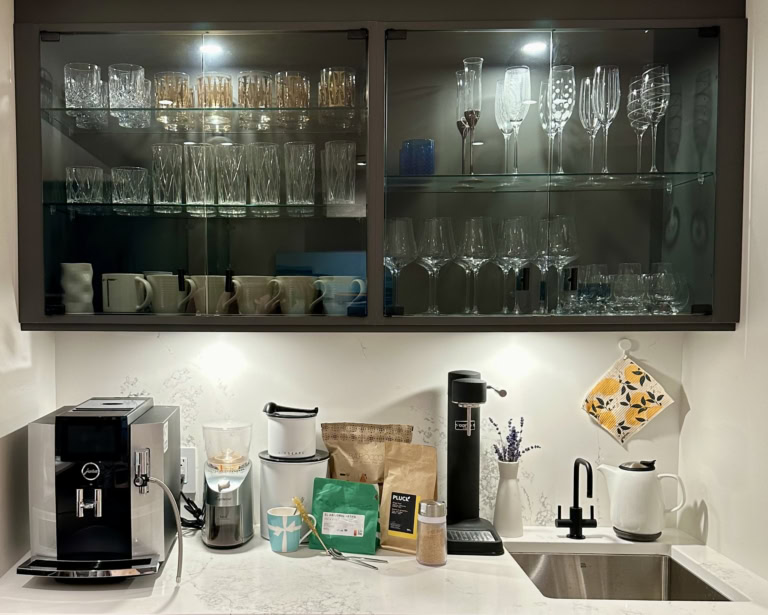
Glassware does more visual work for the home bar than any other line item. Four shapes cover every cocktail in the lineup:
- Coupe (4-6 oz): French 75, gimlet, any straight-up cocktail served without ice.
- Rocks or double rocks (8-10 oz): Negroni, whisky neat, Margarita on the rocks, boilermaker base.
- Highball or Collins (10-12 oz): Gin and Tonic, Paloma, highball, ranch water.
- All-purpose wine glass (14-18 oz): wine, spritz, any cocktail in a wider bowl.
Quantity and Source
Six of each is the right starting count for a four-to-twelve-guest dinner. Twenty-four glasses fit on two open-shelf rows, and the visual symmetry is part of what makes the three-bottle bar look intentional. Two budget moves keep the spend low:
- Brand: single brand and style per shape for visual uniformity.
- Skip specialty: no martini, hurricane, or copper mug until a specific cocktail becomes a regular pour.
A complete bar-tool inventory for hosts covers the shaker, jigger, strainer, and bar spoon that work alongside this glassware. The twelve cocktails the three bottles pour follow next.
The Cocktails Three Bottles Will Pour
Twelve cocktails come out of the three bottle bar without a single additional spirit purchase. The breakdown by base:
Blanco tequila pours four:
- Margarita (rocks or shaken up).
- Paloma (highball with grapefruit soda).
- Ranch water (highball with mineral water).
- Tequila neat or on the rocks.
London dry gin pours five:
- Gin and Tonic.
- Negroni.
- Gimlet.
- French 75 (when sparkling wine is on hand).
- Americano (1 oz Campari, 1 oz sweet vermouth, top with soda).
Japanese whisky pours three plus variations:
- Highball (Bar Goto build).
- Whisky soda (looser ratio for batch pouring).
- Whisky neat or on the rocks.
Ingredient overlap makes the three ingredient cocktails feasible: lime serves Margarita and Gin and Tonic, soda serves Paloma and highball, Campari-vermouth opens Negroni and Americano.
For batch pours, the DIY mimosa bar layout offers a self-pour template. The fourth bottle question comes next.
When to Add the Fourth Bottle (and What to Pick)
The trigger for the fourth bottle is repetition. A host who notices the same guest asks for an Aperol Spritz at every gathering, or who buys a backup of the same brand twice in a year, has hit the signal that one more bottle earns its slot. The cuisine the host most regularly serves decides the pick.
The Three Default Fourth Bottles
- Aperol: for Italian dinners. The Spritz (3 parts prosecco, 2 parts Aperol, 1 part soda, ice, orange) is the welcome drink one bottle covers for four to six guests.
- Lillet Blanc: for French dinners. Chilled over ice with an orange twist as an aperitif, or used in the Vesper.
- Light rum: for warm-weather backyard cookouts. Daiquiri, mojito, rum and tonic without buying a fifth bottle.
The Amaro Path
An alternative fourth-bottle path runs through bitter Italian amari. Tasting Table’s eleven-amari primer covers Amaro Nonino, Averna, and Cynar, each of which pairs with the existing Campari and vermouth to open four or five more cocktails. The amaro path suits a host whose guests skew toward dinner-party-as-tasting-menu. The buying-notes round-up is next.
|
Never Buy the Same Bottle Twice |
Buying Notes: What the Major Review Sites Recommend
Reviewer consensus across the major spirits publications converges on a tight set of starter bottles per category. Pulled from cross-reference of multiple buying guides:
Reviewer Consensus by Category
Tequila for hosting (sub-$40 blanco):
- Espolon Blanco surfaces in Sip Tequila as the everyday value pick.
- Tequila Ocho Plata is the step-up reviewers cite for single-estate quality at the next price tier.
- Cimarron Blanco is the volume workhorse for batch Margaritas.
Gin for hosting (sub-$30 London dry):
- Beefeater London Dry is the cleanest juniper expression at the price.
- Tanqueray London Dry is the step-up assertive juniper bottle.
- Bombay Sapphire is the smoother pivot for guests put off by heavy juniper.
Whisky for hosting (entry-level japanese whisky):
- Suntory Toki is the most-recommended entry-level for highballs.
- Suntory Kakubin (yellow-label) is the more affordable backup, the original japanese highball whisky.
- Hibiki Harmony is the step-up bottle when the budget runs to $90.
Wirecutter’s spirits coverage notes vodka for hosting and mezcal are real categories but lower-yield than the three above for cocktail coverage. Neither earns the starter slot the way blanco tequila, London dry gin, and Japanese whisky do. The shopping list closes the article.
The Three-Bottle Global Bar Shopping List
Final consolidated list for a buy-this-month three bottle home bar with rough price points. North America, Europe, and Asia in one trip:
Spirits, Mixers, and Glassware
Spirits ($90-$150 total):
- Blanco tequila: Espolon ($28) or Ocho Plata ($45). Margarita, Paloma, ranch water, neat.
- London dry gin: Beefeater ($22) or Tanqueray ($28). Gin and Tonic, Negroni, gimlet, French 75, Americano.
- Japanese whisky: Suntory Toki ($40) or Kakubin ($28). Highball, whisky soda, whisky neat.
Mixer shelf ($40 total):
- Tonic water: Fever-Tree 4-pack, $7.
- Club soda or mineral water: Topo Chico 12-pack, $15.
- Sweet vermouth: Carpano Antica or Dolin Rouge, $12.
- Campari: $25, lasts six months of regular Negroni pouring.
- Bitters and citrus: Angostura ($9), fresh limes and grapefruit, simple syrup made at home.
Glassware ($60-$120, one-time): six coupes, six rocks, six highballs, six all-purpose wine glasses.
Total Opening Spend
Bar tools ($30-$60, one-time): shaker, jigger, strainer, bar spoon, citrus juicer. Outdoor hosts should also read the outdoor-bar setup playbook for patio-friendly shelving. Total opening spend: $220 to $360. The bar holds the room across an Italian dinner, a Mexican taco night, and a yakitori spread. Pair the bar with cocktail party games and a small bar earns its keep against a larger one.
Frequently Asked Questions
What three bottles cover the most cocktails for a home host?
Blanco tequila (covers Margarita, Paloma, ranch water, neat sipper), London dry gin (covers Gin and Tonic, Negroni, gimlet, French 75, Americano), and Japanese whisky (covers the highball, whisky soda, whisky neat). Together the three pour roughly twelve distinct cocktails before the host needs to add a fourth bottle.
Is three bottles enough for a dinner party?
Yes, for parties of up to twelve guests. The bottle-coverage logic is straightforward: one base spirit covers four to six cocktails on its own. Three bottles cover most pour requests including welcome drinks, mid-meal cocktails, and after-dinner highballs. Wine, beer, and a non-alcoholic option round the menu out.
What is the best starter tequila for a home bar?
Reviewer consensus across Sip Tequila, Wirecutter spirits coverage, and major industry publications converges on Espolon Blanco, Tequila Ocho Plata, and Cimarron Blanco as the strongest sub-$40 picks. Look for “100% de Agave” on the label; mixto tequilas read harsh and limit cocktail quality across the Margarita family.
Which Japanese whisky is best for a home bar?
Suntory Toki is the most-recommended entry-level Japanese whisky for highballs and is widely available; Suntory Kakubin (yellow-label) is the more affordable backup and is the original highball whisky in Japan. Hibiki Harmony is the step-up bottle when budget allows. All three work neat, on ice, or in highball form.
When should I add a fourth bottle to my home bar?
When you find yourself buying the same brand of pre-mixed cocktail or a backup bottle twice in a year. The most common fourth bottles are Aperol (if you host European dinners), Lillet Blanc (if you host French dinners), or a quality light rum (if you host warm-weather gatherings). Pick the fourth bottle by the cuisine you host most.
What mixers do I need with three bottles?
You need tonic water, club soda, fresh limes, grapefruit soda, sweet vermouth, Campari, and aromatic bitters to pour all twelve cocktails from three bottles. Tonic serves the gin, soda serves the highball, limes cover the Margarita and Gin and Tonic, and vermouth with Campari opens the Negroni and Americano. Budget about $40 for a month of hosting.
Continue Reading:
More On International Drinks
- Drinks by Country (Host’s Guide to 12 Cuisines)
- Welcome Drinks by Country (10 Ideas That Set the Tone)
- Mexican Drinks Menu: 4 Pours That Run the Night
- Italian Drinks: Aperol, Spritz, and Crodino (Host)
- Japanese Drinks: Sake, Highball, Yuzu, Calpis (Plan)
- Indian Drinks: The Four-Pour Menu for Your Dinner
- Classic Aperitifs for Dinner Parties (15 Best Picks)
More from The Gourmet Host
- 10 Potluck Ideas for a Crowd That Make Hosting Effortless
- Easy Food Garnishing Techniques for Stunning Art
- Types of Miso and How to Use White vs Red Paste
- Brunch Table Setting Ideas for Every Style
- Potluck Dinner Party Themes That Your Guests Love
Explore TGH Categories
- Set the Scene
- Drinks and Bar
- Plan the Meal
- Engage with Guests
- Games and Toasts
- Tools and Techniques
- Why We Gather