How to Build a Charcuterie Board: The Host’s 5-Step
 15 min read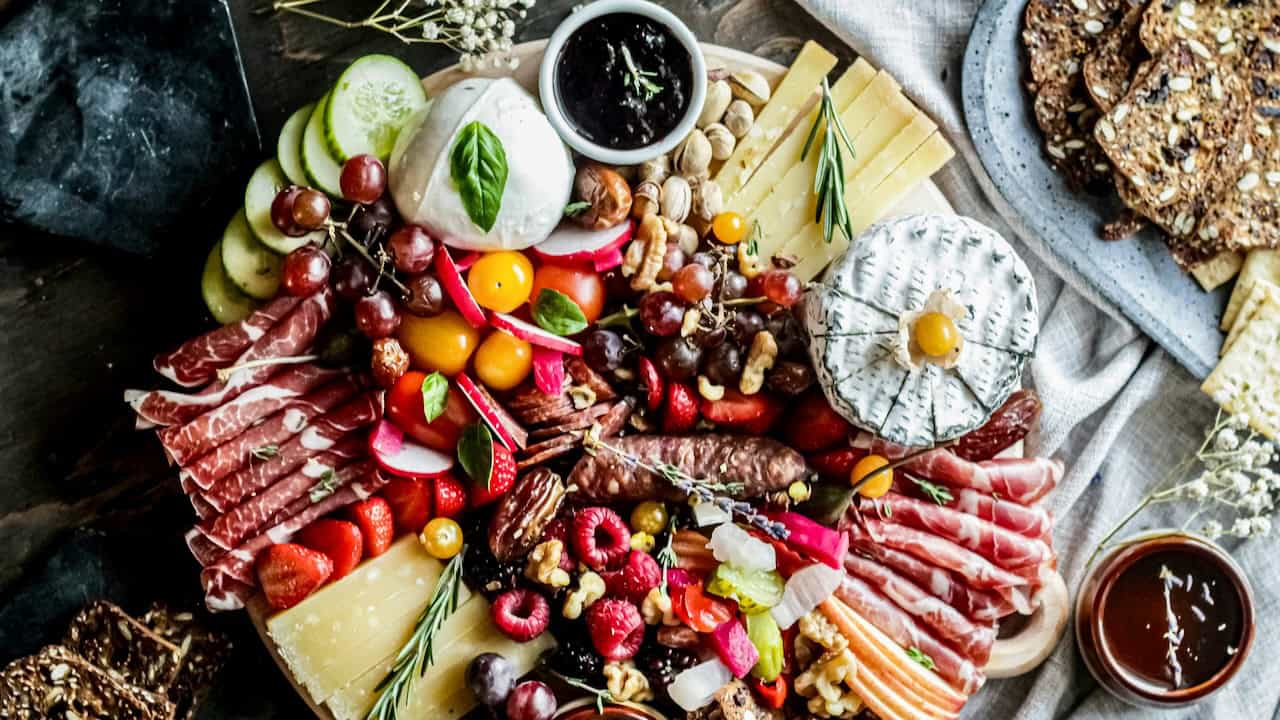
Cheese goes down first, in a triangle, before a single slice of salami or a sprig of rosemary touches the board. Three anchor points, one in each third of the surface, with a four-inch gap between wedges. That single move decides whether the spread reads composed or chaotic.
Plate the cheese in a triangle and the rest of the build solves itself. Cured meats fold into the negative space. Bowls of olives and fig jam tuck against the wedges. Fruit and nuts spill into the gaps.
By the end of the next twelve minutes a board for eight guests is ready, and the host’s hands smell faintly of rosemary. Here are the build sequence, quantities, make-ahead windows, and four-cheese rule that turns a $90 grocery run into a charcuterie board guests actually finish.
At a Glance
- Plate cheese in three points first, then fold cured meats into the gaps, then bowls of wet items, then dry items, then herbs.
- Two ounces of cheese and two ounces of meat per guest for an appetizer board, four ounces of each for a meal.
- The four-cheese rule: one soft, one semi-firm, one firm, one blue covers every palate without confusing the eye.
- Three cured meats: one delicate (prosciutto), one spiced (salami or soppressata), one fatty or whole-muscle (capicola or pate).
- Build the night before what stays firm. Build the morning of what wilts.
What Is a Charcuterie Board?
A charcuterie board is a host-built spread of cured meats, cheeses, and small accompaniments arranged on a single serving surface for guests to graze from before or instead of a seated meal. The charcuterie meaning traces to the French butcher trade for cured pork, and the modern board has grown into a cheese and meat board format that also includes fruit, briny pickles, sweet preserves, nuts, and bread, closer to a small antipasto than a 1970s cheese plate. What separates a great board from a Pinterest screenshot is sequence and quantity: how much per guest, in what order to plate, and which items hold for hours versus which wilt in twenty minutes.
Why the Build Order Is the Whole Job
Sourcing is the easy part. A 90-dollar grocery run at a decent supermarket buys every ingredient on a charcuterie board for eight. The harder part, the part hosts often skip past, is sequence: which items hit the surface first, which fill in around them, and which go on in the last sixty seconds.
A great board is 80 percent sequencing and 20 percent shopping. The host who plates cheese first in three points across the surface wins the layout battle before the meats come out of the deli paper.
Six rules govern the entire build:
- Cheese anchors. Place wedges in three or four points, spaced evenly, with four-inch gaps.
- Meat fills. Fold salami and prosciutto into the empty space between cheeses.
- Wet items go in bowls. Olives, fig jam, hot honey, mustard. Never directly on the wood.
- Dry items scatter. Marcona almonds, dried apricots, grapes, and berries spill into remaining gaps.
- Herbs finish. Rosemary along the edges, thyme tucked under cheese, in the final minute.
Get the order right and the board takes twelve minutes. Get it wrong and the same ingredients take forty-five.
The Five-Bucket Charcuterie Inventory
Every ingredient on a charcuterie board belongs to one of five buckets: cheese, cured meats, something briny, something sweet, something crunchy. The cheese and meat board format works because each bucket pulls a distinct sensory job. Five buckets, twelve to fifteen items total.
More than that and the shopping list explodes without improving the spread. Tastes Better From Scratch covers the same five-category instinct in her charcuterie board build, and most charcuterie board ideas in blog roundups follow a version of the same logic.
The buckets:
- Cheese: brie, Manchego, gouda, aged cheddar, blue cheese. Three to four wedges.
- Cured meats: prosciutto, salami, soppressata, capicola. Three slices folded.
- Briny: cornichons, castelvetrano olives, pickled peppers. Two small bowls.
- Sweet: fig jam, hot honey, mostarda, dried apricots. One spread, one fruit.
- Crunchy: marcona almonds, water crackers, sliced baguette, breadsticks. Two textures.
Once each bucket is checked, stop shopping. A board with fourteen well-chosen items reads more abundant than one with twenty-five.
|
Save The Boards Worth Repeating |
How Much Charcuterie Per Person (Appetizer vs Meal)
The standard quantity question, how much charcuterie per person, splits cleanly along one axis: is this board appetizer or meal? Cheese per person and meat per person scale differently depending on whether the spread plays opener to a real dinner or replaces dinner entirely. An appetizer board comes out during cocktail hour.
A meal board stands alone at a casual weekend gathering or stand-up cocktail party.
The per-guest math:
- Appetizer board: two ounces of cheese plus two ounces of cured meat per guest, plus half a cup of accompaniments (jam, olives, nuts combined). Crackers scale at six to eight per guest.
- Meal board: four ounces of cheese plus four ounces of cured meat per guest. Double the accompaniments and crackers. Add hard-boiled eggs or roasted vegetables to extend it.
Translation for common gatherings: a charcuterie board for 4 appetizer-style needs eight ounces of cheese and eight ounces of meat. A charcuterie board for 6 needs twelve ounces of each. A charcuterie board for 10 needs twenty ounces of each, which is when most hosts switch to two boards rather than one giant platter.
Sip and Feast’s per-guest math lands close to these numbers, with slightly more meat for a Mediterranean lean.
Cheese Selection: Soft, Semi-Firm, Firm, Blue
Three to four cheeses on a board, one from each of four texture categories, covers every palate at the table. The categories sort by how the cheese behaves at room temperature. Soft cheeses spread or smear, semi-firm cheeses slice and stack, firm cheeses crumble or shave, blue cheeses bite.
The Food Network’s primer on what a charcuterie board is walks through the same four-bucket logic in plainer language for readers who came in cold.
The picks per bucket:
- Soft cheeses such as brie, camembert, burrata, fresh chevre spread with a knife or eat with a spoon.
- Semi-firm cheeses such as Manchego, young gouda, Gruyère, fontina slice into wedges or batons before plating.
- Firm cheeses such as aged cheddar, Parmigiano-Reggiano, Pecorino, aged gouda crumble or shave at the board.
- Blue cheeses such as Gorgonzola dolce, Stilton, Roquefort, Danish blue: one wedge is enough for eight guests.
Skip pre-shredded supermarket cheese. The anti-caking powder dulls flavor and the texture reads cheap on a board. Buy whole wedges and slice them yourself the night before.
|
Hosting Tip: Slice Hard Cheeses Cold, Serve Them Warm |
Cured Meat Selection: Prosciutto, Salami, Pate
Three cured meats for a charcuterie board, one of each register. The trio that works almost every time: one delicate slicing meat (prosciutto), one spiced fermented meat (salami, soppressata, or capicola), one fatty or whole-muscle option (pate, rillettes, or ‘nduja).
Things I Made Today walks through her favorite picks, and her plating advice converges on the same three-meat logic from a different angle.
The plating moves per meat:
- Prosciutto: drape in soft folds, do not fan flat. Each slice gets a small ruffle in the center.
- Salami or soppressata: fold each round in half, then in half again. Stack the quarter-folds in a fan.
- Capicola or coppa: lay flat in overlapping rounds. The marbling is the visual interest.
- Pate or rillettes: keep in a small ramekin with a butter knife alongside. Never spread on the board.
Three ounces of each meat covers eight guests at an appetizer board. Buy from a real deli counter when the budget allows.
Accompaniments That Hold the Board Together
Accompaniments are the cuts between cheese and meat, the briny and sweet bites that reset the palate. Six is the right number. Boarderie’s editorial team breaks down what charcuterie means today and how accompaniments separate a modern board from an older cheese plate format.
The six-accompaniment lineup for an eight-guest board:
- Fig jam or quince paste: one small bowl, served with the blue cheese.
- Hot honey: one tiny bowl, served with the brie or aged cheddar.
- Cornichons: one bowl of fifteen to twenty pickles.
- Castelvetrano olives: one bowl of green olives, pits and all (and a small empty bowl for pits).
- Marcona almonds: one bowl of salted, fried almonds.
- Dried apricots: one small pile of orange-colored dried fruit for sweetness.
State and Allen covers the history of the charcuterie board and how the accompaniment tradition predates the cheese board format by a couple of centuries. Six items, six small bowls or piles, evenly spaced around the cheese anchors.
|
Know Every Guest’s Needs In Advance |
Crackers and Bread: How Much, Which Shapes
Two cracker types and one sliced baguette covers a board for eight. Crackers do not go on the board itself. They live in a basket alongside, where guests can grab a handful without disturbing the layout. Pile them on the board and they go soft within twenty minutes from cheese oil and humidity.
The cracker shortlist:
- Round water crackers: the neutral base. One sleeve per eight guests.
- Long seeded crisps or rosemary flatbread: for visual contrast. Half a box per eight.
- Sliced baguette: half a loaf, sliced into half-inch coins, lightly toasted.
- Optional breadsticks: Italian grissini, leaned against the rim of the board for height.
For other cracker- and bread-led spreads, the TGH party food platters guide covers the same logic at larger scale: variety, but not so much that the cheese gets lost. Aim for six to eight pieces of bread or cracker per guest, total. Refill the basket once during the gathering.
Plating Sequence: The 12-Minute Build
Build, start to finish, takes twelve minutes once every ingredient is prepped and laid out on the counter. Run the steps in order, do not jump ahead. Natasha’s Kitchen’s own plating sequence runs along similar lines, with cheese first and herbs last.
The twelve-minute sequence:
- Minute 0-2: place three cheese wedges in three points across the board, four-inch gaps between them. A fourth cheese (blue) goes in a corner.
- Minute 2-5: fold cured meats into the negative space between cheeses. Prosciutto first (most delicate, gets the most attention), salami second, capicola third.
- Minute 5-7: place six small bowls around the perimeter and tuck in two or three near the center. Fill with jam, hot honey, olives, cornichons.
- Minute 7-9: scatter marcona almonds and dried apricots in remaining gaps. Add a small cluster of grapes and a few berries near the blue cheese.
- Minute 9-11: tuck fresh rosemary sprigs along two edges of the board. Add three fig halves or strawberries opposite the rosemary.
- Minute 11-12: photograph the board, then walk it to the table. Set the cracker basket alongside.
Refill no more than once during the gathering. After the second refill, switch to plated finger food.
Board Size and Surface: Wood, Marble, or Slate
Surface matters more than most hosts realize. Wood absorbs cheese juices and reads warm. Marble stays cold longer (useful in a warm room). Slate looks dramatic but stains and dulls knives. Bamboo is light and food-safe with proper sealing.
For a deeper read on board materials and how to choose, the TGH cutting board material guide covers wood vs end-grain vs plastic in detail.
Board size scales with guest count, and the right board size is the variable most hosts get wrong:
- 12-inch round: serves 4 appetizer-style. Tight but workable.
- 15-inch round or 18-inch oval: serves 6 to 8. The most versatile size.
- 20-inch rectangle or 24-inch oval: serves 12 to 16.
- Two coordinating boards: for 20 or more guests, easier than one oversized platter.
Ridge Wine offers a useful read on building a wine-friendly board, and the wood-versus-marble debate gets a different treatment in their notes too. Pick the board first, then plan the food to fit.
Make-Ahead Window: 24 Hours, 6 Hours, 30 Minutes
Building the whole board the morning of and watching the herbs wilt by serving time is the biggest host mistake. Stagger the prep across three windows: 24 hours ahead, 6 hours ahead, and the final 30 minutes.
The TGH easy cold appetizers guide walks through similar make-ahead logic for related cold spreads, and Chris Loves Julia’s own prep schedule runs on roughly the same timeline.
The three windows:
- 24 hours ahead: slice the firm and semi-firm cheeses into wedges or batons. Store flat in airtight containers in the fridge. Pre-fold the salami; cover and refrigerate.
- 6 hours ahead: pull the cheese from the fridge so it comes to room temperature. Fill the small bowls with jam, honey, olives, cornichons. Wash and pat-dry the grapes.
- Final 30 minutes: assemble the board, slice the baguette, plate the prosciutto (it dries out fast), tuck in fresh herbs.
Night-before-or-not rule on cured meats for charcuterie board prep: prosciutto and pate go on in the final 30 minutes. Salami and capicola can be folded the night before and held cold.
Eat Cured Meat covers the food-safety side of how long cured meats hold at room temperature once plated.
Common Mistakes That Make a Board Look Sparse
Boards can read sparse with the same ingredients that another host turns into something abundant. The difference is six small mistakes, each with a sixty-second fix. The TGH grazing table setup guide covers many of the same negative-space and height-variation principles at larger scale, and a few of those charcuterie board ideas scale up directly.
Six fixes that turn an easy charcuterie board into one that reads abundant:
- Cheese in one corner: spread to three or four points. Four-inch gaps minimum.
- Meat in a single pile: fold individually and fan them out, do not pile.
- Crackers stacked on the board: move to a basket alongside. Reclaim the board real estate.
- No height variation: lean breadsticks against the rim, stack salami in a low spiral, place bowls at varied heights.
- Empty perimeter: tuck rosemary sprigs along the edges. Scatter grape clusters in any visible gaps.
- Bright items in the center only: spread red fruit (strawberries, pomegranate, figs) to opposite edges so the eye travels.
The TGH wine and snacks pairing guide closes the loop on what to pour alongside. Apply two or three of the fixes and a board that looked thin reads abundant in under five minutes.
Frequently Asked Questions
How do you build a charcuterie board for beginners?
Start with three to four cheeses from different textures, three cured meats, and six accompaniments. Lay cheese first in three points across the board, then fold meats into the gaps. Add bowls of olives or jam, then scatter nuts and fruit to fill negative space. Twelve to fifteen ingredients total.
What is the rule for building a charcuterie board?
The working rule is the 3-3-3-3 framework: three cheeses, three cured meats, three accompaniments, three add-ons (nuts, fruit, herbs). Plan two ounces of cheese and two ounces of meat per guest for an appetizer board, four ounces each for a meal board. The framework keeps shopping short and plating balanced.
In what order should I assemble a charcuterie board?
Build in this order: cheese first (anchors the layout), cured meats second (filling the space between cheeses), bowls of wet items third, dry accompaniments and nuts fourth, fresh herbs and fruit last. Crackers stay off the board, served in a basket alongside. The sequence takes twelve minutes for an eight-guest board.
How far in advance can I build a charcuterie board?
Cheese can be cut and meat sliced up to 24 hours ahead and stored in the fridge. Assemble the board itself no more than two hours before serving. Add herbs, sliced fruit, and crackers in the final 15 minutes so nothing wilts or dries out. Prosciutto goes on in the last 30 minutes.
How many cheeses and meats do I need on a charcuterie board?
Three to four cheeses and three cured meats cover every taste at the table without overwhelming the eye. One soft, one semi-firm, one firm, and one blue cheese, paired with prosciutto, a spiced salami, and one whole-muscle or fatty option like capicola. Three ounces of each meat covers eight guests.
How much should a charcuterie board cost per person?
Budget six to ten dollars per person for an appetizer board using grocery cheese and supermarket cured meats. Specialty shops with imported prosciutto and aged cheeses push that to fifteen to twenty dollars per person. Quantity drops the per-person cost as guest counts rise. A board for eight runs $50 to $80 at a good supermarket.
Continue Reading:
More on Charcuterie Boards
- Charcuterie Board Ingredients (Everything to Include)
- Charcuterie Board Platter Setup (Host’s Playbook)
- Breakfast Charcuterie Board (Brunch Hosting Guide)
More from The Gourmet Host
- Anniversary Speeches and Toasts for Every Milestone
- Best Quotes for Toasts That Make Every Glass Worth Raising
- 5 Chef Knives Under $100 Reviewers Keep Recommending
- Welcome Drink Ideas (10 Easy Party Recipes to Make)
- Lunch with Friends: Simple Menus and Ideas to Make It Special
Explore TGH Categories
- Set the Scene
- Drinks and Bar
- Plan the Meal
- Engage with Guests
- Games and Toasts
- Tools and Techniques
- Why We Gather