Drinks by Country (Host’s Guide to 12 Cuisines)
 22 min read
Every country answers the same hosting question with a different glass.
An Italian friend reaches for prosecco and a bottle of orange-colored Aperol before the first guest sits down. A Japanese friend pours sparkling water over a finger of whisky as the after-work opener. A Mexican friend sets out a sweating pitcher of agua de jamaica next to a bottle of blanco tequila. None of them call it a drinks menu. They call it dinner.
Country-themed drinks are not a cocktail-list problem; they are a hosting framework. Pour one alcoholic anchor and one non-alcoholic anchor from the same country, and the table reads as a coherent national meal rather than a bar with a theme. By the last H2 of this guide, you will have that two-pour formula for 12 cuisines, with the bottle list and glass conventions to back each one.
At a Glance
- Why country-themed drinks scale better than country-themed food and let one bottle do the work of a full bar.
- The two-pour formula every host can recreate: one alcoholic anchor plus one non-alcoholic anchor from the same country, every time.
- Twelve signature cuisines paired front-to-back, from Italian aperitivo through Scandinavian glogg, with the actual bottles to buy.
- The three-bottle starter kit that covers Italy, Mexico, and Brazil at once, plus two pitcher-based non-alcoholic anchors that travel across menus.
- Glassware and welcome-drink conventions per country, plus the FAQ block that answers the most-asked hosting questions on international pours.
What Is a Drinks-by-Country Menu?
A drinks-by-country menu is a host’s framework for matching the pours at a dinner party to the cuisine on the table — one alcoholic anchor and one non-alcoholic anchor drawn from the same national tradition. The pairing matters as much as the choice: a Mexican night reads as Mexican when a Margarita pitcher sits beside an agua de jamaica jug, not when a generic gin and tonic shows up. Unlike a generic cocktail list, this approach uses two bottles per country to carry the entire evening, which means less inventory, faster pours, and a table that feels like a coherent place rather than a bar.
Why a Country Frame Is the Easiest Theme to Host
Choosing a country for the night does half of the hosting work before the grocery run starts. The cuisine narrows the protein, the sides, the spices, and — quietly — the drinks. A host who picks Italy on Tuesday is no longer scanning a thousand-deep cocktail list on Saturday; the answer was decided three days ago when the menu landed on cacio e pepe.
The drinks side of that decision is the leverage point. One country, two pours, two bottles, and the bar is finished. Guests recognize the signal on sight — an orange spritz reads Italian, a lime-rimmed glass reads Mexican, a stem of cold sake reads Japanese — and the host stops curating individual drinks for individual guests.
There is a sister principle at work for guests who don’t drink. A coherent non-alcoholic anchor from the same country, poured into a real glass and set on the table, does the work of three back-pocket sodas. TGH’s broader host’s guide to non-alcoholic cocktails and spirits covers the wider non-alcoholic ground; this pillar narrows the question to: which one from this country, served alongside which one alcoholic.
What a Two-Pour Menu Actually Looks Like
The shape is the same every time, regardless of cuisine. Pick the country. Buy one bottle of the country’s signature spirit (or the wine equivalent). Buy one bottle or pitcher base for the non-alcoholic anchor. Set both within reach. The host is no longer the bartender; the host is the cook who happens to have two recognizable drinks on the table.
- One alcoholic anchor — the country’s most-recognized pour, ideally one that scales from one glass to ten without a recipe card.
- One non-alcoholic anchor — the country’s traditional table drink, often a pitcher, a bottled aperitif, a steeped tea, or a yogurt-based blend that pours straight from a jug.
- Two glasses, one for each pour — matching glassware tells the table both drinks are intentional, not a backup plan.
The next twelve sections walk through the pairings cuisine by cuisine — Italy first, because it built the modern model of the aperitivo hour, and the country whose drinks menu most Americans already half-know by name.
|
Set The Country Menu In Minutes |
Italy: Aperol Spritz, Negroni, and the Crodino Bottle
Italian drinks divide the dinner into three acts: aperitivo before, wine during, digestivo after. A host who follows that timing carries the table through the entire evening with two cocktails, one wine, and one small after-dinner pour. The structure is the menu.
Eataly’s guide to the aperitivo tradition puts the cultural shape in one line: aperitivo opens the appetite, not the bar. The home version is simpler than the cafe one — a single bottle of Aperol, a single bottle of prosecco, a wedge of orange, and a sleeve of soda. The same setup carries six guests for forty-five minutes, the exact length of an aperitivo hour.
The Three-Two-One Aperol Spritz
The ratio is non-negotiable: three parts prosecco, two parts Aperol, one part soda, served in a wine glass over plenty of ice with a slice of orange. Reversing the order or shorting the prosecco turns the spritz syrupy. Build it in the glass, not in a shaker.
- The bottle list: one Aperol, one Prosecco DOC, one liter of club soda. That kit pours roughly twelve spritzes — exactly enough for an aperitivo hour at a table of six.
- The optional second alcoholic pour: Negroni — equal parts gin, sweet vermouth, and Campari, stirred over ice and finished with an orange peel. Heavier than the spritz; serve one per guest, not on rotation.
- The digestivo pour: Averna or Montenegro over a single ice cube after dessert, plus a bottle of limoncello straight from the freezer for guests who prefer cold and sweet.
The non-alcoholic anchor for an Italian night is Crodino. It comes in a small orange bottle, pours straight over ice into a wine glass with a slice of orange, and reads as the same drink as the spritz from across the table. PUNCH’s essential guide to Italian digestivo covers the after-dinner end of the same Italian three-act structure — useful context if a host wants to extend the menu into the amaro hour.
Mexico: Margarita, Paloma, Horchata, and Agua de Jamaica
Mexican drinks are table drinks, not bar drinks. Horchata and agua de jamaica pour into glasses alongside the food; the tequila bottle stays close enough to refill a Margarita without standing up. Four pours — two alcoholic, two non-alcoholic — cover any Mexican-themed evening from the welcome through the last course.
The Paloma is the workhorse of the bottle. The Kitchn’s classic Paloma recipe confirms the ratio that bartenders in Guadalajara have been pouring for decades: two ounces blanco tequila, top with grapefruit soda, finish with a squeeze of lime. Less prep than a Margarita, faster on the table, and the most-consumed tequila cocktail inside Mexico itself.
The Four-Pour Mexican Menu
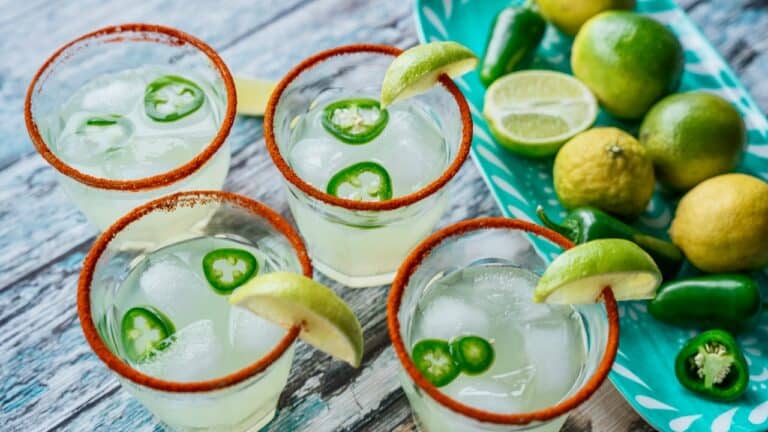
- Margarita — two ounces blanco tequila, three-quarter ounce Cointreau, three-quarter ounce fresh lime juice, served on the rocks with a salt rim. Batch by the pitcher for tables of four or more.
- Paloma — two ounces blanco tequila in a tall glass, topped with Mexican grapefruit soda (Squirt, Jarritos, or Fresca), finished with a lime wedge. Builds in ten seconds per glass.
- Horchata — one cup long-grain rice soaked overnight with two cinnamon sticks, blended with water, sweetened with sugar, strained, served chilled. The non-alcoholic anchor that pairs with spicy food.
- Agua de Jamaica — a half-cup dried hibiscus flowers steeped in hot water for fifteen minutes, strained, sweetened, served over ice. Lighter than horchata; cuts richness rather than coating it.
The agua de jamaica side of the menu does the heavy lifting for non-drinkers. Muy Delish’s recipe for agua fresca de jamaica is the cleanest home version — fifteen minutes of steeping, no specialty equipment, scales by the pitcher. A single pitcher of jamaica covers eight guests across an entire Mexican dinner.
|
Hosting Tip: Pour the Nonalcoholic Anchor First |
Japan: Highball, Sake, Yuzu Lemonade, and Calpis
Japanese drinks split between the formal — sake served at temperature in small porcelain cups — and the after-work — a tall, ice-cold highball of Japanese whisky and soda, poured over a single long ice cube. The dinner table can carry both, and often does.
Sake belongs in the cuisine and in the glass. Decanter’s beginner’s guide to sake explains the service basics — junmai for warming, ginjo and daiginjo chilled, never microwaved — and notes that a half-cup pour is the standard, not a wine-sized fill. For a four-guest dinner, a 720-milliliter bottle covers the entire meal with room to spare.
The Two-Bottle Japanese Setup
- Highball: one part Japanese whisky (Toki, Suntory) to four parts club soda, poured slowly down the side of a chilled tall glass with one long ice cube. The drink that defined modern Japanese after-work hospitality.
- Sake: a chilled junmai daiginjo poured into a small wine glass or a traditional ochoko. Serve with the first food course; pair it with raw or lightly cooked dishes.
- Yuzu lemonade: one tablespoon yuzu juice, two teaspoons honey, top with cold soda water. A four-ingredient build that signals Japan from the first sip.
- Calpis: the fermented milk concentrate that mixes one-to-four with cold water for the cleanest non-alcoholic anchor in the Japanese pantry.
Calpis is the part of the menu most American hosts have never heard of. Wikipedia’s Calpis entry walks through the hundred-year-old lactic-fermentation tradition behind the bottle. The taste is closer to a cold lassi than a soda — lightly sweet, slightly tangy, served in a tall glass over ice. TGH’s deeper tasting guide for Japanese non-alcoholic drinks covers the rest of the bottled options once the host has the highball and Calpis basics in place.
India: Mango Lassi, Masala Chai, Nimbu Pani, Kingfisher
India is a non-alcohol-led country at the dinner table. The signature anchors — lassi, chai, nimbu pani — are dairy and citrus-forward, served chilled or hot depending on the season, and the alcoholic pour, when it appears, is almost always a bottle of cold Kingfisher beer rather than a cocktail.
Mango lassi is the welcome pour for half the country. Veg Recipes of India’s authentic mango lassi uses the home formula that scales — one cup ripe Alphonso mango pulp, one cup full-fat yogurt, two tablespoons sugar, a pinch of cardamom, blended with ice. The result pours thick into a tumbler and cools the palate before the spice arrives.
The Four-Pour Indian Setup
- Kingfisher beer is the most-consumed beer in India, served ice-cold straight from the bottle into a small glass. Pairs across the entire Indian menu without negotiation.
- Mango lassi is the warm-weather welcome pour; blend ahead, refrigerate, and serve in tumblers with a pinch of cardamom on top.
- Masala chai is the cool-weather pour; black tea simmered with whole milk, ginger, cardamom, cinnamon, and cloves, served from a small pitcher after the meal.
- Nimbu pani is the third non-alcoholic option for guests who skip dairy — fresh lime juice, water, salt, sugar, a pinch of black pepper, served chilled.
Feasting at Home’s authentic masala chai recipe is the cleanest version for a host to scale — simmer the whole spices in water first, add tea and milk, sweeten at the end. Brewed in a six-cup batch, a single pot covers eight after-dinner pours. Kingfisher itself has a long history; the BeerAdvocate’s Kingfisher profile covers the United Breweries brand that has held roughly a third of the Indian beer market for two decades.
France, Spain, and Brazil: Three Aperitif Countries, Three Anchor Pours
France, Spain, and Brazil sit on the same shelf of the global drinks pantry because each one opens the meal with a low-ABV aperitif — Kir Royale in Paris, sparkling cava in Madrid, caipirinha in São Paulo — and each has a clean non-alcoholic counterpart that pours alongside without disrupting the ritual.
The host’s move for each country is identical: one bottle of the signature spirit (or wine), one pitcher of the non-alcoholic anchor, two glass shapes. The cuisines diverge wildly, but the drinks architecture is the same. The three pairings, side by side:
- France: Kir Royale (cassis and Crémant) paired with sirop a l’eau (fruit syrup and sparkling water). Both pours sit in a flute or small wine glass; both signal restraint.
- Spain: Sangria or tinto de verano paired with horchata de chufa (tigernut milk). Wine glass for the alcoholic pour, small footed tumbler for the horchata.
- Brazil: Caipirinha (cachaça, lime, sugar) paired with coconut water and lime. Rocks glass for both, salted rim optional on the coconut version.
France: Kir Royale and Sirop a l’Eau
Kir Royale is two ingredients: a teaspoon of crème de cassis poured into a chilled flute, topped with dry sparkling wine — Crémant if the budget allows, Champagne if it doesn’t. The non-alcoholic French anchor is sirop a l’eau, a tablespoon of fruit syrup (cassis, grenadine, mint, or violet) topped with cold sparkling water. TGH’s round-up of French non-alcoholic drinks for gatherings covers the wider French cordial pantry.
Spain: Sangria, Tinto de Verano, Horchata de Chufa
Spanish sangria is red wine, brandy, fruit, and a splash of orange juice or soda, batched in a pitcher. Tinto de verano — Spain’s actual home pour, not the tourist one — is red wine cut half-and-half with lemon-lime soda over ice. The non-alcoholic anchor is horchata de chufa, made from tigernuts rather than rice; TGH’s guide to non-alcoholic Spanish drinks like sangria and horchata walks the tigernut method and the cava-and-juice options.
Brazil: Caipirinha and Coconut Water with Lime
The caipirinha is the simplest national cocktail on this entire pillar — half a lime in quarters, two teaspoons of raw sugar, muddled in a rocks glass, topped with two ounces of cachaça and crushed ice. The Brazilian non-alcoholic anchor is coconut water with lime: one can of cold coconut water over ice with a heavy lime squeeze and a pinch of sea salt. Same flavor family as the caipirinha; the alcohol is the only thing missing.
Morocco, Greece, Vietnam, and Peru: Four Cuisines, Four Distinct Anchors
These four cuisines round out the heart of this pillar by introducing four pour styles that the Italy / Mexico / Japan / India quartet does not cover — a tea-based welcome, an aniseed-forward digestif, a coffee that doubles as a drink, and a fruit-forward sour that hosts can build with two bottles. Each one expands the host’s drinks vocabulary into a region most American dinner tables do not visit.
A quick orientation before the country-by-country detail:
- Morocco leads with mint tea poured from a height into a small glass, with an orange-blossom cooler as the chilled summer alternative.
- Greece anchors on chilled ouzo and a small dish of olives, with honey lemonade and mountain tea as the non-alcoholic counterparts.
- Vietnam treats iced coffee as the centerpiece, paired with a cold Saigon Special beer for drinkers and bottled sugarcane juice for everyone else.
- Peru pours the pisco sour with a coupe of chicha morada (boiled purple corn) on every table that hosts both drinkers and non-drinkers.
Morocco: Mint Tea and Orange Blossom Cooler
Moroccan mint tea is the welcome ritual, the digestive, and the social glue of the country — green gunpowder tea steeped with a generous handful of fresh spearmint and plenty of sugar, poured into small glasses from a height of about a foot to aerate the surface. The pour-from-height move is theater; the tea itself takes ten minutes.
The orange-blossom cooler is the chilled summer option — one tablespoon of orange-blossom water, two teaspoons of honey, topped with cold soda water and a sprig of mint. Both pours sit on the same table without competing.
Greece: Ouzo, Mountain Tea, Honey Lemonade
Ouzo is the Greek aniseed-forward aperitif, served chilled over ice in a small glass; pouring cold water into it turns the liquid milky white — a transformation guests notice on sight. Pair it with a small dish of olives, and the welcome is complete.
The non-alcoholic Greek anchor is honey lemonade — fresh lemon juice, raw Greek honey, cold water, served over ice with a sprig of fresh mint. Mountain tea (tsai vounou) is the after-dinner option, steeped from dried sideritis flowers and served warm without milk.
Vietnam: Iced Coffee, Saigon Beer, Sugarcane Juice
Vietnamese cà phê sữa đá — strong dark-roast coffee dripped over a thick layer of sweetened condensed milk, poured over ice — is a drink, a dessert, and a national habit at once. Brew it stronger than American coffee, serve it in a tall glass with a long spoon to stir down the milk.
The alcoholic anchor is a cold bottle of Saigon Special or Bia Hanoi, served straight. Sugarcane juice — nước mía — is the street-stand non-alcoholic pour, sold from juice bars in Hô Chi Minh City and now available bottled in many U.S. Asian grocers.
Peru: Pisco Sour and Chicha Morada
The pisco sour is Peru’s national cocktail: three parts pisco, one part fresh lime juice, one part simple syrup, an egg white for foam, all shaken hard with ice and strained into a coupe. Two dashes of Angostura bitters on top, and the drink is finished.
Chicha morada is the non-alcoholic anchor — purple corn boiled with pineapple skin, cinnamon, cloves, and lime, sweetened lightly and served chilled. The purple color reads as intentional, not a juice substitute, and the flavor is closer to spiced sangria than to fruit punch.
|
Split The Bar Tab Fairly |
Scandinavia: Glogg, Aquavit, and the Lingonberry Spritz
Scandinavian drinks are the cold-weather end of this pillar — a hot mulled wine poured from a copper pot in December, a chilled neutral spirit served at three temperatures across a single dinner, and a tart red spritz that mirrors the lingonberries already on the holiday plate. The menu reads as winter even in a tasting flight.
Glogg is the seasonal welcome pour — red wine warmed with cardamom pods, cloves, cinnamon sticks, orange peel, raisins, and a splash of aquavit or brandy, served in a small mug. The almonds and raisins at the bottom of the cup are an old Scandinavian Christmas detail; leave them in.
The Three-Pour Scandinavian Setup
- Glogg: one bottle of red wine, a quarter cup of brown sugar, six cardamom pods, three cinnamon sticks, orange peel, and a half-cup of aquavit or brandy, simmered for twenty minutes and served warm in a small mug.
- Aquavit: served ice-cold in a small frozen glass alongside herring, salmon, or any heavy winter starter. The traditional toast pattern (skål) brings the table together at the start of the meal.
- Lingonberry spritz: two tablespoons lingonberry syrup or preserves stirred into a tall glass, topped with cold soda water and a sprig of rosemary. The non-alcoholic pour that visually matches the holiday menu.
Scandinavian drinks scale beautifully for a holiday table because the entire pour list runs from a stovetop. Glogg simmers on low for the whole evening; the aquavit lives in the freezer; the lingonberry spritz builds in fifteen seconds per guest. The kitchen stays calm, the table stays warm, and the December dinner runs itself.
How to Build a Two-Pour Menu for Any Country Theme
The framework underneath every country section above is the same five-step move, and it scales to any cuisine on the map. The trick is to commit to it before the grocery run — once the host has bought eight bottles instead of two, the discipline is gone, and the table goes back to looking like a bar.
The Five-Step Two-Pour Build
- Pick the country first. Choose the cuisine for the night, then derive the drinks. Working from the food backward is the only way the pours read as coherent.
- Choose the alcoholic anchor by recognition, not by ranking. The drink most guests can name without looking — Margarita for Mexico, Aperol Spritz for Italy, caipirinha for Brazil — is the right pour. Save the deeper-cut cocktails for the bar weekend.
- Pair a non-alcoholic anchor from the same country. Not a generic seltzer. The Indian table gets lassi; the Mexican table gets jamaica; the Italian table gets Crodino. The pairing is the entire signal.
- Match the glass. Wine glass for the spritz, highball for Japan, tumbler for the lassi, coupe for the pisco sour. The drink reads as intentional only when the glass agrees with it.
- Set both anchors on the table at the start. Pitcher of non-alcoholic next to the bottle of alcoholic, both visible from every seat. No back-of-the-fridge surprises midway through dinner.
TGH’s broader framework for non-alcoholic drink pairing across any cuisine covers the flavor-matching side of the same equation — useful background when a host wants to substitute the country anchor for a flavor-led one. For most country-themed dinners, the cuisine-driven pairing in steps two and three is the faster path.
Once the two-pour framework is the muscle memory, picking the country in the morning produces the drinks list by noon. The afternoon goes to cooking, not curating.
Bottles to Buy When You Want to Cover Three Countries at Once
A host who keeps three carefully chosen bottles on the shelf can cover Italy, Mexico, and Brazil for any midweek dinner without a grocery run. The kit is small, the bottles overlap by spirit family, and the same shelf handles a spontaneous Friday gathering and a planned Saturday menu equally well.
Difford’s Guide builds the same argument from the cocktail-bar end. Their starter-ingredient guide for cocktails made easy names the same three to five base spirits a working home bar needs. Adapted for the country-themed dinner table, the kit narrows to a tighter shelf.
The Three-Bottle Global Bar Kit
- Blanco tequila: covers Mexico (Margarita, Paloma), and pairs with grapefruit soda for the easiest weeknight pour on this list. One 750ml bottle handles twelve cocktails.
- Cachaça: covers Brazil (caipirinha, batida); the only specialty bottle on the shelf, but it is the entire Brazilian drinks menu in one place.
- Dry prosecco: covers Italy (Aperol Spritz, prosecco straight), plus France in a pinch when a Kir Royale needs to substitute for Champagne. One bottle handles six spritzes or twelve flutes of prosecco.
The Two-Pitcher Non-Alcoholic Anchor Shelf
- Crodino: a four-pack of small bottles covers an Italian dinner of any size; pours straight over ice into a wine glass with an orange wedge. Zero prep, full table presence.
- Agua de jamaica concentrate: a jar of dried hibiscus flowers (under five dollars at most Latin grocers) steeps into a pitcher of jamaica in fifteen minutes. Carries Mexican, Spanish-Caribbean, and tropical menus.
Add a sleeve of grapefruit soda, a sleeve of club soda, a bag of limes, and a small bottle of Cointreau or triple sec, and the same shelf handles four cuisines without a special trip. The whole kit fits in one cabinet and pours roughly forty drinks before the next grocery run.
Glassware and Welcome-Drink Conventions Per Country
Glassware finishes the country-themed drinks menu the way plating finishes a course. The right glass tells the guest the host knew what to pour before the bottle ever came out of the cabinet — a spritz in a wine glass reads completely different from a spritz in a highball, even with the same liquid inside.
The Glass Shape Per Country
- Italy pours into a wine glass for the spritz, a wine glass with a single rock for the Negroni, a small cordial glass for limoncello, and a tiny ochoko-sized cup for grappa.
- Mexico uses a rocks glass with a salt rim for the Margarita, a tall glass for the Paloma, a footed pint or pilsner for the Michelada, and a simple tumbler for horchata and jamaica.
- Japan reaches for a tall highball glass with one long ice cube, a small porcelain ochoko for warm sake, and a white wine glass for chilled daiginjo.
- India serves lassi in a tall tumbler, chai in a small steel cup or ceramic mug, and Kingfisher in a traditional half-pint glass poured from the bottle.
- France and Spain default to a flute or coupe for Kir Royale and cava, a wine glass for sangria, and a small footed glass for sirop a l’eau or tinto de verano.
Welcome-Drink Conventions Per Country
Most country traditions agree on a single welcome pour, and most of them are lighter than the alcoholic anchor served later. Italy opens with an Aperol Spritz; France pours a flute of Crémant or a Kir Royale; Japan starts with a chilled cup of sake or a highball; Mexico hands every guest a Paloma at the door. The welcome drink is rarely the main pour of the night — it is the host’s tempo signal.
For the broader playbook of welcome-pour conventions across cuisines, the satellite article in this cluster walks ten country welcomes in depth. Both pieces work together: this pillar gives the full drinks menu per country, the welcome-drink piece narrows to the first ninety seconds.
Frequently Asked Questions
What are the most popular drinks by country to serve at a dinner party?
The five most reliable signature pours are Italy’s Aperol Spritz, Mexico’s Margarita, Japan’s Highball, India’s Mango Lassi, and France’s Kir Royale. Each represents a coherent national tradition guests recognize on sight. Pair the alcoholic anchor with one non-alcoholic option from the same country so every guest is matched.
What is the most popular non-alcoholic drink in each major cuisine?
The signature non-alcoholic pour is different for every cuisine: Crodino in Italy, agua de jamaica or horchata in Mexico. Japan pours Calpis or yuzu lemonade, India serves mango lassi or nimbu pani, and France finishes with sirop a l’eau or a cassis tonic, each one poured right alongside its country’s alcoholic anchor.
Do I need a full bar to host a country-themed dinner?
No. One bottle of the country’s signature spirit plus one non-alcoholic anchor will cover an entire evening. An Italian night needs only a bottle of Aperol, prosecco, and chilled Crodino bottles. A Mexican night needs blanco tequila, lime, and a pitcher of agua de jamaica. Country-themed dinners use less, not more, behind the bar.
What is the easiest country-themed drinks menu for a first-time host?
Italian. Aperol Spritz is a three-ingredient build (prosecco, Aperol, soda), the Crodino bottle pour is zero-prep, and both are recognized worldwide. The aperitivo hour also doubles as the opening-course timing, so the drinks themselves carry the host’s tempo for the first thirty minutes of the evening.
Are country-specific drinks usually alcoholic or non-alcoholic?
Most country menus carry both. India and Morocco lead on non-alcoholic anchors (lassi, chai, mint tea), while Italy and Mexico lead on alcoholic icons. The host’s framework is to always pour at least one of each from the same country, so the drinks menu reads as a coherent national table rather than a single-track bar.
Which country has the simplest signature cocktail to make at home?
Brazil. The Caipirinha needs three ingredients: cachaça, sugar, and one cut lime, muddled in the glass and topped with crushed ice. Total build time is under sixty seconds, and the only specialty bottle is the cachaça itself. The Italian Aperol Spritz comes second on simplicity, with prosecco and Aperol making up the entire shopping list.
Continue Reading:
More On International Drinks
- Welcome Drinks by Country (10 Ideas That Set the Tone)
- Mexican Drinks Menu: 4 Pours That Run the Night
- Italian Drinks: Aperol, Spritz, and Crodino (Host)
- Japanese Drinks: Sake, Highball, Yuzu, Calpis (Plan)
- Indian Drinks: The Four-Pour Menu for Your Dinner
- Classic Aperitifs for Dinner Parties (15 Best Picks)
- Three-Bottle Home Bar Essentials: Global Starter
More from The Gourmet Host
- Murder Mystery Dinner Party Kit: How to Choose and Host
- 7 Classic French Main Dishes for Confident Hosts
- Icebreaker Questions for Work That Teams Actually Enjoy
- Date Night at Home Dinner Ideas Worth Cooking for Two
- Different Methods and Techniques For Cooking Like a Chef
Explore TGH Categories
- Set the Scene
- Drinks and Bar
- Plan the Meal
- Engage with Guests
- Games and Toasts
- Tools and Techniques
- Why We Gather