Lunar New Year Dinner Menu and Lucky Food Traditions
 17 min read
Reunion dinner runs on a countdown, not a shopping list, from the rice cake you steam days ahead to the fish that leaves the kitchen last.
Eight lucky dishes are the easy part of a Lunar New Year dinner. Whole fish, dumplings folded into ingot shapes, long noodles left uncut: the menu is settled before you start. What decides the evening is the order those dishes leave the kitchen, and how much of the work is finished before anyone knocks.
Reunion dinner is one meal on one evening, cooked mostly by the host, for a table that often spans three generations. Plan it as a countdown and the pressure drops: the rice cake steams days ahead, the fish goes in only once guests are seated, and the red envelopes are counted out the night before.
At a Glance
- Three days out: order the whole fish, steam the nian gao, and settle the guest count, so the dishes that hold well free the stove later.
- The day before: simmer the stock, mix and rest the dumpling filling, count the envelopes, and set the table while the kitchen is still empty.
- Serving day afternoon: fold dumplings, slice the garnishes, and stage every platter and serving spoon so nothing is hunted for at seven o’clock.
- The last thirty minutes: fish into the steamer, water on for the noodles, and everything else already warm or already waiting.
- After the plates: tea, sweets, and the envelopes, which is the part guests carry home with them.
What Is a Lunar New Year Dinner?
A Lunar New Year dinner is the reunion meal a household eats on New Year’s Eve, built from a fixed cast of symbolic dishes and timed so everyone who can travel is at the table for it. Unlike a dinner party you invite people to, this one comes with the guest list, the menu, and the date already settled, which pushes every real decision into the kitchen schedule. The night is not only a Chinese one: Vietnamese families keep Tet and Korean families keep Seollal on the same lunisolar calendar, and the same countdown adapts to each.
Reunion Dinner Timing: Everything Hangs Off One Evening
Planning runs backward from a single evening. The date shifts each year because the calendar is lunisolar, but the meal itself always lands on New Year’s Eve, and every other decision you make is scheduled relative to that one dinner.
Work forward from that date in three passes: three days out for buying and steaming, the day before for the room and the fillings, and serving day for heat.
The Guest Count Comes First
Reunion dinner is not a party people drift into. Ask early who is travelling and who is bringing children, because the answer changes the number of dishes rather than the size of them.
Households who call it a Chinese new year reunion dinner often cook eight or more dishes for a table of ten, which is a different scaling problem from a buffet. Communal meals built around a shared centre have a long history, and the history behind communal reunion dining explains why the shape holds up.
What Actually Locks Three Days Out
Four decisions are fixed the moment you commit to the date.
- The headcount: confirm it before you shop, since one extra cover changes the dish count and the seating, not the recipe quantities.
- The whole fish: order it three days ahead and ask for it scaled, gutted, and left whole, head and tail on.
- The rice cake: steam nian gao, the New Year rice cake whose name means higher year, up to three days early and keep it airtight in the fridge.
- The fridge: clear a full shelf now, because every make-ahead dish in this plan needs a flat space to sit on.
Greens, garnishes, and the fruit at the end can all be decided at the market on the day.
|
Save This Year’s Menu for Next |
Lucky Dishes and What They Mean at the Table
A lunar new year dinner menu is counted before it is composed. Households aim for a set number of dishes, usually eight or more for a full table, and each one carries a meaning that has travelled with it for generations.
Deciding what to serve for lunar new year is mostly a question of how many hands are cooking.
The Eight Dishes and Their Windows
Lunar new year dishes and their meaning sit alongside the window in which each one can be made ahead, and the make-ahead column is the part that decides your evening.
| Dish | What it stands for | Make-ahead window |
|---|---|---|
| Whole steamed fish | Surplus, from the wordplay between fish and having extra | Steam last, 10 to 12 minutes |
| Dumplings | Wealth, from their resemblance to old ingot currency | Fold and freeze up to a month ahead |
| Longevity noodles | A long life, served in one unbroken length | Sauce ahead, boil at the last minute |
| Nian gao rice cake | A higher year, from the wordplay in its name | Steam up to three days ahead |
| Spring rolls | Gold bars, by shape and colour | Roll a day ahead, fry to order |
| Whole chicken or duck | The family together and unbroken | Poach a day ahead, serve at room temperature |
| Leafy greens, left whole | Long life for parents in many households | Blanch in the last ten minutes |
| Tangerines and pomelo | Luck and abundance, stacked and given in pairs | Buy two days ahead |
The fish is the dish that sets your clock. A Cantonese steamed whole fish with ginger and scallion wants about twelve minutes over fully boiling water, ten for a smaller fish, which is less time than it takes to seat a table of ten.
Meanings vary by region and by dialect, so treat any single explanation as one household’s rather than the rule.
How Many Dishes, and Which Ones Wait
Eight is a common target for a full table, and the count matters more than the ambition of any single dish. Nine or ten shows up where the table is large, and six is an honest number when one person is cooking alone.
- Add covers by adding dishes rather than by doubling the quantity of the ones you already planned.
- Keep at least four dishes that can be finished and set aside before the first guest arrives.
- Hold one dish back to cook while people are seated, so the kitchen keeps a rhythm.
- Count the fruit and the rice cake in the total, because they belong to the set rather than sitting outside it as dessert.
Chinese new year dumplings are the most forgiving item on the list, since they freeze raw and cook straight from frozen. Longevity noodles are the least forgiving, because a noodle held warm for ten minutes turns into a clump.
Serving a Buffet Instead of a Seated Table
A reunion dinner does not require a seated table, and a buffet line handles a bigger guest count without adding staff.
- Group by temperature: hot dishes together, room-temperature dishes together, so a guest is not carrying a warm plate across the room to reach the fish.
- Two access points: a single line backs up fast once ten people are holding plates, so split the buffet into two identical spreads on opposite ends of the table.
- Plates before food: stack plates and chopsticks at the start of the line, never at the end, so nobody balances a full plate while hunting for utensils.
A buffet also solves the reheating problem a seated dinner creates. Dishes sit under low heat on a warming tray or a slow cooker set to keep warm, rather than getting reheated in batches that pull the cook away from the room.
The lazy Susan trick from the table setting works even better on a buffet, since a turntable at the centre of a spread lets two guests reach different dishes at once without a queue forming.
Seated or buffet, the eight dishes and their meanings stay the same. What changes is only how guests reach them.
Feeding a Table With Dietary Restrictions
A reunion table often seats a vegetarian aunt, a guest who avoids shellfish, or a child with a gluten allergy, and the eight lucky dishes can flex around all three without losing their meaning.
- Whole fish: a whole steamed tofu, dressed the same way with ginger, scallion, and hot oil, takes the fish’s place on a vegetarian table as a whole, shared dish.
- Dumplings: a mushroom, cabbage, and tofu filling folds into the same wrapper and freezes the same way as the meat version, so one tray can hold both.
- Longevity noodles: rice noodles skip the wheat, and a vegetable broth skips the pork, without shortening the noodle itself.
- Whole chicken or duck: a whole roasted cauliflower takes the bird’s place as the whole dish carved and shared at the table.
Label each dish rather than announcing it at the table. A card naming the dish and any substitution lets a guest serve themselves without asking, and it keeps the conversation on the food rather than on who cannot eat what.
Cross-contamination matters more at a shared table than at a plated dinner, because serving spoons move between dishes. Keep one spoon per dish, and set the vegetarian and gluten-free plates at the end of the table, away from the fryer dishes, so a guest with an allergy can reach them first.
The substitutes keep the count and the table’s shape, even where the wordplay belongs to the original dish.
Red and Gold: Set the Room Before You Start Cooking
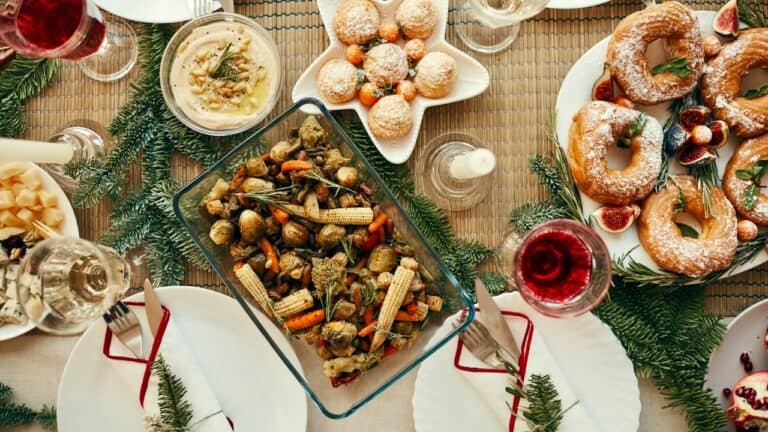
Set the room the day before. None of it needs a hot stove, which makes it the easiest work to move out of the danger hours. A Chinese new year table setting leans red and gold, and Lunar New Year decorations in the same two colours read right from the doorway.
The Table Itself
Red runs the room: a red cloth or runner, red napkins, gold-rimmed serving plates if you have them. Leave the centre of the table clear, because the platters land there and a centrepiece will be in the way by the second course.
Households also hang red lanterns, paste couplets on the door frame, and turn the character fu upside down, and the specific set varies by region. A rundown of Spring Festival couplets, fu characters, and red lanterns explains what each one is for.
- One cloth, one colour: a single red runner reads better than four competing red objects.
- Low light, high count: several small candles or lanterns beat one large arrangement on a table that has to hold eight platters.
- A lazy Susan if you own one: shared dishes get reached for, and a turntable saves the table from a dozen crossing arms.
- Nothing tall in the middle: guests need to see each other across a meal that runs two hours.
Red Envelopes, Counted the Night Before
Envelopes are a task, not a gesture, and they take longer than hosts expect. Count them out on the counter the night before, one per child and unmarried younger guest, with fresh notes inside and a couple spare for the person who brings a cousin.
Who gives and who receives varies by family, and the conventions around amounts are real. A short guide to red envelope etiquette covers the practical questions guests are too polite to ask.
What to Say at the Door
Greetings are the one piece of preparation that costs nothing. Learn two, one for the door and one for the toast, in whichever language your guests use.
TGH keeps a fuller guide to Chinese dining etiquette for hosts for the table conventions, and a rundown of what to say to guests, from gong hei fat choy onward covers the wording itself.
|
Hosting Tip: Brew the Second Pot Before Anyone Sits Down |
Which Drinks Belong on a Lunar New Year Table?
Tea is the answer for most of the meal, with one poured drink reserved for the toast. That single decision keeps a three-generation table drinking together rather than splitting into an adults’ end and a children’s end.
Tea Runs the Whole Meal
Brew a large pot of something plain and keep a second pot going on the counter. Jasmine, oolong, or roasted barley all sit well against fried and salty dishes, and none of them fight the fish.
Set the pot where guests can reach it, and you stay in your chair through the middle of the meal.
One Pour for the Toast
Keep the alcohol to a single shared moment. Rice wine or a small pour of baijiu at the start of the meal does the work of a whole bar, and it keeps the table on the food.
- Pour tea first, for everyone, before any other glass is filled.
- Bring out the toast pour once the fish is on the table, not before.
- Offer a sweet, non-alcoholic option in the same glassware so nobody is drinking from a different set.
- Return to tea for the rest of the meal.
Korean tables answer the same question with sikhye, the sweet rice punch served on Korean holidays, poured as a dessert drink because it is thought to aid digestion.
For a wider view, a host’s guide to drinks by country sets out the same logic across a dozen cuisines.
Serving Day: The Run Sheet From Afternoon to the Last Course
Serving day is short. If the make-ahead work is done, the last three hours are a sequence of small moves rather than a scramble, and the only genuinely timed items are the fish and the noodles.
Write the sheet down, because a schedule held in your head turns into a guess once three people are in the kitchen asking what needs doing.
A set of nine tips for hosting a Chinese New Year feast makes the same case from a cook’s side: plan dishes you can shop for and cook ahead. A dish which reheats well is worth two that do not.
Leave the finished sheet on the counter where everyone can see it, so nobody in the kitchen has to hold the order in their head.
The Last Thirty Minutes
- Fish first, everything else after: it goes into the steamer once guests are seated, and it comes out glossy or it comes out rubbery.
- Noodles second: boil them while the fish rests, and dress them the moment they drain.
- Dumplings in batches: two rounds of twenty beat one round of forty, because the second round arrives hot.
- Nothing new after the fish: anything not already cooked or plated at this point is next year’s dish.
The dishes that cause trouble are the ones that have to be hot at the same minute, and building the schedule around make-ahead recipes for large groups is what shrinks that list to two.
Where Hosts Over-Plan
A frequent overreach is adding dishes to prove effort. A tenth dish costs an hour and earns nothing, because the table was already full at eight.
Others are decorating on serving day, which steals the afternoon the fish needs, and trying to time every dish to arrive at once, when a reunion dinner is served in waves.
|
Keep the Shared Shopping Straight |
Hosting Across the Many Lunar New Year Traditions
The same date is kept by families who would not describe it the same way. Getting that right costs a host nothing and matters to the people at the table.
Lunar New Year or Chinese New Year?
Whether to call the night Lunar New Year or Chinese New Year is a live question, and both names are in use. The distinction, and the reasons people hold it, are set out in a plain comparison of the two names.
The same date is kept as Tet, the Vietnamese Lunar New Year, and as Seollal in Korean households, so Lunar New Year is the name that covers everyone at a mixed table.
One Table, More Than One Tradition
Lunar new year food traditions are not one menu with regional accents. They are separate menus that happen to share a date.
- Korean tables centre on tteokguk, the rice cake soup Koreans eat on Seollal, the bowl served on New Year’s Day.
- Vietnamese tables build around banh chung and banh tet, sticky rice cakes wrapped in leaves and boiled for hours.
- Northern Chinese tables lean on dumplings, while southern tables lean on nian gao and whole fish.
- A guest who keeps one of these will notice immediately whether you asked or assumed.
The practical move is to ask rather than to research. If a guest keeps Seollal, Korean dining etiquette covers the table conventions that come with it, and one question in advance is worth more than any amount of reading.
Adding one dish from a guest’s own new year is a generous move, and asking them to cook it is a better one.
What the Night Looks Like When It Works
The fish reaches the table still glossy. The noodles come out in one length, the envelopes are handed over before coats go on, and you sat down for the meal instead of standing at the stove for it.
Frequently Asked Questions
What foods symbolize good luck at Lunar New Year?
Whole fish, dumplings, long noodles, and spring rolls lead the lucky list. Fish sounds like “surplus” in Chinese, dumplings are shaped like gold ingots, longevity noodles stand for a long life, and golden spring rolls signal wealth. A whole chicken is served too, representing family wholeness and unity.
How long does the Lunar New Year celebration last?
Lunar New Year traditionally runs fifteen days, from New Year’s Eve through the Lantern Festival. The first few days center on family visits and reunion meals, while later days bring temple visits and community celebrations. Workplaces and schools typically close for only three to seven days, even though the full festival continues at home.
Why do families give red envelopes during Lunar New Year?
Red envelopes, called hongbao or lai see, carry money as a blessing for luck and protection in the year ahead. The red color symbolizes good fortune and wards off bad luck, and giving cash in an envelope rather than by hand keeps the gesture polite. Versions of this custom appear across East and Southeast Asian Lunar New Year traditions.
Do you need to wear new clothes for Lunar New Year?
Wearing new clothes isn’t required, but it’s a common way to mark a fresh start for the year. In many Chinese New Year traditions, red or other bright colors are favored, while black and white are avoided because they’re linked to mourning. Customs vary by family, region, and which Lunar New Year culture you follow.
Who traditionally receives red envelopes at Lunar New Year?
Married adults and elders typically give red envelopes to children and unmarried younger relatives as a blessing for the year ahead. Employers sometimes give them to staff, and some hosts include unmarried guests at a reunion dinner. Exactly who gives and receives varies by family and by which Lunar New Year tradition you follow.
Should you clean your house before Lunar New Year begins?
Yes, many households do a thorough clean before Lunar New Year’s Eve to sweep away bad luck from the old year. Once the new year begins, sweeping or taking out the trash is often avoided for the first day or two, since it’s seen as sweeping away the new year’s good fortune.
Continue Reading:
More On Global Holiday Table
- Diwali Party Menu, Decorations, and What to Wear
- Cinco de Mayo Party Menu of Regional Mexican Dishes
- Hanukkah Dinner Menu, from Latkes to Sufganiyot
More from The Gourmet Host
- A History of Communal Dining Experiences (& How To Create Your Own)
- Chinese Dining Etiquette: The Host’s Table Guide
- Drinks by Country (Host’s Guide to 12 Cuisines)
- Make-Ahead Recipes for Large Groups: The 7-Day Chainv
- Korean Dining Etiquette: A Complete Host’s Guide
Explore TGH Categories
- Set the Scene
- Drinks and Bar
- Plan the Meal
- Engage with Guests
- Games and Toasts
- Tools and Techniques
- Why We Gather