How to Host a Crowd: 3 Self-Serve Systems That Hold for Hours
 14 min read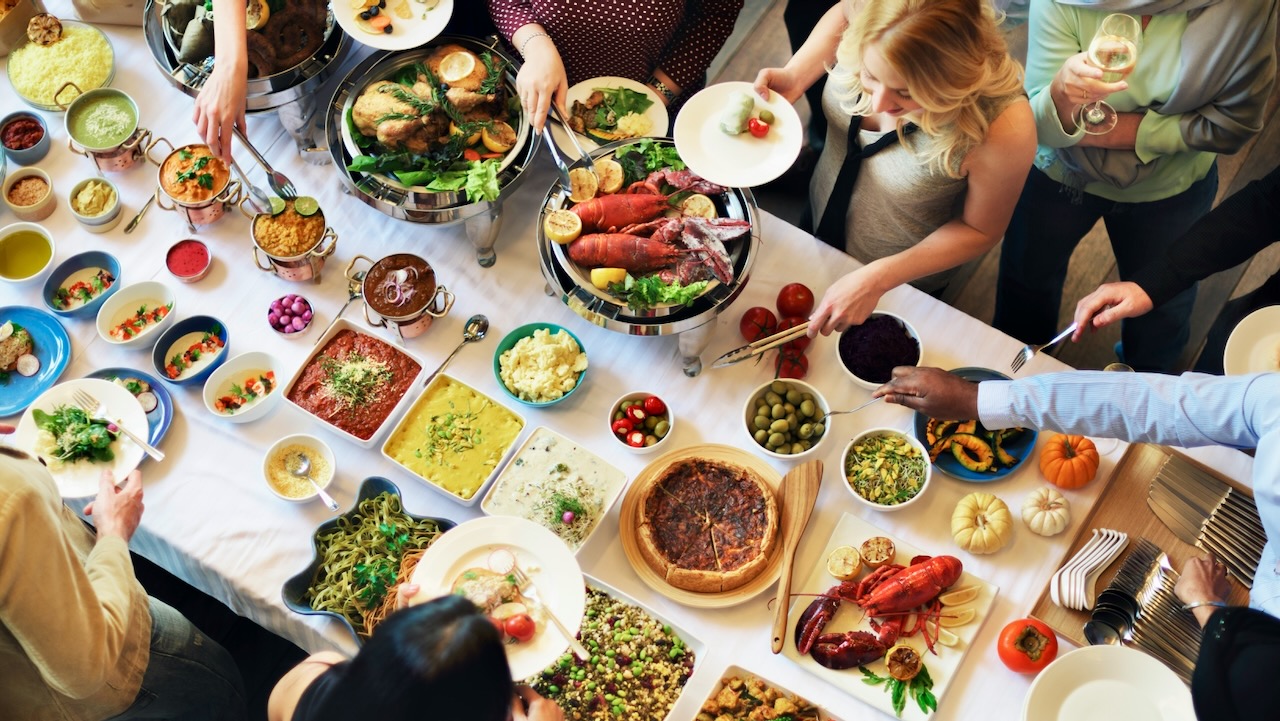
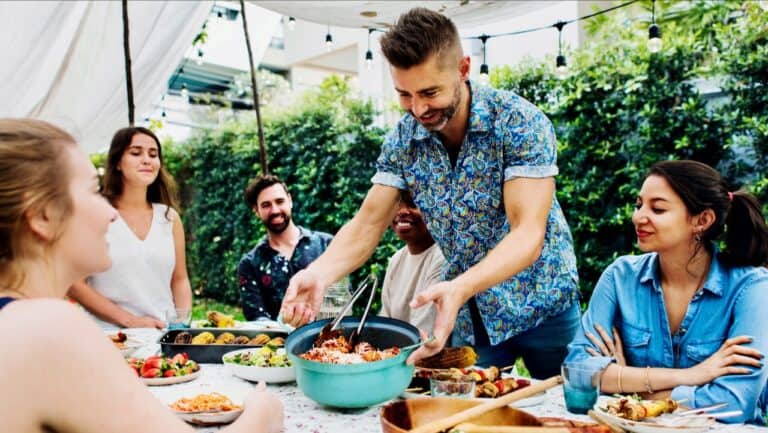
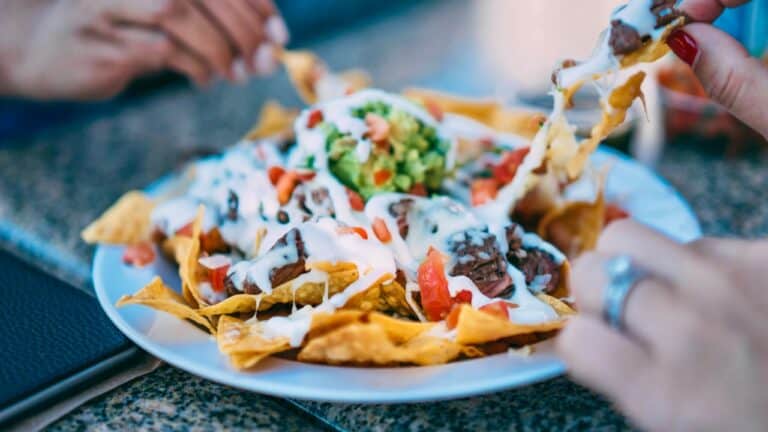
Steam rises off the warmed corn shells the moment the foil comes off, and the line forms before anyone announces dinner. Bowls of seasoned ground beef, shredded chicken, charred peppers, black beans, pico, sour cream, and lime wedges run down the long table in a single confident arc. Guests serve themselves and drift back for seconds; the host is sitting down within twelve minutes of opening the oven.
That image is the answer to almost every large-group meal question hosts ask. There are many large-group-meal listicles that read like Pinterest dumps — 47 random recipes with no structure.
TGH frames the work around three repeatable systems instead: a build-your-own bar, a baking-tray scale-up, and a slow-cooker batch. Each system handles 12, 15, or 20 hungry guests with the same calm cadence — no juggling burners, no apologizing for what’s still in the oven.
At a Glance
- Three repeatable systems — build-your-own bar, baking-tray scale-up, slow-cooker batch — handle large group meals without juggling burners.
- Build-your-own bars (taco, baked-potato, pasta) feed mixed groups with food allergies in one menu, not three.
- A 9×13 baking dish serves 8–10; two trays plus a half-sheet pan cover 18–20 guests on a single oven rack.
- The 1 main : 2 sides : 1 starch : 1 green ratio reads more abundant than stacking mains, at lower cost per person.
- Slow cookers and chafing dishes hold quality safely for two hours; the FoodSafety.gov rule starts the clock when food leaves heat.
What Are Large Group Meals?
Large group meals are the meals you cook when 12, 15, or 20 people are coming to dinner — meals that scale up cleanly, hold their quality across hours, and feed a crowd without three different burners running at once. The hosting challenge is not finding more recipes; it is finding repeatable patterns that survive the trip from a normal kitchen to a full table. Unlike a weeknight family dinner, a large group meal trades chef-style flourish for a system that runs the same way every time you use it — which is exactly why the same hosts keep getting asked to host.
Three Systems That Make Large Group Meals Work Every Time
The shortcut to stress-free entertaining for large groups is not a longer recipe list. It is choosing one of three formats and committing to it for the whole menu. Each of these systems is a hosting habit, not a one-night recipe — once you run it twice, the pan sizes, prep timing, and shopping list move into muscle memory.
Editorial collections of 23 inexpensive meals for large groups from Camille Styles and feed-a-crowd recipes from BBC Good Food cover dozens of dishes, but read them carefully and the same three structures keep surfacing: a self-serve bar, a single big tray that comes out of the oven hot, and a slow-cooker pot that has been working all afternoon.
The systems work because they shift the bottleneck off the host, and they keep easy recipes inside reach instead of pushing menus toward chef-tested complexity.
How the three formats divide the work
- Build-your-own bar: one base + multiple toppings (taco bar, baked potato bar, pasta bar). Feeds groups with food allergies and picky eaters in one menu instead of three.
- Baking-tray scale-up: one or two large baking dishes (9×13 casserole, half-sheet pan dinner) that come out of the oven serving 8–10 portions each. Best when you want a hot main course with a single point of failure.
- Slow-cooker batch: one or two crock pots loaded by 11 a.m. holding chili, pulled pork sandwiches, taco meat, or a hearty meal of stew. Best when you also want the kitchen quiet during the gathering itself.
The system you pick determines the rest of the planning chain — pan sizes, shopping list, side dishes, holding strategy. Matching the format to the gathering matters more than picking the right main dish.
Our piece on main course ideas that wow dinner party guests walks through how mains anchor smaller gatherings; for large group meals the anchor flips to format, with the main following from the format choice rather than driving it. That inversion is what stops the host from having to perform thirty pieces of beef in one window.
Once the format is locked, the next question is which one to default to first — and the build-your-own bar earns the spot for almost every host.
|
Keep This Party Plan Together |
Build-Your-Own Bars: The Hosting Pattern That Disappears the Work
A build-your-own bar — taco bar, baked potato bar, pasta bar, pork sandwiches with three sauces — solves the hardest part of feeding a crowd: getting hot food in front of 15 people simultaneously. You stop performing thirty plates; the line performs itself.
Thriving Home’s collection of 20 easy meal ideas for groups builds half its menu around this pattern, and Good Cheap Eats’s guide to building a sandwich bar on a budget breaks down the math: one base, six toppings, and a posted serving order. Don’t Waste the Crumbs leans on the same structure for feeding a crowd on a budget — it scales linearly, accommodates dietary differences, and holds price-per-person under control without anyone noticing.
Three bar templates that work every time
What makes the bar format actually work is the topping count and the staging order, not the base. Aim for one warm protein, one cool protein or vegetarian option, four to six toppings (something crunchy, something acidic, something creamy, something fresh), and one starch or wrap. Set them in serving order so guests build left-to-right without backtracking.
- 1. Taco bar — seasoned ground beef with chili powder, shredded chicken, charred peppers, black beans, pico, sour cream, lime wedges. Crisp taco shells and small flour tortillas at the start of the line.
- 2. Baked potato bar — 18–20 russet potatoes baked at 400°F for 60 minutes, then held in a warm oven; sour cream, butter, chives, bacon bits, chili, broccoli, cheese. Naturally vegetarian-friendly.
- 3. Pulled pork sandwiches — slow-cooker pork shoulder shredded into a deep pan, three sauces (sweet, smoky, vinegar), small buns, slaw, pickles. Holds for hours without quality loss.
Why it solves the food-allergy problem
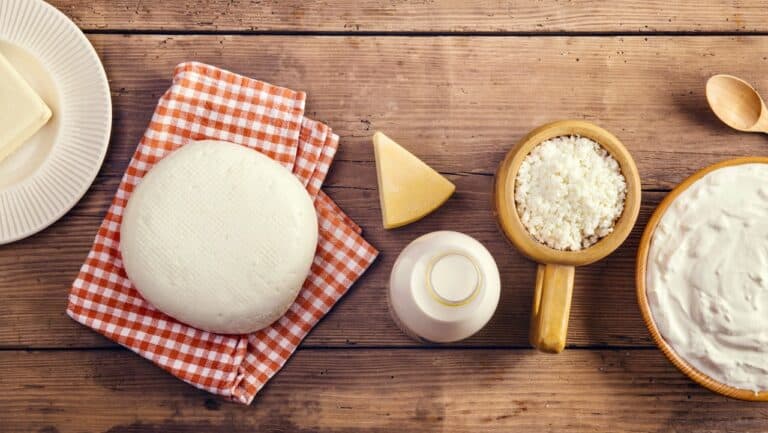
Food allergies and dietary restrictions disappear into a bar format because the guest does the assembly. There is no wrong combination, no awkward request to skip the dairy, no shadow menu cooked separately — just one base + a clearly labeled topping line.
If you want a deeper take on potluck logistics for the same audience, our piece on 10 potluck ideas for a crowd maps directly onto the build-your-own bar pattern. The bar format is what makes large group meals feel less like catering and more like a confident, friendly party.
When a build-your-own bar is not the right fit — when guests expect a single hot main rather than a self-serve line — the next two systems carry the menu instead.
|
Hosting Tip: Set the Next Decision Early |
Baking-Tray Scale-Up and Slow-Cooker Batch: The Two Cooking Methods That Hold for Hours
Two cooking methods carry almost every reliable recipe for a hosted crowd: a large baking dish loaded the day before, or a crock pot loaded the morning of. Both reward make-ahead prep and both buy the host hours back on the day of the gathering. Each scales the simple meal logic of easy weeknight dinners up to 12, 15, or 20 plates without rebuilding the menu from scratch.
Taste of Home’s roundup of 47 dinner recipes that feed a crowd skews almost entirely to baked casseroles and braises for that exact reason — they hold heat and flavor without supervision. Love and Lemons — 25 crowd-pleasing party food ideas extends the same pattern to vegetarian-friendly mains and sides that bake or slow-cook at scale, and Thriving Home’s 20+ tested crock-pot recipes confirm the scaling math from a recipe creator’s testing kitchen.
Pan-size scaling that actually works
A 9×13 baking dish — sometimes called a large baking dish in older cookbooks — holds 8–10 portions of any layered casserole, baked ziti, lasagna, or enchiladas. A half-sheet pan (13×18) holds 10 portions of a one-pan dinner like sheet-pan fajitas, a tomato-sauce-based bake spaghetti, or roasted chicken thighs with vegetables. For 18–20 guests, two 9×13s side by side cover the main; one half-sheet pan handles a side.
- 1 × 9×13 baking dish: feeds 8–10. Examples: baked ziti with tomato sauce, lasagna with sour cream layer, chicken-and-rice casserole, enchiladas with red onion and green onions on top.
- 1 × half-sheet pan (13×18): feeds 10. Examples: sheet-pan fajitas with chicken breast and bell peppers, baked salmon, sausage and roasted vegetables in olive oil.
- 2 × 9×13 + 1 × half-sheet: feeds 18–22. Same oven rack at 375°F covers both casseroles plus the side, with 10 minutes of staggered timing.
Slow-cooker batch math
A standard 6-quart slow cooker holds enough chuck roasts, ground beef chili, or stew for 10 servings; an 8-quart holds 14–16. Two crock pots (chili in one, taco meat or easy chicken pulled into pulled pork in the other) plus a tray of cornbread covers a hearty meal for 20.
A 5-pound whole chicken roasted at 375°F until the skin runs golden brown and the juices clear is a parallel anchor — pulled and held warm, it feeds 8–10 the same way as a big batch of carnitas. The crock pot’s keep-warm setting holds at 165°F for about two hours after cooking — long enough for a buffet line to move through twice.
Both methods earn their place because they decouple cooking time from serving time. Our breakdown of family-style dinner wedding meal ideas borrows from the same playbook — casseroles and crock pots reward a host who plans backward from serving time.
With a system locked in, the planning question that most hosts get wrong next is the ratio of mains to sides — and getting that ratio right matters more than the dish itself.
|
Share Every Hosting Task Clearly |
What’s the Right Mains-to-Sides Ratio When You’re Cooking for a Crowd?
The ratio that holds across almost every party menu is one main, two sides, one starch, and one something-green. More sides — not more mains — is the move that reads abundant on the table without doubling the host’s work. This is the question most large group meal listicles answer poorly or skip entirely, which is part of why so many crowd dinners cost too much for what they show up as.
Budget Bytes — 30 party food ideas with cost-per-serving and Good Cheap Eats’s 15 budget-friendly potluck meals both show how a single complete meal anchored by one main and three sides comes in well below the cost of a two-main menu that ends up with leftover protein.
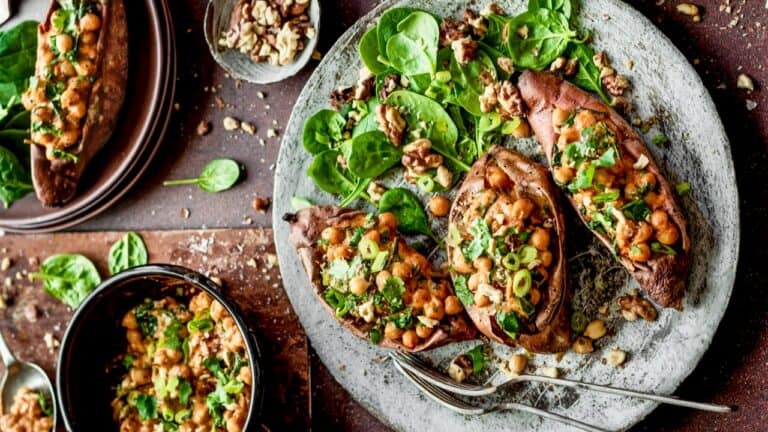
Side dishes in this format do the heavy lifting: a green salad with crème fraîche dressing, garlicky shrimp on a tray, roasted carrots in olive oil and chili powder, or a simple ingredients tray of cherry tomatoes, fresh herbs, and crusty bread.
The 1 : 2 : 1 : 1 plate template
- 1 main: a baked ziti, slow-cooker carnitas, or pulled pork as the single anchor that everyone tries.
- 2 sides: one warm vegetable, one cold salad. Vary texture and temperature so the plate reads composed.
- 1 starch: a tray of cornbread, a basket of crusty bread, or a large serving bowl of seasoned rice or potatoes.
- 1 green: greens with a sharp vinaigrette, roasted broccoli with red onion, or a charcuterie-style tray of fresh herbs and pickles for visual lift.
A vegetarian option lives inside the sides — bean chili in a small pot, a sweet potato bake, or a portabella mushrooms tray — without forcing a parallel menu. Special occasions and large family gatherings are also where this ratio earns its keep: it scales linearly without breaking, because more sides cost less per person than more mains.
Food safety and the two-hour rule
FoodSafety.gov’s two-hour rule is the constraint that locks the rest of the plan in place. Cold sides need an ice bath if they sit out longer than two hours; hot sides need a chafing dish, a warm oven on 170°F, or the slow-cooker keep-warm setting. Replenish in batches from the kitchen rather than putting the full quantity out at once, and the buffet stays both food-safe and visually full from start to finish.
Our dinner party planning checklist covers this ratio for smaller numbers; the math does not break at 20 guests, it just gets more important. If your crowd menu also needs an opening course, the same logic carries over to dinner party appetizers your guests will love — pick one platter and one warm bite, not five competing options.
Hold the ratio, hold the system, and a large group meal lands cleanly without anyone in the kitchen on their hands and knees looking for another tray.
Frequently Asked Questions
What’s the best one-pan meal that scales to 15+ people without me losing my mind?
Baked ziti in two 9×13 dishes is the safest one-pan answer for 15+. Each pan serves 8 to 10 of the layered tomato-sauce-and-mozzarella main, holds in a warm oven for 30 minutes after baking, and pairs with a green salad and bread. Sheet-pan fajitas (chicken breast plus bell peppers) work just as well at the same scale.
How do I feed a crowd with food allergies or dietary restrictions without cooking three different meals?
Run a build-your-own bar: taco bar, baked-potato bar, or pasta bar. The base is one dish; the toppings are six clearly labeled bowls, including a vegetarian option and a dairy-free option. Guests assemble what they can eat. You cook one menu, not three, and dietary differences solve themselves in line.
What’s the right ratio of mains to sides when cooking for a large group?
Aim for one main, two sides, one starch, and one something-green. More sides, not more mains, reads abundant on the table without doubling the host’s work or per-person cost. Vary temperature and texture across the sides so the plate composition feels intentional rather than random and overstuffed.
How long can I leave food out at a buffet before it becomes a food safety problem?
FoodSafety.gov’s two-hour rule applies the moment food leaves heat or refrigeration. Hot dishes need a chafing dish, a 170°F warm oven, or a slow-cooker keep-warm setting; cold dishes need an ice bath underneath the bowl. Replenish in small batches from the kitchen rather than putting the full quantity out at once.
Can I cook the meat the day before and still have it taste fresh when I serve it the next day?
Yes for braises, stews, and pulled meats: chili, pulled pork, slow-cooker chicken, beef stew. They taste better the next day as flavors meld. Skip make-ahead for steaks, grilled cuts, and crisp-skin chicken; their texture suffers in storage. Reheat braises low and covered with a splash of stock added back in.
How do I keep food warm for hours when I’m hosting a large group without a warming drawer?
Three reliable options: the foil-and-cooler trick (wrapped pan in an empty cooler holds 60 minutes), the oven-on-warm trick (170°F holds 90 minutes for casseroles), and the slow-cooker keep-warm setting (about two hours at 165°F). The slow cooker holds quality longest for braises and stews; the warm oven works best for baked dishes.
Continue Reading:
More On Cheap Family Meals & Crowd Cooking
- Cheap Easy Meals for Family on a Budget
- Easy Meal Ideas for 10 People at Home
- Easy Meals for 20 People to Feed a Crowd
- Recipes for Large Groups Make Ahead Dinners
More from The Gourmet Host
- White Wine Food Pairings: A Host’s Guide to the Perfect Match
- Graduation Party Centrepiece Ideas to Celebrate
- 6 White Wine Substitutes for Cooking Beyond Vinegar
- Coed Baby Shower Ideas: Tips for Fun Couples Showers
- Small Group Icebreaker Questions That Spark Real Talk
Explore TGH Categories
- Set the Scene
- Drinks and Bar
- Plan the Meal
- Engage with Guests
- Games and Toasts
- Tools and Techniques
- Why We Gather