Easy Meals for 20 People That Survive Real Ovens
 16 min read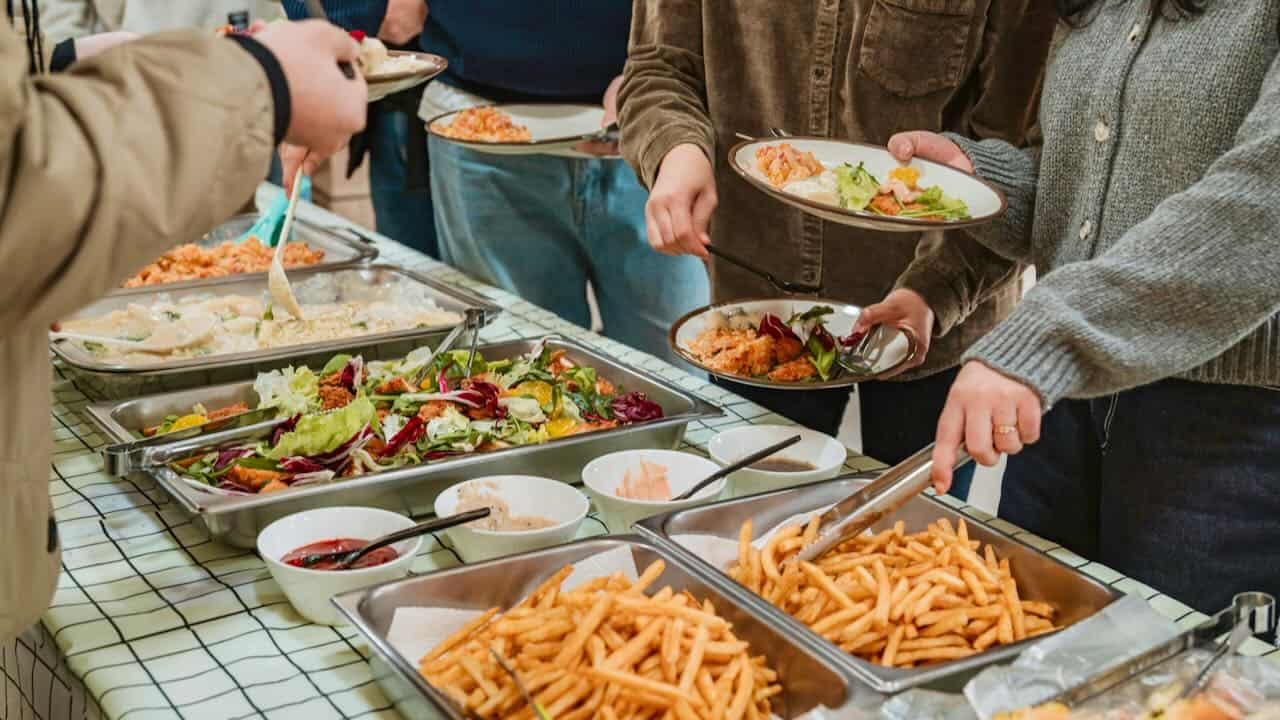
Doubling the recipe is the worst advice in cookbook history for crowds of twenty. The math looks innocent on paper — sixteen servings becomes thirty-two, four pounds of chicken becomes eight, one pan becomes two. The math is fine. The kitchen is the problem. At the twenty-guest mark, oven capacity, refrigerator shelf space, holding time, and the choreography of plating all hit walls that simply do not exist when you are cooking for eight.
Most crowd-cooking roundups skip past this. They list easy meals scaled to serve thirty in a single line of italics, as if a 9×13 casserole containing eight servings and a 9×13 containing fifteen are the same dish. They are not.
The menu that works for twenty is built backward from your kitchen — its oven count, its fridge clearance, its counter inches — and only then does the recipe selection happen. Order of operations is everything.
At a Glance
- Plan from constraints first, recipes second — measure your oven and fridge before choosing what to cook for 20 guests.
- Doubling a recipe rarely scales linearly; sauces, doughs, and pasta water all break in predictable ways past a 1.5× multiplier.
- Modest per-head budgets work for a casual feed-the-crowd meal; sit-down dinners with multiple side dishes demand more — but TGH’s structural choices keep both well below recipe-blog assumptions.
- Build the timing chain backward from service time — anchor dish, cold sides, reheat windows, and a 20-minute buffer for late arrivals.
- Buffet flow lives or dies on plate placement; one-way traffic and a separate dessert station prevent the kitchen bottleneck.
- A shadow main — a deployable backup like premade lasagna or rotisserie chicken sliders — turns a failed dish into a non-event.
What Are Easy Meals for 20 People?
Easy meals for 20 people are dinner formats that scale cleanly through the bottlenecks of a home kitchen — one oven, one refrigerator, one counter — without forcing the host into a frantic two-hour finale. The real challenge at this guest count is not finding a recipe that “feeds a crowd” but sequencing one main dish, two or three sides, and a dessert so they all reach the table at temperature without colliding for oven space at 6:45 pm.
Unlike weeknight cooking for a family of four, a crowd menu has to absorb late arrivals, reheat windows, and serving logistics that most published recipes never test against.
Why Doubling the Recipe Quietly Fails at 20 Guests
At eight servings, almost any home recipe survives a 1.5× scale-up. The oven holds the casserole, the pasta pot fits the noodles, the salad bowl absorbs the dressing. Move to twenty servings and the failure modes start stacking — most invisible until the food is already in the pan. The problem is not arithmetic. It is physical capacity, heat distribution, and how flavor compounds redistribute through a larger volume of ingredients.
A 9×13 lasagna serves eight to ten people generously. For twenty, the conventional fix is two pans. That sounds fine until you realize a standard home oven holds two 9×13 pans only if you stack them on different racks, which means staggered cooking times and an internal temperature differential of fifteen to twenty degrees between the two. One emerges bubbling; the other emerges lukewarm in the center. The recipe author who wrote “double for a crowd” almost certainly never tested it in a thirty-inch single-oven kitchen.
The four scale-ups that break first
- Pasta water salt ratio: the standard one tablespoon per gallon does not double — at six gallons of water you are already past the saturation point your taste buds register, and pasta tastes oversalted before the tomato sauce hits.
- Yeast dough hydration: flour absorbs water in proportion to surface area, not volume. Doubling a pizza dough almost always leaves you with a batter, not a workable dough.
- Baking-powder leavening: chemical leaveners scale to volume, not depth. Cake batters baked in oversized pans rise unevenly and crater in the middle.
- Emulsified sauces: hollandaise, beurre blanc, mayonnaise — anything with whisked fat — breaks at 1.5× scale because the whisk size and bowl curvature stop matching the volume.
The fix is not to abandon your favorite recipes. It is to choose dishes that scale linearly and reserve doubled-recipe execution for items where the math holds up — braises with chuck roasts, soups, marinated proteins, sheet-pan vegetables tossed with olive oil. A guide to stretching a meal when extra company shows up captures the underlying principle: identify the dishes that absorb additional guests gracefully, then build the menu around those, not against them.
Cost behaves the same way. A per-person reasoning approach to cheap dinners for company makes the case more directly than recipe-first lists do — when you start from a budget per head and work outward to ingredient choices, you avoid the trap of doubling the original ingredient list into an oversized grocery run that still has structural gaps.
That mental shift, from recipe-first to constraint-first, is the unlock for cooking for twenty.
Most twenty-person dinners happen during the holidays, when the guest count expands from a regular Sunday dinner of eight to a full extended-family gathering — TGH’s holiday dinner party planning guide on menus, budget, and timeline walks through that scaling jump in detail. With recipe-doubling out of the way, the next gate is your kitchen itself.
|
Plan Your 20-Person Menu in One Place |
Map Your Kitchen’s Real Capacity Before You Write the Menu
Before a single recipe gets chosen, the menu for twenty has to clear three physical tests — oven space, refrigerator clearance, and counter inches for plating. Most home kitchens fail at least one of them, and the place to discover that is not at 5 pm on the day of the dinner. Take five minutes the week before to measure what you have to work with.
A standard thirty-inch home oven gives you about 23 inches of usable rack width and two functional racks (the third lives too close to the broiler element to use for anything but warming). That is two 9×13 pans on a single rack, OR one half-sheet pan (13×18) and one 9×13 if you stagger them. Not three 9×13 pans. Not a half-sheet plus a Dutch oven or a cast iron skillet.
The three measurements that change your menu
- Usable oven width — measure inside the oven, not the exterior. Subtract two inches for safe airflow on each side. This is the real number for pan planning.
- Empty fridge shelf inches — clear at least one full shelf forty-eight hours before service. Two shelves if you are pre-prepping a salad and a dessert that both need overnight rest.
- Counter run for plating — you need eight to ten linear feet of clear counter at service time. Most home kitchens have six. The cooler-on-the-floor trick recovers the difference temporarily.
Refrigerator space is the second hidden bottleneck. Cooking for twenty means at least one full shelf cleared for prepped ingredients, raw proteins, and cold sides like potato salad or marinated grain bowls that need to chill overnight. A single 9×13 of pasta salad takes nearly half a fridge shelf on its own. Most grocery stores stock the staples this menu needs in big-pot quantities, but the storage problem hits the moment you get home.
A food ideas approach for feeding a large group that emphasizes simple sides over showy mains is not a stylistic preference — it is a math problem. The fewer your sides need oven time, the more your anchor dish can occupy the oven undisturbed for ninety minutes. The same logic applies across all large groups, from milestone dinners to weeknight crowd cooking. That single trade-off shapes the next decision: what to cook.
Build the Menu Backward From the Constraints
Once your oven, fridge, and counter are mapped, the menu starts writing itself. You are not choosing a hero recipe and forcing it into your kitchen. You are starting from “I have one oven, one cleared fridge shelf, and six feet of counter” and asking what twenty-person menu fits inside those numbers without surprises.
The cleanest formula at this guest count is one anchor protein that holds well, two large sides (one cold, one warm), one starch, one bread, and a dessert that can be assembled the day before. That is six dishes total. Three of them — the cold side, the bread, and the dessert — should require zero oven time on service day.
Crowd-pleasing dishes that scale predictably
- Braises with chuck roasts: short ribs, pulled pork, or beef stew in a big pot — all hold for hours, all benefit from overnight rest, all serve twenty from a single Dutch oven or roasting pan.
- Pan pasta with tomato sauce: lasagna or baked ziti with ground beef — two 9×13 pans fit one oven rack, and the pasta sauce tastes better after twenty-four hours of melding.
- Whole chicken shortcut: three rotisserie chickens together cost less than one premium whole bird, scale better, and free the oven entirely.
- Sheet pan recipe: fajitas or chicken thighs with red onion and bell peppers — one half-sheet feeds ten to twelve, two staggered halves cover twenty with a single oven cycle.
- Taco bar / build-your-own bowls: cayenne pepper and chili powder for the spicy flavors crowd, sour cream and lime for the mild crowd — naturally accommodates various diets, scales linearly, and shifts plating labor to the guests themselves.
The anchor dish carries the most risk. A 20-person dinner party menu prototype that pairs slow-braised short ribs with a make-ahead grain salad and a baked-the-night-before tart works because every component except the rib reheating is already done by 5 pm.
Compare that to a roast turkey approach, where the centerpiece dominates the oven for four hours and pushes every side dish into a slow cooker. Slow cooker carnitas is the exception that proves the rule — it cooks itself overnight while the oven stays free.
Side dishes follow a parallel logic. Instead of three hot sides competing for stovetop burners, build around one warm side (green beans tossed with olive oil and garlic, or roasted potatoes) and two cold ones (a charcuterie board with fresh fruits like cherry tomatoes, plus a grain salad).
Seasonal summer meals for a crowd lean on this pattern almost exclusively because outdoor entertaining forces the kitchen to do less. The next question is when each of these dishes needs to start.
A milestone twenty-person dinner — a fortieth birthday, a graduation, an anniversary — uses the same architecture as any large family gathering, and TGH’s birthday party planning checklist for hosts shows how the host’s timeline gets compressed when a celebration is layered on top.
That timeline is what the next section breaks down hour by hour.
|
The Anchor Dish Should Finish Cooking Two Hours Before Service A braise pulled from the oven at 5 pm for a 7 pm service is not late — it is on time. Slow-cooked proteins benefit from a forty-minute rest, redistributing their own juices and reaching a serving temperature that holds for the full meal. The host who plans the anchor to come out at 6:55 pm is the same host frantically slicing something steaming hot at 7:05 while guests stand in the dining room. Pull early, rest covered, slice or shred warm. The two-hour gap is the move that makes everything else feel relaxed. |
The Reverse-Timeline Cooking Chain for 20 People
Every well-run dinner for twenty has the same shape under the surface — a reverse timeline that starts at service hour and works backward through forty-eight hours. The home cook who feels relaxed at 7 pm did the work between Thursday afternoon and Saturday morning. The home cook sweating at 7 pm started at noon Saturday.
Build the timeline the way professional kitchens do: anchor on service time, then place each dish at the latest moment it can begin without missing the table. Most amateur menus front-load the day-of cooking; a constraint-built menu spreads it across three days, with each window doing only what it can do.
A 20-person timing chain, anchored at 7 pm service
- T-48 hours (Thursday) — shopping list finalized, two grocery-store trips planned. Marinated proteins start their brine. Stock or sauce base goes on for any braise; flavor melding happens overnight, not in the final hour.
- T-24 hours (Friday afternoon) — cold sides assembled and refrigerated, dessert baked, bread shaped if homemade. Anything that “tastes better the next day” gets cooked now.
- T-6 hours (Saturday 1 pm) — anchor dish goes in. A four-hour braise plus a forty-minute rest plus a thirty-minute reheat lands at 6:30 pm. Salad components prepped, dressings made, table set.
- T-90 minutes (5:30 pm) — cold sides plated, bread sliced, charcuterie board assembled if serving as appetizer. Drinks station stocked with orange juice for the kids and wine for the adults. Last fridge edits.
- T-30 minutes (6:30 pm) — anchor reheating, warm side in oven, candles lit, serving spoons placed. Host changes clothes. The kitchen should be quiet.
- T-0 (7 pm) — plating happens, guests sit, doorbell stops ringing. Anyone arriving in the next twenty minutes lands a plate identical to the one served at 7:00.
A big-batch playbook with freezing instructions extends this further — the same reverse-timeline thinking applied across a full week, with proteins frozen at T-7 days and thawed at T-2. For twenty people, that level of advance prep is rarely necessary; for thirty or forty, it becomes the only way to keep one home oven viable for the whole family.
Holiday hosting concentrates this challenge. Chef-tested holiday party recipes default to dishes that survive a long hold — braises with warming spices, dips, bakeable proteins like a glazed ham — precisely because they absorb the timing slippage that always happens when twenty people are arriving at once. Steady-state cooking, not last-minute heroics, is the move for special occasions and large family gatherings alike.
Hosting twenty also means thinking about how guests are received — TGH’s dinner party etiquette for hosts covers the side of the night the timing chain alone cannot solve. Once the cooking is sequenced, the next physical question is how all those people move through your kitchen at 7 pm.
|
Get a 20-Person Menu in Your Inbox Every Sunday Dinner Notes is the weekly TGH newsletter for hosts cooking past their comfort zone. Each issue lands one tested menu — anchor dish, sides, timing chain, shopping list — sized for ten to twenty guests. No paywall, no sponsored picks, no “27 recipes you have to try” filler. Just one menu, fully built out, ready to scale to your guest count. Subscribe to Dinner Notes for one menu a week, sized for the crowd at your table. |
How Do You Keep a Buffet Line Moving Through Your Kitchen?
Plated service for twenty is technically possible and almost never worth it. The plates take counter space you do not have, the food cools while the last three are assembled, and guests stand around waiting for the host to finish. A buffet line solves both problems — but only if the line is designed for one-way traffic and the dish geometry moves people through.
The single most important decision is where the plates go. Plates and silverware at the start of the line force every guest into the same starting point and prevent the back-and-forth that creates the kitchen bottleneck. Drinks and dessert (think ice cream sundaes for the kids, coffee for the adults) get their own surface — a dining room sideboard or a separate kitchen island corner — so guests circle back without re-entering the queue.
The five rules of a moving buffet line
- Plates and silverware first: every guest starts at position one; nobody backtracks for a fork.
- Anchor protein second: the largest dish, often a main course like braised beef or chicken wings, anchors the meal mentally and physically.
- Sides in single-file order: the most labor-intensive serving (the salad tongs, the lasagna spatula) goes where the line widens to absorb the slowdown.
- Sauces and condiments last: position six is the last station before the table — nobody holds up the line debating ranch versus vinaigrette.
- Dessert and coffee elsewhere: a completely separate surface, accessed after dinner, removes the second-trip-back from the main line entirely.
A milestone-dinner menu structure for twenty guests typically illustrates this exact pattern, even when the article is framed around a birthday — the underlying logistics are identical for dinner parties, milestone birthdays, and large family gatherings. Mains go in the deepest serving dishes (think pasta shells stuffed with ricotta, or a deep stew), sides in shallow ones, and any condiment or topping bar lives at the end of the line.
Food safety is the silent constraint on every buffet. The two-hour rule from FoodSafety.gov applies to anything sitting at room temperature — past 120 minutes, cooked food at 40°F to 140°F enters a danger zone that no amount of attractive plating will fix. For a 7 pm service that lingers until 10 pm, hot dishes need a chafing dish or a 170°F oven hold, and cold dishes need an ice bath or steady fridge rotation. Set the timer when the first plate hits the line; rotate or remove dishes at the 90-minute mark to give yourself buffer.
The buffet line is also where modern hosting etiquette shows up most visibly to guests — what they see and feel as they move through your kitchen at 7 pm. With the line and the food safety figured out, the only question left is what happens when the plan does not hold.
When the Plan Holds — and When You Reach for the Backup
Even a kitchen-mapped, reverse-timed, buffet-optimized menu for twenty has one failure mode the plan cannot eliminate: the anchor dish itself going wrong. The lasagna burns. The brisket comes out tough. The sheet-pan chicken is somehow underdone in a way that requires another forty minutes — and you do not have forty minutes. This is where the shadow main earns its keep.
A shadow main is a deployable backup — a frozen lasagna in the freezer, a pre-ordered tray of slider sandwiches, a pickup-able rotisserie chicken platter from a nearby supermarket — that can hit the table within ninety minutes without explanation. Most experienced crowd cooks do not call it that, but the principle is universal: at this scale, the cost of a backup is far lower than the cost of a failed centerpiece. (TGH’s guide to hosting memorable dinners makes the same case from a guest-experience angle — the host’s composure matters more than the original menu.)
Three deployable backups for the 20-person table
- A second tray of frozen lasagna kept in the chest freezer year-round — thaws in three hours at room temperature, bakes covered for forty minutes, never once tastes like a backup. Add a side of microwaved green beans and the meal looks intentional.
- Rotisserie chickens from a supermarket open until 9 pm — a phone call, a fifteen-minute drive, three birds together yield sixty servings of pulled chicken sliders. Every crowd pleaser comes pre-cooked.
- A standing order with a local trattoria for half-trays of pasta with sauce and a tray of meatballs — pickup possible in forty minutes, feeds fifteen, costs less than the wine you already poured.
Budget logic supports the same conclusion. An emergency rotisserie order runs in the low double-digit percentage of that grocery budget, an insurance premium against the full menu collapsing.
The cost math behind cooking for twenty
- USDA cost-of-food-at-home plans anchor weekly grocery spending for a four-person family across the Thrifty, Low-Cost, Moderate, and Liberal tiers — meaning a 20-person dinner on a casual budget runs equivalent to roughly one week of family-of-four groceries on a moderate plan.
- A modest shadow-main budget runs 10 to 20 percent of total spend — the same percentage range a restaurant would charge as a deposit, and worth considering as your insurance line.
The math is unforgiving but predictable — exactly the kind of constraint a planner can work with for everything from easy weeknight dinners to easy dinner party recipes scaled up.
A 30+ easy holiday dinner ideas approach illustrates the principle implicitly: every easy recipe that survives across multiple holiday articles absorbs a slipped timeline or a swapped ingredient. Cooks who feed twenty repeatedly are not the ones who execute heroic last-minute fixes; they are the ones whose plan never required heroics.
Frequently Asked Questions
Plan on at least one full-size oven (thirty inches, two functional racks), one completely cleared fridge shelf for cold staging, and a spare cooler with ice for overflow. Most home kitchens have enough oven space; almost none have enough refrigerator space without forty-eight hours of advance clearing. The cooler covers the gap.
Pasta water salt, yeast doughs, baking-powder leavening, and emulsified sauces all break above 1.5×. The reason is geometry: salt saturates by perception not volume, dough hydration tracks surface area, leaveners scale with depth, and emulsions need a whisk-to-bowl ratio that doubling violates. Braises, soups, and sheet-pan dishes scale cleanly.
Use directional guidance instead of fixed numbers. The USDA cost-of-food-at-home plans (Thrifty, Low-Cost, Moderate, Liberal) anchor what a four-person household spends weekly across budget tiers — apply the corresponding per-head rate for casual hosting, and step up one tier for a more curated sit-down menu. Add roughly 10 percent for shadow-main backups and you have a working number that flexes with your local prices.
Forty-eight hours out: shopping done, brine started. Twenty-four hours out: cold sides, dessert, and bread completed. Six hours out: anchor dish in oven, table set. Ninety minutes out: cold plates assembled. Thirty minutes out: warm sides reheating, host changed. Service at 7 pm with everything already at temperature.
Plates and silverware at the start, anchor protein second, sides in single file, condiments at the end. Dessert and coffee live on a separate surface entirely. One-way traffic with no backtracking. The bottleneck is always the second-trip-back; design that out of the line and twenty people clear in twelve to fifteen minutes.
Keep a shadow main on standby — a frozen lasagna, a pre-known supermarket rotisserie source, or a standing pickup order at a local trattoria. The deploy window is under ninety minutes from realization to plating. Cost runs a small fraction of the overall menu. Treat it as insurance, not failure; experienced crowd cooks always have one.
Continue Reading:
More On Cheap Family Meals & Crowd Cooking
- Cheap Easy Meals for Family on a Budget
- Large Group Meals for Stress-Free Entertaining
- Easy Meal Ideas for 10 People at Home
- Recipes for Large Groups Make Ahead Dinners
More from The Gourmet Host
- Holiday dinner party planning guide — menus, budget, timeline
- Birthday party planning — host’s complete checklist
- Dinner party etiquette for hosts
- Modern hosting etiquette
- Guide to hosting memorable dinners
Explore TGH Categories