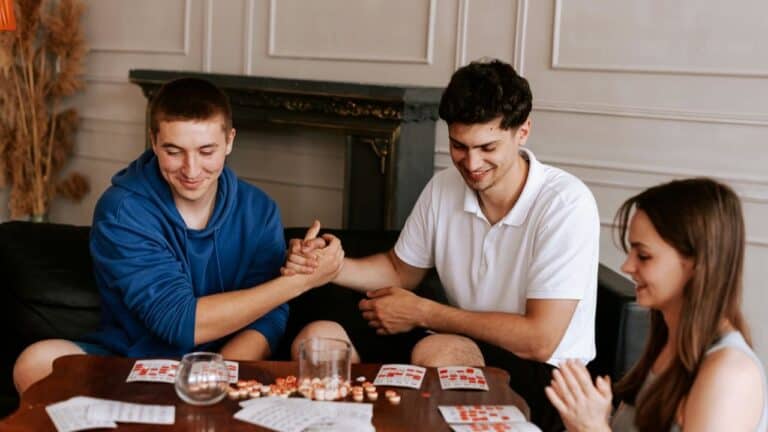
15 Party Games With Cards for Adults to Play Now
 18 min read
Fifteen party games with cards for adults, sorted by the moment in the night you need them, with a one-minute way to teach any of them.
Deal one prompt-and-answer round the minute the third guest walks in, before anyone asks what the plan is, and you have already won the night. A worn deck and one sharp prompt fold everyone in fast, forgive latecomers, and reset in seconds when a round dies.
The move that turns a good host into a great one is small: match the game to the room in front of you instead of to a title you memorized. A sharp deck stalls when it does not fit the room. Get it right and a five-dollar pack outlasts the fanciest board game on the shelf.
The fifteen games below are grouped by the stage of the night they rescue, from the first arrival round to the late competitive stretch, so the right one is always within reach.
At a glance:
- Four to twelve players is the sweet spot for most card and party games.
- Teach any game in under a minute, then run one throwaway practice round.
- Keep each game to fifteen or twenty minutes and switch before energy dips.
- No deck handy? Talk-based party games for adults no materials run on your guests alone.
- Read the room first, then match the game’s tone to the people in it.
Party Games With Cards: The Short Answer
Party games with cards for adults are quick, low-setup games built around a deck or a single prompt, chosen to fit the specific room rather than a best-of list. The best ones teach in under a minute, bring a turn back around fast, and give guests a reason to talk. Run them as a rising curve across the night: light and social early, loud and competitive in the middle, and something everyone plays at once to close, so the room warms up and winds down on purpose.
Size Up the Room Before You Deal
Every good card night starts with a read, not a rulebook. Before you name a single game, look at who is actually in your living room and let that decide the deck.
Hosts stall because they treat game night as a list of titles to memorize. The faster path is to size up the people first, since a quiet table of eight coworkers and a rowdy table of eight old friends want opposite games even though the head count is identical.
Run the Read in Three Questions
Run the read in three quick questions and the right game almost picks itself:
- Who and how close: count the players and gauge whether they are close friends or near-strangers, since that sets how bold a prompt deck can be.
- What is on the table: check your space and props, because cups, balloons, and paper open up games a bare table cannot.
- How loud already: read the mood in the room, then match the game’s energy to it instead of fighting it.
Those answers point you at a game far more reliably than a best-of ranking can, because a ranking cannot see your specific room. For a raw idea bank to draw from, roundups like Best Party Card Games and this list of Great Card Games for All Occasions hand you names, and the read tells you which name to reach for.
One rule keeps every choice safe: open low-pressure and escalate slowly. Start with a game a latecomer can join mid-round, then move to the competitive ones once the room has warmed up.
The read beats a ranking because a ranking optimizes for the average party, and your party is never the average one. A game that tops every list can still die in a room that is too new to each other for its prompts, so trust the people in front of you over the crowd’s favorite.
If you want quiet guests talking before the cards even come out, our guide to Icebreaker Questions for Kids That Get Everyone Talking adapts cleanly to a grown-up table.
Teach a Card Game in Under a Minute
The fastest way to kill momentum is a five-minute rules lecture while everyone’s drink goes warm. A game that takes longer to explain than to play loses the room before the first round.
Teach the whole thing in three sentences and let the fine print sort itself out as you go:
- State the goal in one line, so players know what winning looks like.
- Show how a single turn works, then hand the next turn to the person beside you.
- Name the one way the game ends, and start dealing before questions pile up.
Then run one throwaway practice round where nothing counts. That round catches the rule nobody understood and lets a nervous guest make a harmless mistake, so the real game starts with everyone playing instead of asking.
The practice round works because it moves the learning off the host and into the play. People remember a rule they used once far better than a rule they only heard, which is why one live turn beats another sentence of explanation.
Keep a house rule for what to skip, too. Plenty of party decks ship with a card or two that will not fit your room, so pull them before you deal rather than pausing mid-game to litigate a prompt in front of everyone.
Fifteen Card and Party Games, Grouped by the Night
Each game below lists the players it suits and a one-line way to play. Read the group headers first, then pull the one game that fits the room you just sized up.
Card games that anchor the table
- Prompt-and-answer decks: best for six to ten close friends: everyone fills a cheeky phrase with an answer card and the funniest one wins, and keeping the sharpest cards optional keeps it playful.
- President, also called Scum: best for four to eight: players race to shed their whole hand, the first out rules and the last stays Scum, and the status-swapping is where the trash talk lives.
- Codenames: best for four to eight in two teams: one clue-giver links words on a grid with a single word and a number, and it rewards wordplay across every age at the table.
- Poker for silly stakes: best for five to eight: play for chips that cash out as who does the dishes, so the bluffing stays fun and beginners learn in a hand or two.
- Kings: best for six to twelve: draw a card, follow its rule, and pass the deck, swapping any drinking rules for dares or trivia forfeits so it works for every crowd.
These anchor games reward a deck you already own, and to stock one, Adult Card Games, Card Games, Party Board Card Games, and this reference on Card Games Every Adult Should Know and How to Play Them all point you at the right pack.
No-materials games for when the deck is buried
- Two Truths and a Lie: best for four to twelve: each person states three things about themselves, one false, and the group votes on the lie, which doubles as an icebreaker with zero setup.
- Would You Rather: best for any size: pose two absurd choices and make everyone defend theirs out loud, because the argument, not the answer, is the game.
- The Celebrity Name Game: best for six to twelve in teams: everyone writes famous names on slips, then teams race to guess them across three rounds of describe, one word, and charades.
- Charades: best for six to twelve: act out a movie or phrase while your team shouts guesses against the clock, and it travels across ages better than niche trivia.
These party games for adults no materials are your safety net when the deck is buried, and idea banks like Party Games No Prep and Dinner Party Games for Adults No Materials keep a backup ready.
The reason to keep a no-materials tier at all is that decks go missing and guests arrive in waves. A game that runs on nothing but talk means the night never stalls while someone digs through a drawer for the cards.
They pair well with our roundup of Easy Party Games for Adults That Need No Prep Time for nights when you want zero setup at all.
Bigger-energy games that get people out of their chairs
- Cup-stacking relay: best for eight-plus in teams: race to build and collapse a pyramid of plastic cups and tag the next player, one of the loudest party games with cups for adults you can run.
- Balloon keep-up: best for any size: split into teams and keep a balloon off the floor with hands only, adding a second balloon whenever the room gets too good, an easy balloon party games for adults staple.
- Blindfold guess: best for six to ten: one player is blindfolded and names objects or a partner’s voice by touch or ear alone, a friendly blindfold party games for adults round.
- Wavelength: best for four to twelve in teams: one player nudges a hidden dial between two extremes and gives a clue, and the near-misses spark the best debates.
- Printable trivia rounds: best for any size: hand out free printable party games for adults, run three or four themed rounds, and score on paper, which scales from six guests to thirty.
- Never Have I Ever, card edition: best for six to twelve close friends: read a prompt, anyone it applies to folds a finger, and a loud pass rule keeps everyone comfortable.
For ready-made rounds, our Best Fun Trivia Games for Adults at Your Next Party has printable sheets, and curated lists like Best Selling Party Games and Fun Group Games That Work keep more options on the shelf.
|
Confirm the Table Before Choosing Cards |
Read the Table Mid-Round and Switch Fast
Sizing up the crowd at the door gets you the first game. Reading it mid-round gets you the whole night.
Watch three signals as you play, and each one tells you what to do next:
- Whether people are talking over the game or waiting silently for it, which tells you to switch or stay.
- Whether latecomers are folding in or hovering at the edge, which tells you to restart with something open.
- Whether the laughs land on the group or on one person, which tells you to pull back before it stings.
The switch itself should be quick and unapologetic. When a game peaks, call it, hand out any final points, and move on before the energy sags.
Hosts stall here because cutting a game short feels rude, but the opposite is true. Ending on a high is a gift, and dragging a game to exhaustion is the real rudeness.
Mid-round reading matters because energy is a moving target, not a setting you lock at the door. A group that wanted gentle openers at seven can handle the loudest game in the deck by nine, and the only way to catch that shift is to keep watching while you play.
Keep one no-materials game in your back pocket for the moment a deck runs dry or a new guest arrives cold. A quick round of Would You Rather resets the room in a minute and buys you time to set up the next thing.
Fold In the Guest Who Says No to Games
Almost every gathering has one guest who folds their arms and says they are terrible at games. Push them into the circle and the whole table tenses; leave them stranded and you lose them for the night.
The move is a third option that gives them a job instead of a spotlight. Hand the reluctant player a role that keeps them in the game without the exposure they dread:
- Make them the scorekeeper, so they track points and stay at the center of the action.
- Give them the timer, so they run the clock and feel the pace of every round.
- Let them judge close calls or read clues for a team, which is influence without a turn.
The side-job move works because it swaps performance anxiety for a clear task, and a clear task is easy to say yes to. A guest who would never volunteer to play will happily keep score, and holding a real role in the room almost always thaws the resistance within a round or two.
Watch the reason behind the resistance, because it changes your fix. A shy guest wants a low-stakes on-ramp where everyone answers at once, while a guest who hates losing wants a game with a built-in comeback like President.
Never make the holdout the subject of the group’s attention. Extend the invitation once, warmly, give them the side job, and turn back to the players who are in, because comfort, not pressure, is what pulls a reluctant guest off the sidelines.
|
Hosting Tip: Give Reluctant Guests a Role |
Stock a Shoebox Kit You Can Grab Anytime
You do not need a game closet, but a few basics turn a blank evening into a full night in ninety seconds. Stock it once and hosting stops feeling like an event you have to prepare for.
A kit that fits in a shoebox covers a dozen of the games above:
- Two standard decks: cover President, poker, and any draw-a-card circle without a single specialty purchase.
- One prompt-and-answer deck: handles the cheeky middle of the evening when the room is warm.
- Cups and balloons: unlock the active party games with cups for adults and the balloon rounds when a room needs to get on its feet.
- Paper, pens, and a phone timer: run trivia, the celebrity name game, and honest rounds, plus free printable party games for adults.
Restock the consumables after each party and the decision to play stops being a project. That low friction is the quiet secret behind people who always seem to throw a good game night.
Think of the kit as lowering the activation cost of a good night. Every item you would otherwise hunt for is one more reason to skip the games, so pre-packing the box is really pre-deciding that you will play.
A fixed kit also removes the one thing that sinks most spontaneous nights: the search. When the decks, cups, and pens live in one box by the door, you skip the ten-minute hunt that talks a tired host out of playing at all.
Arrange the Night as a Rising Curve
A single game, no matter how good, exhausts a room if you let it run. Line up three or four short games instead, and end each one while people still want another round.
Sequence matters as much as selection. Think of the night as a curve, not a flat line:
- Open with a low-pressure icebreaker that latecomers can join mid-round.
- Build to the loud, competitive middle once everyone has arrived and warmed up.
- Close on something the whole room plays at once, so nobody exits on a loss.
Energy should rise from a soft start, crest during the competitive middle, and ease down at the end so people leave warm rather than wired. A party that runs full-tilt from the first minute burns out by nine, and one that never lifts off never gets going.
Match the kind of game to where you are in the night.
| Stage of the night | Game energy | Best group | Keep it to |
|---|---|---|---|
| Arrival / warm-up | Light, social, join mid-round | Any size, latecomers welcome | 10 to 15 min |
| Mid-party | Loud, competitive | 4 to 12 players | 15 to 20 min |
| Late / close | Everyone plays at once | The whole room | 15 to 20 min |
Group size bends the curve too. Around four players, one game holds the whole table, but past eight the room splits, so a game where everyone answers at once keeps a big crowd in a single conversation instead of three side chats.
When you want a broader set of no-card options to slot into that same curve, our roundup of Fun Party Games for Adults to Play at Gatherings leans hard on the same short-round rhythm, so the transitions stay smooth even when you swap the deck for a movement game.
If your crowd skews toward pairs, a few prompts from Icebreaker Questions for Couples That Deepen Connection make a gentle opener before the cards come out, and three or four games arranged along that curve do the emotional pacing for you.
|
Share the Card Night Setup Jobs |
Signs Your Card Night Actually Landed
You know it worked when nobody checks a phone, the rules explanation took a minute, and the room is arguing over an answer rather than a drink. Games end on a laugh instead of a slow fade.
The quieter sign is what happens after. Guests leave quoting a specific round, a bluff someone pulled or an answer nobody saw coming, and they bring it up the next time you gather.
Here is what a night like that has in common, whatever the occasion:
- The host teaches fast, then steps back and lets the table play.
- Games end while they are still fun, not when they finally run out.
- One no-materials backup is always ready for the lull between rounds.
None of it requires a big budget or a rare title. It is built from choices any host can make: the right game for the room, a fast teach, short rounds, and a clean exit before the fun runs out.
The after-party proof matters more than the in-the-moment noise, because a loud room can still be one person performing while everyone else waits. A night that lands is one where three different guests each remember a different high point, which only happens when the games spread the spotlight around.
That is why the method travels. Learn to read the room once and the same handful of habits carries a coworker mixer, a birthday, and a holiday table, even when the guest list and the decks change completely.
Wrap-Up: Read People, Not the Box
Party games with cards for adults work when the game fits the room: teachable in a minute, fast turns, a reason to talk, and a clean exit before the fun runs out.
Stock a couple of decks, keep a no-materials backup, and line up three or four short games in rising order of energy:
- Size up the people before you name a game.
- Teach in three sentences and run one practice round.
- Read the table mid-play and switch the moment a game peaks.
Read the people, not the box, and almost any night turns into the one your guests bring up later.
Frequently Asked Questions
What are the best party games for adults with no supplies?
The best no-supply games rely on talk and quick thinking: two truths and a lie, the celebrity name game, and would you rather. Each needs only your guests and a few prompts. Keep rounds short, let everyone speak once before repeating, and the energy stays high without any setup.
How many people do you need for a good party game?
Four to twelve players works for the widest range of party games. Under four, guessing games lose their bluff. Over twelve, everyone waits too long for a turn. For a bigger group, split into teams or pick a game where people answer at once, like a drawing race or trivia.
Which party games work without drinking?
Plenty of adult games stand on their own without alcohol: charades, codenames, wavelength, and trivia all run on wits and laughter. Set out coffee, mocktails, or dessert to keep hands busy. The best test is whether people lean in and argue over answers, which has nothing to do with a drink.
How do you pick a party game for a mixed group?
Pick a game with simple rules and no inside knowledge so newcomers and old friends start even. Word and drawing games travel across ages and personalities better than niche trivia. Explain the rules in under a minute, run one practice round, and switch games the moment interest dips.
Where should you start the night with a party game?
Start with a low-pressure icebreaker that lets latecomers join mid-game, such as two truths and a lie or a quick name game. These warm up quiet guests without putting anyone on the spot. Save the loud, competitive games for later, once the room is comfortable and everyone has arrived.
How long should a party game last?
Keep any single game to fifteen or twenty minutes, then change it up. Adults stay sharpest when a game ends while it is still fun rather than dragging to exhaustion. Line up three or four short games instead of one long one, and stop each while people still want more.
Continue Reading:
More On Party Games for Adults
- 12 Christmas Party Games for Adults and Big Groups
- 10 Party Games for Adults Only With No Kids Around
- 12 Holiday Party Games for Adults Your Guests Love
- 12 Online Party Games for Video Calls With Friends
- 12 Olympics Party Games for Adults Who Love to Win
More from The Gourmet Host
- Icebreaker Questions for Kids That Get Everyone Talking
- Easy Party Games for Adults That Need No Prep Time
- Best Fun Trivia Games for Adults at Your Next Party
- Fun Party Games for Adults to Play at Gatherings
- Icebreaker Questions for Couples That Deepen Connection
Explore TGH Categories
- Set the Scene
- Drinks and Bar
- Plan the Meal
- Engage with Guests
- Games and Toasts
- Tools and Techniques
- Why We Gather