How to Plan a Five-Course French Dinner Party Menu
 14 min read
Five courses sounds like a restaurant promise, but a French dinner party menu is a structure for a relaxed evening at home. The sequence carries the night so you do not have to: aperitif, starter, main, cheese, then dessert, each portion small, each gap a chance to talk.
Built that way, the menu becomes a planning tool rather than a test of nerve. You decide the order once, prep most of it ahead, and let the courses pace the room while you stay at the table. The work that matters happens before the doorbell, not during it.
What follows maps every course in turn, the make-ahead timing that keeps the kitchen calm, and the pairings that tie the meal together, with a route to a deeper recipe set for each plate when you want one.
At a Glance
- Five courses, kept small: aperitif, starter, main, cheese, and dessert, sized so guests finish the evening glad rather than full.
- Make-ahead is the strategy: braised mains, custards, and soups all improve overnight, so most of the cooking finishes a day or two before guests arrive.
- One confident main: choose a single centerpiece dish and let the supporting courses stay simple around it.
- A cheese course needs no cooking: three to five cheeses brought to room temperature bridge the savory and sweet halves of the meal.
- Pace by the clock: a short host run-sheet tells you when each course leaves the kitchen, so the rhythm feels designed instead of rushed.
What Is a Five-Course French Dinner Party Menu?
A five-course French dinner party menu is a planned sequence of small courses, aperitif, starter, main, cheese, and dessert, paced with real gaps so the evening flows rather than rushes. For a home host, the value lies in the order: deciding the sequence once lets you cook most of it ahead and stay at the table. Unlike a weeknight dinner, a 5 course French meal plans for pacing, make-ahead timing, and how each course hands to the next.
Course One and Two: Aperitif Hour and the Starter
The first hour sets the tone, and it asks almost nothing of you once guests arrive. Pour a light aperitif, set out a small salty bite, and let people settle. This is the French themed dinner party at its most generous: an unhurried welcome before anyone sits down.
Keep the aperitif simple. A dry sparkling wine, a kir, or a chilled vermouth all work, paired with olives, radishes with butter and salt, or a few cheese gougeres. The point is to open appetites, not fill them, so portions stay small and the kitchen stays free for final touches.
Choosing a Make-Ahead Starter
The starter is your first seated course, and it should be fully prepped before guests arrive. Soups, pates, and savory tarts all hold beautifully, which is why they anchor most French menu for dinner party planning. A chilled soup needs only a ladle and a swirl of cream; a country pate waits on the board with cornichons and toast.
- Soup: a velvety leek-and-potato or a chilled tomato, portioned into warmed bowls minutes before serving.
- Pate or terrine: sliced cold, served with cornichons, mustard, and crusty bread for an effortless plated start.
- Savory tart: a small slice of onion tart or a mini quiche bridges the aperitif and the main with little last-minute work.
Pardon Your French keeps a deep Pardon Your French appetizer recipes set for exactly this slot, and our own guide to classic aperitifs to open the evening covers what to pour while the starter waits. For the savory-tart route, the cluster’s mini quiche course gives you fifteen party-sized variations to choose from.
One practical note on the aperitif hour: treat it as a buffer, not a course to plate. If the main needs ten more minutes, the room will never know, because guests are happy with a glass and an olive. That flexibility is exactly why the hour exists, and it is the first place a five-course menu builds in slack.
With the welcome poured and the starter resting, the menu’s center of gravity arrives next: the one dish the evening is built around.
|
Build The Five Courses That Balance |
The Main Course: Choosing One Confident French Dish
One dish carries the meal. The main course is where a traditional French dinner party menu earns its reputation, and the smartest move is to pick a single centerpiece that cooks low, holds well, and reheats without fuss. That choice frees the rest of the evening.
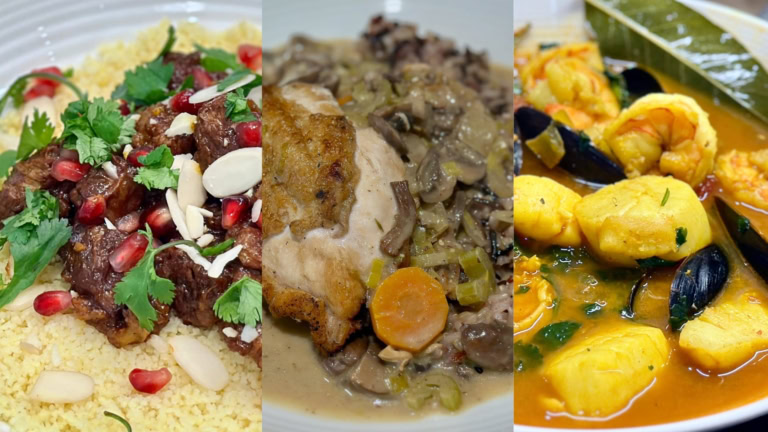
Braised classics are built for hosting. Coq au vin and beef bourguignon both simmer in red wine hours before guests arrive, then sit happily until you reheat them. The flavor deepens overnight, so making the main a day early is an advantage rather than a compromise.
Braises That Reheat in Your Favor
- Coq au vin: chicken braised in red wine with mushrooms and bacon, the most forgiving centerpiece for a first French dinner.
- Beef bourguignon: a Burgundy beef braise that tastes better on day two, ideal when you want to cook entirely ahead.
- Ratatouille: a Provencal vegetable main for mixed tables, served warm over polenta or with bread.
RecipeTin Eats keeps a well-tested RecipeTin Eats French category for the braising route, and David Lebovitz, cooking from Paris, offers an authentic David Lebovitz French recipe archive when you want the home-kitchen version, drawn from years of cooking French food at home.
Bistro Mains for a Faster Night
Not every French main demands an overnight braise. If your evening leans simpler, a pan-to-plate bistro dish keeps the centerpiece light: steak frites, sole meuniere, or a duck breast seared and rested while the starter clears. These cook in minutes, so they ask for a host comfortable with a little last-minute heat rather than a long simmer.
The trade-off is timing. A braise waits for you; a seared steak does not, so save the quick mains for menus where you want fewer guests and a more hands-on kitchen. For a larger table, the braise scales more reliably and frees you to greet the room.
Whatever you choose, resist a second main. One confident dish, plainly plated, reads as a host in control, and it leaves room for the course that follows it to do quieter work.
Bridging to Dessert with a Cheese Course
Cheese earns its own slot in the French sequence, served after the main and before anything sweet. It needs no cooking, which makes it the calmest course on a classic French dinner party menu, and it gives the table a reason to linger over the last of the red wine.
Three to five cheeses is plenty. Aim across the texture spectrum rather than for volume: a soft bloomy round, a firmer aged wheel, and a blue cover most of the range, with a fresh chevre or a washed-rind type to round it out. Pull everything from the fridge an hour ahead so the flavors open up.
- Start soft and bloomy with a Brie or Camembert, mild enough to open the board gently.
- Move to a firm, aged wheel such as Comte or a young Gruyere for a nutty middle.
- Finish on a blue like Roquefort, served alongside bread, walnuts, and a little honey.
Serve from mildest to strongest so the palate is not overwhelmed early, and keep the accompaniments plain. Saveur keeps a curated Saveur’s French recipe collection worth a browse for the surrounding courses, and the cluster’s dedicated cheese-board course walks through the full plateau de fromages step by step.
When to Bring It Out
The cheese course is also a pacing tool. After a substantial main, a board gives the table a natural pause, a stretch of conversation that needs nothing from the kitchen while appetites reset for dessert. Some hosts shorten the meal by serving cheese and dessert together; in a full five-course sequence, keep them apart so each gets its own moment.
Arrange the board clockwise from mild to strong so guests can follow the order without instruction, and label nothing. A little honey, a handful of walnuts, and a fresh baguette are all the company the cheeses need.
Once the board has done its work and the wine glasses are low, the evening earns its sweet finish.
|
Hosting Tip: Set the French Dessert Overnight |
Finishing with a French Dessert
Dessert closes the meal, and the French approach favors a single, confident sweet over a spread. By this point in a French dinner party menu, guests want a small, well-made finish, not a second dinner, so one plated dessert reads better than a crowded table of options.
Lean on dishes that finish ahead. Custards and creams set overnight, which removes the day-of pressure entirely. Knowing how to host a French dinner party without a late scramble usually comes down to one rule: the dessert is done before the first guest knocks.
- Pots de creme: individual chocolate custards, portioned and chilled a day ahead.
- Creme brulee: baked early, with only the sugar torched at the table for a live finishing touch.
- Tarte tatin: a caramelized apple tart that reheats gently and slices cleanly for a seated course.
- Ile flottante: poached meringue on creme anglaise, the lightest close after a rich main.
BBC Good Food keeps a reliably tested BBC Good Food French recipe collection for the sweet course, and the cluster’s dessert satellite gathers a dozen entertaining-ready options with make-ahead notes.
If you want variety without more work, set out a small plate of two or three bite-size sweets, macarons, madeleines, a square of financier, in place of a single plated dessert. Guests graze with coffee, and the spread reads as generous while staying entirely make-ahead. Either way, the finish should be small enough that no one leaves the table feeling they overdid it.
Pour coffee to close, and the menu has carried the full arc from welcome to last bite.
Your Make-Ahead Timeline and Host Run-Sheet
Timing is the quiet engine of a calm evening. A simple run-sheet, written the week of the party, turns a five-course menu from a juggling act into a sequence you can follow without thinking. The goal is to front-load the work so the night itself stays easy.
Two Days to One Day Ahead
Most of a French menu can be prepared one to two days in advance, and several dishes are better for it. Braised mains, custard desserts, and soups all improve overnight, so this is where the heavy cooking belongs.
- Braise the main: cook coq au vin or bourguignon fully, cool, and refrigerate; it deepens overnight.
- Set the dessert: bake or chill custards so they need only finishing.
- Make the soup or pate: both hold for two days and reheat or slice cleanly.
The Day Itself
Reserve day-of time for the few things that cannot wait: the bread, the plating, and bringing the cheese to room temperature. Write the order down. The Gingered Whisk offers a practical walkthrough of hosting an easy five-course French meal if you want a second timeline to compare against, and our guide to make the whole menu ahead of time shows how far in advance each component can go.
A clear run-sheet also tells you when each course leaves the kitchen, which is what separates a paced evening from a rushed one. Our step-by-step guide to hosting a dinner party covers the wider logistics, while a plan a dinner party menu guests remember framework helps you balance the courses themselves.
With the cooking timeline settled, the last variable is the room itself, how you dress the table and pace the courses across the evening.
|
Keep Every Course’s Recipe At Hand |
Setting the Table and Pacing the Evening
Set the table the night before. A laid table the morning of the party is one less thing between you and the kitchen, and it lets you focus the final hours on food and welcome rather than folding napkins. Candles, simple flowers, and water on the table are enough.
Pacing is what makes five courses feel relaxed rather than long. Leave real gaps between courses so conversation has room, and resist the urge to rush plates out. A French evening is measured in hours, not minutes, and the pauses are part of the design.
Wine Without Overthinking It
Match the wine to the main course rather than to every plate. A single versatile red, a red Burgundy with a beef or chicken braise, and a dry white for the starter or any seafood will carry most menus. Save a sweet wine or Champagne for the dessert if you want a flourish.
- A Burgundy-style red and a crisp dry white together cover the savory courses without a bottle per plate.
- Open the evening with sparkling wine or a kir, poured before any final tasks begin.
- Keep water on the table throughout; it keeps the pace gentle across a long meal.
For the atmosphere side, The Blonde Abroad has a warm guide to throwing a French-inspired dinner party, Happily Ever Adventures offers a host-focused walkthrough of hosting a French-inspired dinner party, Afar takes a travel-writer’s view of a quintessentially French dinner party, and Mon Petit Four lays out Mon Petit Four’s French dinner party blueprint from a French-American baker. For the full logistics of the evening, our plan a full meal start to finish guide ties the courses and the clock together.
Dressed early and paced with intention, the table does its own quiet work, and the five courses arrive as a single unhurried evening rather than a series of deadlines.
Frequently Asked Questions
What are the courses in a traditional French dinner party menu?
A traditional French dinner moves through aperitif, starter, main course, cheese, then dessert, with coffee to close. Home hosts can run five courses comfortably by keeping each portion small. The pacing matters more than the number of plates, so leave real gaps between courses for conversation.
How many courses should a French dinner party have at home?
Five courses works well for most home hosts: aperitif, starter, main, cheese, and dessert. You can trim to three by folding the aperitif into the starter and serving cheese alongside dessert. The goal is a relaxed rhythm, not a marathon, so scale the number to your kitchen and seating.
What is a good French dinner party menu for beginners?
A beginner-friendly French menu pairs a make-ahead starter like soup or pate with a braised main such as coq au vin, a small cheese plate, and a simple dessert like pots de creme. Braises and custards both hold well, so most of the work happens before guests arrive.
How far in advance can I prepare a French dinner party?
Most of a French menu can be prepared one to two days ahead. Braised mains, custard desserts, and soups all improve overnight, and cheese only needs to come to room temperature before serving. Reserve day-of time for the starter, bread, and plating so the kitchen stays calm.
What wine goes with a French dinner party menu?
Match the wine to the main course: red Burgundy with beef or chicken braises, a crisp white with seafood or quiche, and a sweet wine or Champagne with dessert. A single versatile red and a dry white cover most menus, so you do not need a different bottle for every course.
How do I host a French dinner party without stressing?
Build the menu around make-ahead dishes, set the table the night before, and write a simple run-sheet listing when each course leaves the kitchen. Keep the main course to one confident dish, lean on a cheese course that needs no cooking, and pour the aperitif before any final tasks begin.
Continue Reading:
More On French Entertaining
- 12 French Dessert Recipes for Easy Entertaining
- 7 Classic French Main Dishes for Confident Hosts
- 15 Crowd-Pleasing Mini Quiche Recipes for Parties
- 18 Classic French Foods Every Confident Host Knows
- How to Build a French Cheese Board Course at Home
More from The Gourmet Host
- The Best Hot Sauce Making Kits for a DIY Dinner Party Activity
- How to Flambé at Home: A Host’s Guide to Safe Flames
- Welcome Drinks by Country (10 Ideas That Set the Tone)
- Short 3 Minute Speeches That Inspire Dinner Guests
- 20 Easy Minute to Win It Games (No-Prep Household)
Explore TGH Categories
- Set the Scene
- Drinks and Bar
- Plan the Meal
- Engage with Guests
- Games and Toasts
- Tools and Techniques
- Why We Gather