French Dining Etiquette: A Host’s Continental Primer
 16 min read
Three hours into a French dinner, the cheese course has not yet arrived, the wine glass is half-full, and no one is checking the time — and that is the entire technique. An American home host’s instinct is to speed up: clear plates, refill glasses to the top, move the table toward dessert. The French instinct is the opposite. Slow down. Top off rather than pour. Let the conversation outlast the food by design.
The dining etiquette of france is, in practice, a pacing system more than a manners code — built around the idea that a meal is conversation with food underneath, and the host’s job is to keep both moving at the same rhythm. Six rules carry an American table through a French-themed dinner without affectation: how to handle the knife and fork, when the bread and cheese land, how to pour and refill wine, how to pace a three-hour meal, what to say before each course, and how to use Continental style at home without overplaying the part.
At a Glance
- Continental knife-and-fork style: fork in the left hand tines-down, knife in the right, no switching between bites — standard French table etiquette and most European dining etiquette.
- Bread sits on the table beside the plate, not on a side plate; it pairs with cheese and the main, never buttered first.
- The cheese course arrives after the main and before dessert — three to five cheeses, eaten mild to strong.
- Wine is topped off during the meal, never poured to the rim; glasses are kept roughly one-third full.
- A French dinner runs three hours minimum: apéritif in hour one, plated courses in hour two, cheese and dessert in hour three.
- What the host says before each course is short, warm, and timed to the moment the first plate is set down.
What Is French Dining Etiquette?
The dining etiquette of france is a pacing-and-presence system disguised as a manners code — a sequence of choices about utensils, course timing, and how long the table stays alive between plates. For an American home host, the working definition is not a list of don’ts; it is the rhythm that lets a three-hour meal feel intimate rather than stretched, with Continental utensil style as the visible signal and apéritif-to-cheese pacing as the architecture. Unlike a Saturday dinner where the host clears plates as soon as they empty, French table etiquette treats the empty plate as the moment a conversation deepens.
Why French Dining Has Its Own Grammar
French dining etiquette behaves like a grammar — internal rules that look arbitrary from the outside but make the meal legible to everyone at the table. The central premise: dinner is a conversation with food underneath, not a performance with conversation on top.
Britannica’s overview of French cuisine and its codified service traditions traces the structure to the 19th-century formalization of the meal into named courses — apéritif to wake the palate, entrée to set the tone, plat principal to anchor, cheese to bridge, dessert to close. Kinfolk’s profile of eating in Paris with Tatiana and Katia Levha makes the stagecraft point at home-host scale: the host’s choices set the pace, and the pace is the hospitality.
What the grammar asks of the host
- Sit with the table, not above it: the host eats at the same speed as the slowest guest. The seat is the host’s post for the evening.
- Set the rhythm with the first course: the apéritif is served at a deliberate pace — small bites, light pours, fifteen to thirty minutes. The rest of the meal inherits the tempo.
- Treat the pauses between courses as content, not gaps: the conversation in the five-minute pause before the cheese arrives is the dinner — the cheese is the prompt.
For an American home host, the useful shift is to stop optimizing for efficiency and start optimizing for presence. The prep architecture in our Italian dinner party menu host’s guide makes a long, slow-paced dinner possible without the host ducking out every fifteen minutes.
Holding the Knife and Fork the Continental Way
Continental utensil style — also called french etiquette dining or, more broadly, european dining etiquette — keeps the fork in the left hand with the tines pointing down and the knife in the right hand throughout the meal. No American zigzag, no switching, no resting the knife on the rim of the plate between bites.
The Smithsonian’s history of Western eating utensils traces the Continental method to the standardization of the dinner fork across 17th- and 18th-century European courts — when fork-in-left-hand became the marker of court-trained dining. Food Republic’s knife-and-fork rule when dining in Europe is the working reference for table manners france follows today: tines-down, no zigzag, knife stays in the right hand from soup spoon to dessert.
The four-cue cheat sheet
- Tines down, always. The fork pushes food onto the tines from the back — bread crusts, herbs, or a piece of potato serve as the pusher when the cut isn’t enough.
- Knife stays in the right hand. The knife rests across the top of the plate, not on the rim, between bites. When the host puts the knife down, the table reads the meal as paused.
- Hands on the table, wrists at the edge. French manners at the table keep both hands visible — never in the lap. Wrists at the table edge; elbows do not.
- Plate finished = utensils at 4 o’clock, parallel. Fork tines down, knife edge inward. The signal is universal across france table etiquette: the host can clear.
Four cues that read as Continental without veering into theatre. A guest unfamiliar with the style will mirror the host within the first course. For the sequencing details (passing direction, the bread plate question, salt-and-pepper protocol), David Lebovitz’s piece on the role of the napkin in a French meal is worth a ten-minute read before guests arrive.
|
Keep Your French Recipes Together |
Bread, Cheese, and the Order of the Courses
Bread on a french table is an accompaniment, not pre-meal filler — it arrives with the main course, sits on the table beside the plate, and stays through the cheese. There is no side plate for bread in classical french table manners; the table is the surface. Hosts tear pieces from a baguette to mop sauce, pair with cheese, and balance richness.
Britannica’s entry on the baguette and its place in French dining is load-bearing: the baguette is structural to the meal, not decorative. Bread is part of the dinner’s grammar, never buttered before being eaten with a course.
The cheese course
The cheese course lands after the main and before dessert — never with drinks at the start. Three to five cheeses on one board: one soft (Brie or Camembert), one semi-soft (Comté or young Tomme), one blue (Roquefort or Fourme d’Ambert), one harder aged option (aged Comté or Mimolette). The board is passed; each guest cuts their own portion. The bread on the table during the main continues here.
France Today’s profile of Baronne Staffe’s guide to French table manners covers the protocol — Staffe was the 19th-century etiquette author whose conventions still anchor french dining etiquette today. Two host cues that matter: do not stack soft and hard cheeses on the same cut, and pour a final small glass of red to carry the table through the cheese course before dessert lands.
The order of courses, condensed
- Apéritif + small bites (15–30 min): one light cocktail or sparkling wine, three to four small bites. Sets the pace.
- Entrée — first plated course (20–30 min): a light starter — salad, charcuterie, soup. Not the American main.
- Plat principal — main course (30–45 min): one protein, one starch, one vegetable. The host’s anchor course.
- Cheese course (15–20 min): three to five cheeses + bread + the closing pour of red.
- Dessert + coffee (20–30 min): one small dessert, then espresso. Coffee lands after dessert plates are cleared.
Course order carries the meal’s rhythm; the wine service is what carries each course.
Wine Service at the Host’s Table
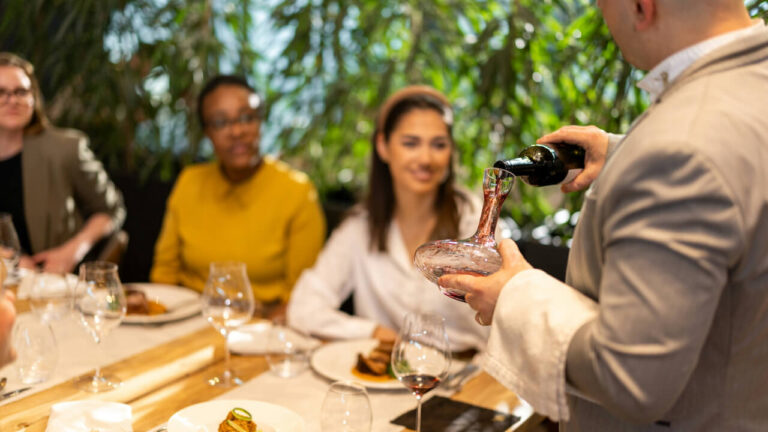
Wine service is the most visible host move at a French-themed dinner. The french table etiquette move is to pour roughly one-third up the bowl, then top off through the meal as the glass drops below the halfway mark. The glass stays alive across the course, not consumed-then-refilled in cycles.
Two reasons for the pour height. First, the bowl needs room for the wine to open — aroma sits in the empty third of the glass. Second, the topping-off pattern keeps the host present at the table. Our guide to building a wine pairing menu for any dinner party covers the course-by-course pairing logic — when to switch from a crisp white at the entrée to a structured red at the plat principal.
The host’s role across the meal
- Apéritif: pour the apéritif round once all guests have arrived — never before. A light wine, a sparkling, or a classic Kir (white wine + a teaspoon of cassis liqueur).
- First plated course: switch glasses. A fresh white for the entrée — Sancerre, Chablis, or a dry Alsatian Riesling work cleanly with a salad, charcuterie, or soup.
- Plat principal: open the red 30 minutes before plating. Pour one-third up the bowl. Top off twice across the course — fine dining serving etiquette favors a steady, attentive presence over a single dramatic pour.
- Cheese course: a final small pour of the same red. The host pours from a comfortable height to let a small bit of air mix in.
The host’s hands are the entire wine service. The moves that fine dining waiter etiquette would assign to a server (the bottle angle, the wrist twist at the end of the pour, the napkin over the bottleneck) all transfer to the host. Our piece on different ways to describe wine at your dinner party covers what to say when you pour the first red — short phrases that signal character without performing.
|
Hosting Tip: Offer Wine Before the Glass Is Empty |
Pacing a Three-Hour Dinner Without Stalling
Three hours is the floor for a hosted French dinner — apéritif in hour one, plated courses across hour two, cheese and dessert anchoring hour three. The pacing is the hospitality. The host’s job is to build the prep timeline so the meal can run at this tempo without anyone leaving the table to check the oven.
France Today’s piece on the apéritif round and how to host one is the reference for the first hour — the apéritif calibrates the table to French time. Camille Styles’ ultimate French-inspired happy-hour guide to hosting an apéro covers the at-home build — the small bites, the pour rhythm, the way the first hour sets the entire dinner’s tempo.
The three-hour build, hour by hour
- Hour one — apéritif and arrival: guests arrive over 15 minutes, the host pours the apéritif round once everyone is seated, three to four small bites circulate. The full table sits at the apéritif for at least 30 minutes before the entrée.
- Hour two — the plated courses: entrée plated at minute 60, cleared by minute 90, plat principal landing immediately after with the wine switched. The plat holds heat for 15 minutes so the host doesn’t duck back to the kitchen.
- Hour three — cheese, dessert, coffee: plat cleared at minute 130, cheese board out, final small pour of red. Dessert plated 20 minutes after the cheese; espresso after dessert plates are cleared.
Our main course ideas that hold the table during a long dinner covers the plat principal choices that survive a 15-minute hold — a braised dish, a low-and-slow roast, a confit. The wrong plat for a three-hour French dinner is a quick-cooked steak.
What the Host Says Before, During, and After
Bon appétit is said once — by the host, the moment their own plate is set and they have picked up the fork. Not before, not at the door, not after the first guest has started eating. The phrase is a permission cue: the host has begun, so the table may begin. Saying it earlier reads as rushing; saying it later leaves the table waiting.
A second host move is a one-sentence introduction to each course as it lands — eight to twelve words that name the dish, the protein at its center, and one specific detail. “A Bresse-style chicken with tarragon — the herbs are from the garden.” Or, at the cheese course: “Three cheeses left to right — Comté, Camembert, Roquefort.” Short, warm, on time.
The four host phrases that carry the meal
- At the apéritif (everyone seated): “Welcome — let’s start.” The apéritif is poured for everyone, in one round, at one moment.
- At the entrée: “Bon appétit” — said once the host’s plate is set; the host lifts their fork as the words land. The cue gives the table permission to begin.
- At the plat principal: the dish name + one detail. “Duck leg confit — the potatoes are roasted in the duck fat.” Then the host picks up the wine bottle and refills the table.
- At the cheese: “From left to right, in order of strength — start with the mildest.” The board is passed; the host does not cut for anyone.
What not to say is as important. No apologies for what’s still in the oven, no recipe-step narration, no “I hope you like it.” French manners at the table assume the host has cooked confidently. The David Lebovitz napkin piece referenced earlier covers another small cue: the napkin is unfolded once seated and placed on the lap — not tucked, not flourished, just placed.
|
Plan Every Course In One Menu |
How to Host French at Home Without the Affectation
The risk in any French-themed dinner is overplaying the part — too many french phrases, the napkin folded into a swan, the wine described in three sentences. None of that reads as table etiquette france actually uses; it reads as a costume. The Continental style works at an American home table when the host imports the architecture and leaves the theatre behind.
Which moves transfer cleanly is a question of what the table can read without explanation. Tines-down fork-and-knife is invisible — guests mirror within five minutes. Apéritif-first pacing is invisible; guests settle in. Topping-off wine pours read as attentive hosting. France Travel Tips’ ten dos and don’ts when dining French-style is a useful sanity-check for the at-home host on which conventions transfer and which read as costume.
What transfers, what doesn’t
- Transfers cleanly to a home table: Continental utensil style, course order (apéritif → entrée → plat → cheese → dessert), three-hour pacing, wine top-offs, short course intros, the cheese course before dessert.
- Skip at home: bread tucked between courses on a cloth basket, separate cheese knives for each cheese (one shared knife is fine), hand-written menu cards at each setting, French phrases for the courses (use English course names).
- Optional flourishes that read warm: a single small flower at each setting (no centerpiece over 12 inches that blocks sightlines), a hand-poured carafe of water, a wooden cheese board rather than slate or marble.
The principle is to host the way the French host: with confidence in the architecture and no insistence that the table notice it. The same logic governs any cross-cultural dinner — our piece on throwing an Italian-themed dinner party with style covers the lift-the-architecture, drop-the-theatre principle for a different cuisine. The dining etiquette of france carries an American table further than any imported phrasebook.
Frequently Asked Questions
What is Continental dining etiquette?
Continental style holds the fork in the left hand, tines pointing down, with the knife in the right hand throughout the meal. No fork-switching between bites. The style is standard across most of Europe and signals familiarity with formal-but-modern dining conventions, including french dining etiquette and european dining etiquette in general.
Why do French people eat bread with their meal instead of before?
Bread is treated as an accompaniment to the main course in french dining (meant to pair with cheese, mop sauce, and balance richness) not as a pre-meal filler. The bread basket arrives with the food, stays on the table, and isn’t buttered before eating. It’s a structural part of the meal, not a starter.
When is the cheese course served at a French dinner?
Cheese is served after the main course and before dessert. Three to five cheeses are arranged on a board with bread, eaten in order of mild to strong. The host introduces each cheese briefly and pours a final small glass of red to accompany, standard french table etiquette across formal and casual French dinners.
How long should a French dinner party last?
Three hours is the floor for a hosted French dinner: apéritif at one hour, dinner courses staggered over two more, with cheese and dessert anchoring the second half. Faster dinners feel rushed; the pacing is the hospitality. Build the prep timeline so the meal can hold its tempo without the host ducking out.
Is it rude to drink wine before food arrives?
No. The apéritif round is built into the French dinner pattern. Light wines or aperitifs paired with small bites set the mood before the first plated course. The host pours the apéritif round once everyone has arrived, never before. It signals the meal has begun and the table can settle in.
What do French hosts say before everyone starts eating?
Bon appétit. Said once the host’s own plate is set and ready. The host typically lifts their fork at the same time, which gives guests the room to begin. Saying it before the host’s plate arrives reads as a rush rather than a welcome. The timing is the cue.
Continue Reading:
More On Hosting Etiquette
- Table Manners for Hosts: 9 Cues That Set the Tone
- Dining Table Etiquette: Place Setting Rules for Hosts
- Japanese Table Etiquette: A Host’s 8-Rule Quickstart
- RSVP Etiquette: 8 Host Rules for Replies and No-Shows
- Hostess Gift Etiquette: A Host’s Guide to Receiving
- Dinner Party Seating: 6 Rules for the Host’s Chart
More from The Gourmet Host
- Stock the Bar Party: Gifts, Food, and Games for Every Host
- Irish Wedding Toasts: Traditional Celtic Blessings
- The Great Entertaining Debate: Home or Out?
- How to Plate Food Like A Pro: Easy Plating Tips
- Gluten-Free Dairy-Free Hors d’Oeuvres: 6 Safe Bites
Explore TGH Categories
- Set the Scene
- Drinks and Bar
- Plan the Meal
- Engage with Guests
- Games and Toasts
- Tools and Techniques
- Why We Gather