Sunrise Mocktail Recipe: A Layered Tequila-Free Drink
 14 min read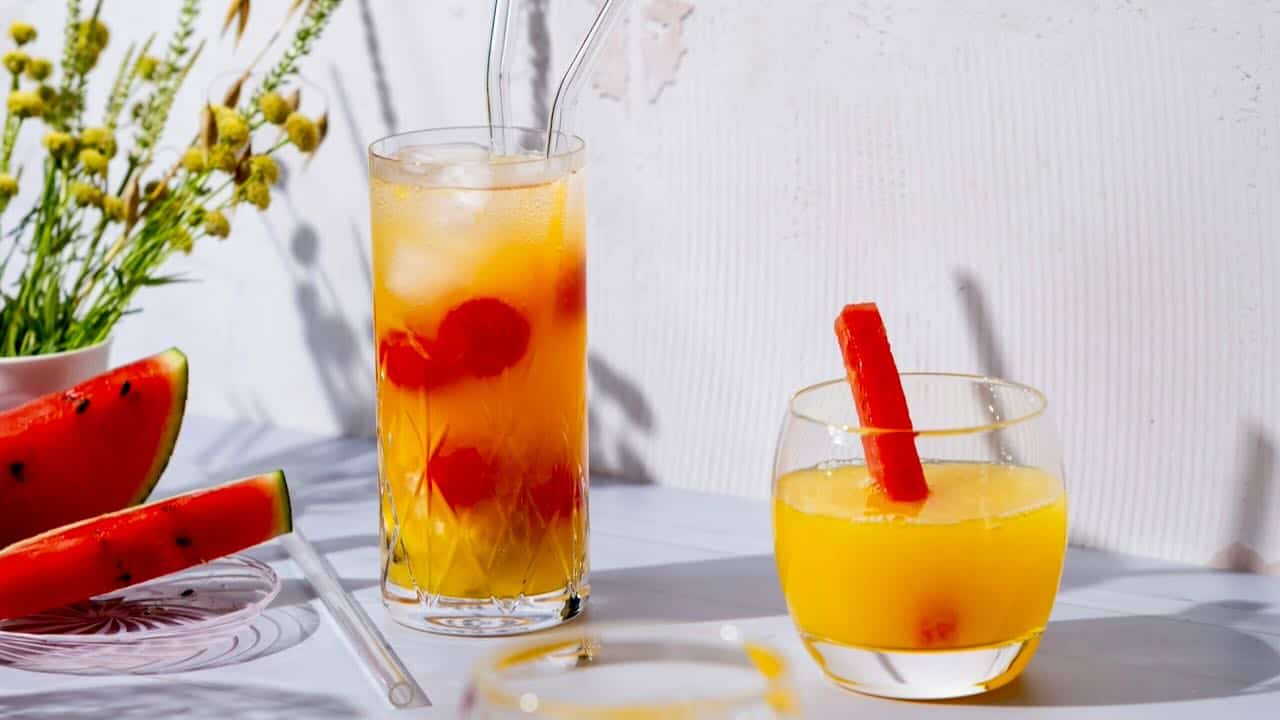
Twelve highball glasses on a brunch counter, each one finishing the same way — a thin red layer settling through orange juice toward a single ice cube — and the host pours each gradient in under twenty seconds. That tiny gesture, a controlled grenadine pour from a height of about an inch, is what separates a homemade sunrise mocktail recipe from a stirred-together orange drink with red food coloring on top.
For a non-drinking host, the layered gradient is the most useful piece of brunch staging there is — a visual signal that the drink was deliberately built. By the end of this breakdown, you will be able to layer a single sunrise mocktail by hand, build pineapple and peach variations that hold their gradient, and pre-batch the components so a table of twelve guests gets a fresh sunrise in under four minutes flat.
At a Glance
- A sunrise mocktail recipe is built on three simple ingredients: fresh orange juice, grenadine, and a sparkling lift (club soda, ginger ale, or lemon-lime soda) — pineapple juice subs for orange in tropical variations.
- The red layer at the bottom of the glass comes from grenadine’s higher sugar density, not from a pour technique. Cold ingredients hold the gradient longer.
- Layering by hand: fill a tall glass with ice, pour orange juice to two-thirds, then float half an ounce of grenadine slowly down the inside wall — it sinks on its own.
- Variations: pineapple-orange Sweet Sunrise, peach-and-grenadine summer sunrise, sparkling Sunrise Spritzer with non-alcoholic sparkling wine.
- The host’s brunch workflow: pre-batch the orange-juice base, pre-measure grenadine pours into shot glasses, garnish with one orange slice and one maraschino cherry per drink.
What Is a Sunrise Mocktail?
A sunrise mocktail is the non-alcoholic version of tequila sunrise — a layered drink built from orange juice, grenadine, and ice, finished with an orange slice and maraschino cherry. The visual signature is a red-to-orange gradient: grenadine’s sugar density pulls it to the bottom of the glass, where it pools beneath the orange juice instead of mixing in. Unlike an everyday fruit punch, a sunrise mocktail is structured around that gradient — the host pours each component in sequence, and the drink’s color shifts from red at the base through amber to bright orange at the rim.
What Goes Into a Sunrise Mocktail
A working sunrise mocktail recipe leans on five components, and only three do structural work. Orange juice and grenadine carry the gradient; ice slows diffusion and gives the drink its hold time on the table. The remaining components — a sparkling lift and the garnish — are flavor and finish.
Standard sunrise mocktail formula, one tall glass:
- 4 oz of orange juice — fresh orange juice gives the brightest color; not-from-concentrate cartons from the grocery store are the practical brunch choice.
- Half an ounce of grenadine syrup — pomegranate-based pomegranate syrup layers more cleanly than artificially-colored grenadine; a little grenadine is enough.
- 2 ounces of club soda or lemon-lime soda — added last, on top, for the fizzy texture.
- Tall glass packed with ice cubes — larger cubes mean slower dilution and a longer-lasting gradient.
- Garnish: one orange slice and one maraschino cherry — the maraschino cherry anchors the drink visually at the rim; a second cherry can rest at the bottom of the cup.
Sequence and substitutions that hold the gradient
Pour sequence matters more than any other variable. Pour orange juice first, top with the sparkling component, then float the grenadine — never the reverse. If soda is added after the grenadine, carbonation lifts the red layer back into the orange and the gradient collapses within ten seconds, a failure mode De Soi’s non-alcoholic tequila sunrise build avoids by reserving the grenadine pour for last.
Mindful Mocktail’s sunrise mocktail recipe swaps the soda for sparkling lemonade, which adds tartness without dulling the gradient. A splash of grenadine syrup is the only red component — more dulls the colorful layered drink into a muddy pink. A few drops of lemon juice or lime juice on the orange juice surface cut the sweetness without shifting the color.
Three quick variations on the structural recipe:
- Tropical sunrise: pineapple juice as the base, grenadine for the red layer, maraschino cherry garnish — a fun drink that reads as classic ingredients in a different proportion.
- Sweetened orange: 4 oz of orange juice + a teaspoon of pomegranate syrup stirred into the soda layer — useful when one guest wants extra sweetness without a second pour.
- Sober fun spritzer: 3 oz orange juice + 3 oz non-alcoholic sparkling wine + half an ounce of grenadine — the adult variant that keeps the sunrise effect while reducing sugar.
All three follow the same logic that governs a classic sunrise cocktail, with the alcohol stripped out and a sparkling component added in its place.
For brunch hosts thinking past the drink itself, our easy brunch recipes for every home cook pair well with the sweetness of a sunrise build.
Get the gradient right and the drink reads as a built classic drink. The next decision is what variables drive that gradient when you move from one glass to twelve.
|
Keep the Sunrise Build Close |
Building the Layered Gradient: Density, Temperature, Pour Speed
Three variables decide whether the red layer sinks cleanly or muddies into a pink wash. Density does the heavy lifting — grenadine’s sugar concentration is higher than orange juice’s, so it pulls toward the bottom on its own.
Temperature is the second lever: cold ingredients hold the gradient roughly twice as long as room-temperature ones. Pour speed is the third — a slow pour gives the grenadine time to find its level.
The 30-second layered build:
- Fill a tall glass to the rim with ice cubes — the larger the cubes, the slower the dilution.
- Pour 4 oz of orange juice over the ice, leaving an inch of headroom at the top of the drink.
- Add 2 ounces of club soda directly into the orange juice — soda water adds a little carbonation without touching the grenadine layer yet.
- Float half an ounce of grenadine slowly down the inside wall of a clear glass, holding the bottle about an inch above the rim. The pour should take three to four seconds end to end.
- Garnish with an orange slice clipped to the rim and a maraschino cherry dropped to the bottom of the cup, which anchors the red layer visually.
Charming Cocktails’ tequila sunrise mocktail walkthrough and Finding Zest’s layering guide both teach the back of a spoon technique — invert a teaspoon over the glass and pour the grenadine over the back of the spoon so it spreads across the surface before sinking.
The grenadine drifts down rather than punching through, which gives a softer transition between the red base and the amber middle.
The next decision is whether to stop at the classic gradient or build a variation that pushes past orange juice entirely.
Variations Beyond the Classic
The orange-and-grenadine sunrise is the entry point, not the ceiling. Three variations work cleanly at brunch — Sweet Sunrise, peach sunrise, and a sparkling Sunrise Spritzer — and each one targets a different guest preference.
- Sweet Sunrise (pineapple-orange): 2 oz orange juice + 2 oz pineapple juice over ice, then half an ounce of grenadine floated last. The Speckled Palate’s Sweet Sunrise Mocktail and Sweets and Thank You’s version both use this 50/50 juice base. Pineapple cuts orange’s acidity and gives the gradient a creamier middle.
- Summer peach sunrise: 3 oz orange juice + 1 oz peach nectar over ice, then half an ounce of grenadine. Whisk It Real Gud’s tequila sunrise mocktail recipe leans on peach to anchor the drink in late-summer fruit — a special occasion drink that still reads as a fun drink.
- Sunrise Spritzer (sparkling, lighter): 3 oz orange juice + 3 oz non-alcoholic sparkling wine, then half an ounce of grenadine floated last. The spritzer format reduces sweetness and gives a virgin sunrise mocktail enough complexity to land at an adults-only brunch.
The variation that fails most often is the all-juice version — orange + pineapple + cranberry — which collapses the gradient because pineapple and cranberry juices have similar densities to grenadine. The red layer cannot sink past them, and the drink reads as a flat fruit punch with red food coloring on top.
The peach version also wants a wider glass than the orange-only build — a Collins works better than a highball. For a slower-paced morning when one host is building drinks for two or three, our easy brunch ideas for a relaxed weekend pair well with the peach build. The next consideration is what changes when the host moves from one drink to twelve.
|
Hosting Tip: Prebatch the Juice but Not the Grenadine |
Hosting at Scale: Pre-Batching for the Brunch Rush
Building one sunrise mocktail by hand is straightforward. Building twelve in the four-minute window between guests sitting down and the first food course landing is about workflow, not the recipe. The host’s job at scale is to remove every step that requires measuring or judgment from the live pour.
Stage the components, not the drink
Every component except the grenadine pour gets prepared in advance. Orange juice and any secondary juice goes into a chilled pitcher in the fridge — Feast + West’s sunrise mocktail batches the juice base up to 24 hours ahead with no flavor degradation. Club soda or sparkling wine stays in the fridge unopened until service. Glasses are pre-filled with ice and lined up on the counter ten minutes before guests sit.
The pre-batch checklist for 12 guests:
- Pre-pour 12 grenadine shot pours, half an ounce each, into small shot glasses. This removes the grenadine bottle from the live pour entirely — the single biggest time saver.
- Pre-fill 12 highball glasses with ice 10 minutes before guests sit, kept on the counter rather than in a freezer.
- Decant the orange juice into a pitcher with a wide spout — a narrow-spout carafe doubles the live pour time.
- Pre-cut 12 orange slices, one slit per slice so each clips cleanly onto the rim. Maraschino cherries stay in the jar with a long-handled spoon in the lid.
- Open the club soda or sparkling wine 30 seconds before service — earlier and the carbonation drops; later and the host loses the time gain.
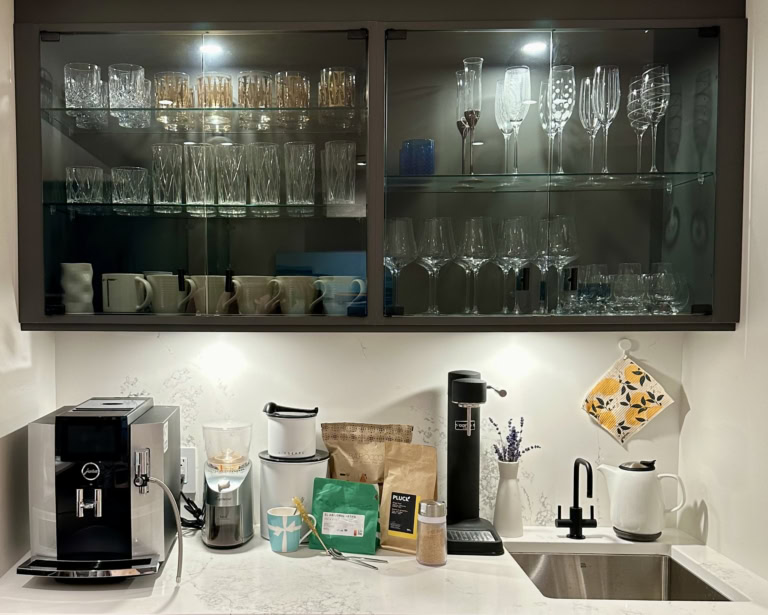
If the brunch also includes a hot-drink station, our guide on how to set up a coffee bar your guests will love pairs cleanly with the sunrise pour — both stations work from the same counter. The live pour then runs orange juice → soda → grenadine across all 12 glasses in series, not one drink at a time.
In practice, a brunch host who has run this workflow once can build 12 sunrise mocktails in roughly three minutes — twenty seconds per glass once the components are staged.
The drink that walks to the table looks identical to the single hand-built version; the host just spent a quarter of the time on it.
Why Does the Sunrise Mocktail Belong on a Brunch Table?
Brunch is the only meal at which a non-alcoholic drink is expected to do as much visual work as the food. Mimosas, Bloody Marys, and Aperol spritzes signal that brunch has officially started — and a sunrise mocktail does the same job for non-drinking guests, kids, and pregnant guests without making them feel handed a juice box.
The gradient is the cue. Something built was placed in front of them, not poured.
Three brunch contexts that reward the gradient
Three brunch contexts use the sunrise well — and the best part is that the same recipe scales across all three with only a glass-shape change:
- A baby shower drink station, where the new parent can be handed a fully built drink that matches the rest of the menu visually. The beautiful colors of the gradient give the moment a touch of sober fun.
- A multi-generational brunch with kids and adults at the same table, served in a clear glass that matches the adult mimosas. The gradient turns a pretty drink into one the kids feel was built for them too.
- A late-summer outdoor brunch, where the peach-and-grenadine variation reads as seasonal. Served in a highball glass on a sunlit table, the glasses glow as the light catches the layers.
Entirely Elizabeth’s Sunrise Mocktail Spritzer makes the same case for sparkling variants — the spritzer reads more delicious drink than dessert. A high quality grenadine in the right proportion is the difference between a kid’s drink and a host’s drink.
The acidity of the orange juice cuts through richer dishes the way a mimosa would; the sparkling component resets the palate between bites; the gradient stays photogenic for 20 minutes on a buffet line, far longer than stirred fruity mocktails with the same ingredients.
A red-to-orange palette against a white tablecloth makes the drinks the visual centerpiece without elaborate centerpieces or place settings — a point our guides on brunch setup ideas for creative table setting decor at home and brunch table setting ideas for every style both build on.
The sunrise effect solves the staging problem with one half-ounce pour. That is the actual reason this easy sunrise mocktail recipe keeps showing up on brunch menus alongside the sunset mocktail it borrows its layering logic from: not nostalgia, not novelty, but visual progression at the table.
Frequently Asked Questions
What is a tequila sunrise without tequila called?
A tequila sunrise without tequila is called a sunrise mocktail or virgin tequila sunrise. Both names describe the same layered drink built from orange juice, grenadine, and ice in a tall glass. The red-to-orange gradient, not the missing alcohol, is what makes the drink recognizable in either name.
How do you layer a sunrise mocktail?
Fill a tall glass with ice, pour 4 ounces of cold orange juice over the ice, then float half an ounce of grenadine slowly down the inside wall of the glass. Cold ingredients hold the gradient longer because diffusion slows in the cold. The grenadine sinks on its own. Pour speed and temperature matter more than any pour-from-height trick.
What gives a sunrise mocktail its red layer?
Grenadine syrup gives the sunrise mocktail its red layer. Grenadine has a higher sugar density than orange juice, which causes it to sink to the bottom of the glass and pool there instead of mixing in. Pomegranate-based grenadine layers more cleanly than artificially-colored versions because the sugar concentration is consistent throughout the syrup.
Can you make a tropical sunrise mocktail with pineapple?
Yes. Swap orange juice for pineapple juice or use a 50/50 split. Pineapple juice has a slightly higher density than orange, so the grenadine layer sinks more quickly and reads a little thinner, but the gradient still holds for the length of a brunch course. The result is often called a Sweet Sunrise or tropical sunrise mocktail.
Why is grenadine used in sunrise drinks?
Grenadine is used in sunrise drinks for two reasons: density and color. Its sugar concentration pulls it to the bottom of the glass, which creates the layered gradient. Its deep pomegranate red against an amber juice produces the visual effect that gives the drink its name, a red base resolving into orange at the rim of the glass.
Is a sunrise mocktail brunch-appropriate?
Yes, a sunrise mocktail fits brunch naturally as a non-alcoholic centerpiece drink. It matches a mimosa’s visual impact at the table, pairs with savory and sweet dishes alike, and gives non-drinking guests a fully built drink instead of plain juice. The orange and grenadine profile reads as brunch from the first sip.
Continue Reading:
More on Mocktail Recipes by Drink Type
- Shirley Temple Mocktail: A Host\’s Guide to the Classic + 5 Variations
- Margarita Mocktail Recipe: Virgin Margaritas Hosts Can Build in 5 Minutes
- Mojito Mocktail Recipe: Fresh Virgin Mojitos for Hot-Day Hosting
- Ginger Beer Mocktail Recipes: 4 Mule-Style Drinks Without the Vodka
- Strawberry Mocktail Recipes: Sweet Non-Alcoholic Drinks for Any Crowd
More from The Gourmet Host
- Food Presentation Techniques: Easy Plating Tips for Cooks
- Dinner Party Appetizers: Easy Starters Your Guests Will Love
- Cold Smoking vs Hot Smoking: Which Technique Is Right for You?
- Non-Alcoholic Drink Pairing: Match Flavors to Any Meal
- Tapas Ideas: 5 Spanish Small-Plates Host Spread
Explore TGH Categories
- Set the Scene
- Drinks and Bar
- Plan the Meal
- Engage with Guests
- Games and Toasts
- Tools and Techniques
- Why We Gather