Italian Dinner Party Menu: A Complete Host’s Guide
 16 min read
Olive oil hits a hot pan and the kitchen changes — garlic going translucent in about forty seconds, the moka pot gurgling on the back burner, somebody slicing crusty bread on the counter. That is the sound of an Italian dinner being built, and it is also the moment most home hosts realize the menu in their head is too long, too random, and too dependent on the oven being free at 7:45.
This guide gives you the five-course flow Italians actually use (aperitivo, antipasto, primo, secondo with contorni, dolce + caffè), the make-ahead schedule that lets you sit at the table with your guests, the portion math per head, and the wine pairing per course. Use it once and the menu builds itself the next time.
At a Glance
- The five-course Italian dinner party menu architecture — aperitivo, antipasto, primo, secondo + contorni, dolce + caffè — and what each course is doing for the evening.
- Course-by-course portion math for an Italian dinner: roughly 4–5 antipasti pieces per guest, 80–100g dry pasta for a primo, 150–180g protein for a secondo, one shared dolce per six people.
- The two-pasta rule and the swap rules that let you simplify any course — including when polenta or risotto replaces a second pasta and when a salad replaces a contorno.
- Wine pairing per course (aperol spritz or pinot grigio for the aperitivo; a hearty pasta dish takes a Chianti; a sweet note dolce wants a chilled vin santo) without turning the meal into a tasting menu.
- A make-ahead timeline that walks 48 hours before the dinner party down to the moment guests sit, so the host is at the table — not in the kitchen.
Definition: What an Italian Dinner Party Menu Actually Is
An Italian dinner party menu is a course-by-course evening built around five named courses — aperitivo, antipasto, primo (a first course of pasta, risotto, or soup), secondo (the main course, usually meat or fish, served with contorni or a simple salad), and dolce with caffè — paced over two to three hours so guests eat, talk, and refill wine glasses between plates.
For first-time hosts, the real challenge isn’t finding Italian recipes; it’s choosing one item per course and committing to that structure. Done that way, the kitchen quiets down by the time guests arrive and the host eats every course at the table.
The Five-Course Italian Dinner Party Menu Architecture
A traditional Italian meal is built on five named courses, served in sequence with deliberate gaps between plates.
Pasta Evangelists’ guide to hosting an authentic Italian dinner party walks the full sequence — aperitivo with light bites, antipasto, primo (pasta or risotto as a first course), secondo with contorni, and dolce closed by a shot of strong espresso. The framework is what makes the evening pace correctly; the recipes are interchangeable inside it.
The trap most home hosts fall into is treating Italian food like a buffet — pasta, chicken, salad, and bread arriving together.
Bona Furtuna’s Italian summer dinner party menu puts it bluntly: in true Italian style, courses are sequential, not simultaneous. Each plate is small enough that guests want the next one, and the conversation has room to breathe between them. Plenty of room at the table for that pacing is part of the point.
What Each Course Is Actually Doing for the Evening
Each course has a job. If a host knows the job, the menu writes itself:
- Aperitivo: a 20–30 minute pre-dinner drink with light bites (olives, taralli, marcona almonds) designed to wake the appetite. Aperol spritz or a chilled white wine — not a full cocktail hour.
- Antipasto: the first plate at the table. A shared Italian antipasto platter (cured meats, Italian cheeses, marinated vegetables, crusty bread). Served cold while the primo finishes.
- Primo: the first course — pasta, risotto, soup, or gnocchi. Smaller than guests expect (about 80–100g dry pasta per person). It should set the rhythm, not fill anyone up.
- Secondo: the main course — meat or fish with one or two contorni and crusty bread. The protein moment. Rarely paired with pasta in true Italian style.
- Dolce + caffè: a small classic Italian dessert, then strong espresso. Panna cotta with seasonal fruits, or a slice of cake. The caffè is the punctuation.
The Swap Rules: How to Simplify Any Course
Not every dinner party gets all five courses. Yummy Mummy Kitchen’s Italian dinner party menu demonstrates the practical swap most hosts make: combine antipasto and aperitivo into one arrival board, then run primo and secondo as the two seated courses. Four courses, one less hand-off.
Three swap rules to keep handy:
- Combine aperitivo and antipasto into a single arrival board when the guest count exceeds twelve — this saves a plate change and lets guests graze while the primo finishes in the kitchen.
- Replace the primo with risotto, soup, or polenta when the secondo is heavy (osso buco, braised short rib) — never serve a hearty pasta dish before a heavy main meal.
- Drop the secondo when the menu is built around one signature pasta recipes — a lasagna or baked ziti becomes the main dish, with antipasto and dolce as bookends.
Knowing the framework is half the battle; the other half is making each course do its job without crowding the next. We’ll start where every Italian-inspired dinner party starts — with a drink in hand.
For a parallel framework that scales beyond Italian nights, see the dinner party menu planning guide for any cuisine.
|
Build the Five Course Menu First |
Aperitivo to Antipasto: How an Italian Evening Actually Begins
The first thirty minutes of an Italian dinner party are not the meal — they are the warm-up. Cucina by Elena’s classic Italian dinner ideas treats this opening window the way a professional kitchen treats mise en place: a small drink, light bites, and an Italian antipasto platter that lets guests stand, talk, and ease into the room.
The aperitivo is the host’s chance to settle the social temperature before the first plate sits down.
Three drinks anchor most Italian aperitivo programs. Choose one and pour it generously rather than offering all three:
- Aperol spritz — three parts prosecco, two parts Aperol, one part soda, an orange slice. Bright orange in the glass, slightly bitter, low alcohol. The default for an aperitivo, particularly al fresco in summer.
- Pinot grigio or another crisp white wine — chilled to 45°F, poured into a small wine glass. Northern Italian, low fuss, pairs with almost any antipasto. Pinot grigio is the safe pick for a mixed crowd.
- Negroni sbagliato — equal parts Campari, sweet vermouth, prosecco. A grown-up alternative to the spritz when the dinner party leans more formal. One per guest is plenty before the first course.
Building an Antipasto Platter That Anchors the Course
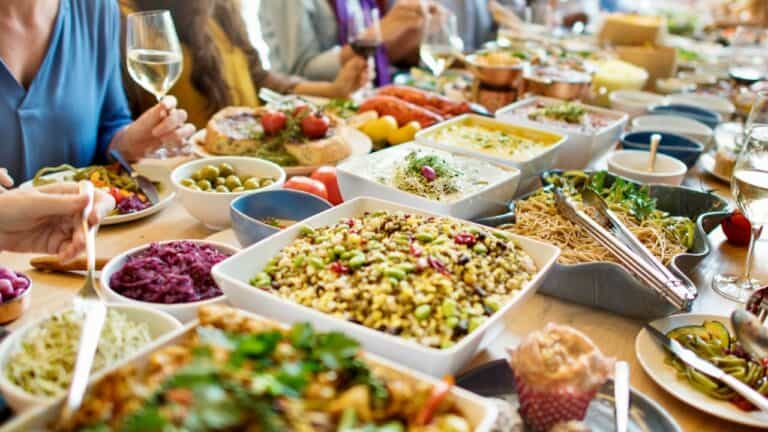
A classic Italian antipasto platter is not a charcuterie board with Italian ingredients — it is a deliberate composition of cured meats, Italian cheeses, Sottoli (vegetables in oil), sottaceti (vegetables in vinegar), and crusty bread, arranged so every guest can build several bites without anything running out.
What’s Gaby Cooking’s Italian dinner party menu lays out a four-section build that scales cleanly from six guests to twenty.
Use this four-section build as the template — adjust quantities to your guest count:
- Cured meats — prosciutto di Parma, salami toscano, sopressata. Plan two to three slices per guest.
- Italian cheeses — fresh mozzarella, a hard cheese (Parmigiano-Reggiano or pecorino), and a soft option (a wedge of taleggio). Roughly one ounce of each cheese per guest.
- Marinated vegetables — sun-dried tomatoes in olive oil, marinated artichokes, roasted red peppers, a small bowl of olives. The acid and oil cut through the cured meats.
- Bread and crackers — crusty bread sliced thin, taralli, and grissini. About four pieces per guest, replenished once during the antipasto window.
When to Skip the Platter and Plate a Fresh Caprese Salad
If the dinner is more formal, a plated fresh caprese salad — ripe tomatoes, fresh mozzarella, fresh basil, extra virgin olive oil, flaky salt — replaces the shared platter.
Tipps in the Kitch’s Italian dinner party guide makes the case that a single seasonal antipasto plated per guest signals the meal has officially begun in a way a grazing board does not. Use a salad plate, not a dinner plate. Drizzle the olive oil at the table.
By the time the antipasto plates clear, the kitchen should be quiet — the primo is the next plate up, and that one needs the host’s full attention.
For longer-form ambience cues that work across themes, our hosting checklist walks the time-stamped sequence in detail.
Primo, Secondo, Contorni: Building the Heart of the Meal
The primo and secondo together form the spine of any Italian dinner party menu. Ron’s Original on creating the perfect Italian dinner party menu frames the relationship as deliberately uneven: the primo is small and warming (a hearty pasta dish, a creamy risotto, or a brothy soup), and the secondo is the protein moment — paired with one or two contorni that brighten the plate.
The Primo: Pasta, Risotto, or Soup as the First Course
In true Italian style, the primo is a first course — not the main meal. Portion is small (about 80–100g dry pasta per guest, or a half-cup of risotto rice per guest). The Spiffy Cookie’s nine-course Italian dinner shows how a restrained primo (a single tortellini in brodo) leaves room for everything that follows. Resist the urge to make pasta the main event.
Three primo formats that work for almost any Italian dinner party menu:
- A baked pasta — ziti al forno, lasagna, or pasta al forno with rich tomato sauce. Make-ahead friendly. Serves six to eight from a 9×13 pan.
- A fresh pasta with a simple sauce — pappardelle with butter and sage, tagliatelle al pomodoro, or cacio e pepe. Faster, but the host has to be at the stove during plating.
- A creamy risotto or polenta — saffron risotto alla Milanese or soft polenta with olive oil and parmesan. Both hold for fifteen minutes; both pair with almost any secondo.
The Secondo: Where the Protein Lives
The secondo is the moment the meal commits to a flavor profile. Olive Magazine’s collection of best-ever Italian recipes surveys the classics — chicken piccata, veal saltimbocca, branzino al sale, osso buco — each built around one protein with a clean preparation. Pair with one or two contorni; never more. The contorno’s job is to brighten and refresh:
- A simple salad — arugula, shaved Parmigiano-Reggiano, lemon juice, extra virgin olive oil. Perfect way to cut a rich main dish.
- Roasted seasonal vegetables — fennel in winter, zucchini and cherry tomatoes in summer. Olive oil, salt, lemon zest, eight minutes at 425°F.
- Crusty bread and a small bowl of olive oil with balsamic vinegar at the table. Passive contorno; works without effort.
Wine Pairing Per Course Without Overcomplicating It
Wine pairing for an Italian dinner does not need to be a tasting menu. Midwest Life & Style’s recipes for the perfect Italian dinner party menu suggests the simplest logic: white through antipasto and lighter primi, red for the secondo. One bottle per course, the conventional rules are:
- Aperitivo: aperol spritz or a glass of pinot grigio chilled to 45°F.
- Antipasto: continue the white wine — pinot grigio or a vermentino — or pour a light red like a Valpolicella.
- Primo with rich tomato sauce or a hearty pasta dish: a Chianti Classico or a Sangiovese-based red.
- Secondo with red meat: a heavier red — Brunello, Barolo, or a Nebbiolo from northern Italy.
- Dolce: a small pour of vin santo or limoncello, chilled.
With the primo and secondo settled, only the dolce remains. The Italian way to end a meal is short, sweet, and built around a coffee. For protein-led mains beyond Italian, see the main course ideas guide.
|
Hosting Tip: Set the Dolce Before Dinner |
Dolce, Caffè, and the Italian Way to End a Dinner
Dessert in Italian cuisine is a lighter touch than American hosts often expect. Pasta Evangelists’ guide on how to host an authentic Italian dinner party notes that a sweet note at the end of an Italian meal is usually small — a single classic Italian dessert plated per guest, often with seasonal fruits, finished with a strong espresso.
The dolce is the comma at the end of the evening, not another course that competes with the secondo.
Three Classic Italian Desserts That Hold for a Dinner Party
Pick one. Make it the day before. Plate at the table:
- Panna cotta — set in individual ramekins, topped with a spoon of seasonal fruits or a thin layer of berry coulis. Two-day make-ahead window. The cleanest dolce on the list.
- Tiramisu — layered with creamy mascarpone, espresso-soaked ladyfingers, cocoa dusted on top. Twelve hours minimum in the fridge; tastes better at twenty-four. Serves twelve from a 9×13 pan.
- Affogato — a scoop of vanilla gelato, a shot of strong espresso poured over at the table. Built per guest in about thirty seconds. Best for a smaller, intimate gathering where the espresso is already pulling.
The Caffè: Why the Last Pour Matters
An Italian dinner ends with caffè — a small, strong shot of espresso pulled from a moka pot or a machine, served in a tiny demitasse cup, no milk after a meal. Italian native and chef Antonia at Tipps in the Kitch treats the caffè as the social signal that the meal is finishing — a buon appetito at the start, a buon caffè at the close.
Skip the cappuccino; in true Italian style, milky coffee is breakfast, not dinner.
If the dinner has gone late, follow the caffè with a small pour of digestivo — limoncello served frosty from the freezer, an amaro like Averna, or a grappa. The pour is small (about an ounce per guest), the glassware is small, and the conversation usually shifts at this point.
Our wine pairing menu guide walks the post-dinner pour for any cuisine, not just Italian.
Once the caffè cups clear, the menu has done its job. What’s left is the timeline behind it — the part that decides whether the host actually sat at the table or spent the evening apologizing from the kitchen.
How Far Ahead Can You Prepare an Italian Dinner Party Menu?
The honest answer: roughly 80% of an Italian dinner party menu can be built in the 48 hours before guests arrive, leaving the host with about thirty minutes of active work the day of.
Cucina by Elena’s Italian dinner ideas collection surfaces the make-ahead logic across courses that hold — baked pastas, braised secondi, and any dolce — and the result is a host who eats every course at the table.
A 48-Hour Make-Ahead Timeline
Use this rough schedule for an Italian dinner party for eight to twelve guests:
- 48 hours before: make the dolce (panna cotta, tiramisu). Marinate any meat for the secondo. Toast and store taralli or homemade grissini in an airtight container.
- 24 hours before: build the baked pasta or assemble the lasagna and refrigerate (bake the day of). Mix the antipasto components — slice cheeses, drain the marinated vegetables, portion the cured meats. Chill the white wine.
- Morning of: set the Italian table (linens, glassware, candles, a playlist of classic Italian music ready to start). Pull the dolce out for a 30-minute temper. Wash and prep the contorni vegetables.
- Two hours before: preheat the oven for the baked primo. Sear or brown the secondo if it finishes in the oven. Open and decant the red wine. Plate the antipasto on its serving board and refrigerate.
- Thirty minutes before guests arrive: pour yourself one glass of pinot grigio, light the candles, start the playlist, and put the antipasto board out at room temperature. Everything else is timing.
What Has to Be Made the Day Of (and What Absolutely Doesn’t)
A short list of plates that genuinely need day-of attention, and a longer list of things hosts wrongly believe must be made fresh. The shores of Sicily are not watching.
Tipps in the Kitch’s Italian dinner party guide — written by an Italian native — confirms that the dolce, the antipasto, the marinades, and most braises are not just acceptable to make ahead but actually better the next day.
Day-of items (do these, in order):
- Cook the primo — boil the pasta, plate the risotto, pull the lasagna from the oven about ten minutes before serving.
- Finish the secondo — sear the chicken piccata, slice the osso buco, pull a roast at the right internal temperature. Most secondi need about twenty minutes of active attention.
- Plate the contorni — toss the simple salad with lemon zest and a fresh drizzle of best olive oil right before service.
- Pull the espresso — start the moka pot the moment the dolce plates leave the table.
The point of building the menu around make-ahead courses is not to cut corners — it is to make sure the host eats. A host who is at the stove during the secondo is a host who never tastes the antipasto. The 48-hour rhythm above is the leverage point that turns a dinner party from a performance into a meal.
For a parallel hosting timeline that works for any cuisine, the homemade pasta hosting skill guide details the one technique that pays back across every Italian-themed dinner party.
Frequently Asked Questions
How many courses should an Italian dinner party menu include?
Five courses is the traditional Italian standard: aperitivo, antipasto, primo, secondo with contorni, and dolce with caffè. Most home hosts run four (combining aperitivo and antipasto into a single arrival board). Three is the minimum that still reads as an Italian meal: antipasto, one main course, and dolce.
Can an Italian dinner party menu be made ahead of time?
Yes. Roughly 80% of a five-course Italian dinner party menu can be built in the 48 hours before guests arrive. The dolce (panna cotta, tiramisu), antipasto components, marinades, and any baked pasta can all be made one to two days in advance. Only the primo cooking and secondo finishing happen day-of.
What is the right order of courses on an Italian dinner party menu?
The order is aperitivo (drinks and light bites), antipasto (a shared platter or plated starter), primo (first course of pasta, risotto, or soup), secondo (the main course with contorni), and dolce with caffè. Each course is small and paced; gaps between plates are part of the design.
Do you serve pasta as a main course or a first course in an Italian menu?
Pasta is served as a first course (the primo) in true Italian style: never as the main meal. The portion is small (about 80 to 100g dry pasta per guest), the sauce is restrained, and a separate secondo of meat or fish follows with its own contorni. The Americanized pasta-as-main treatment is the single biggest tell of a non-Italian menu.
How much food should you plan per guest for an Italian dinner party?
Plan roughly 4 to 5 antipasti pieces, 80 to 100 grams of dry pasta (or a half-cup of risotto rice) for the primo, and 150 to 180 grams of protein for the secondo per guest. Add one to two shared contorni, a dolce per six guests, and about 300ml of wine per guest for the evening.
Does an Italian dinner party menu always need an antipasto?
No. The antipasto is the most skippable course in an Italian meal, especially for smaller, intimate gatherings or when the primo is heavy. Many hosts roll it into the aperitivo as a single arrival board of olives, cured meats, and crusty bread, then move directly to the primo at the table. The five-course framework is a maximum, not a minimum.
Continue Reading:
More On Italian Dinner Parties
More from The Gourmet Host
- Graduation Party Centrepiece Ideas to Celebrate
- 6 White Wine Substitutes for Cooking Beyond Vinegar
- Coed Baby Shower Ideas: Tips for Fun Couples Showers
- Small Group Icebreaker Questions That Spark Real Talk
- Complete Dinner: Plan a Full Meal Start to Finish
Explore TGH Categories
- Set the Scene
- Drinks and Bar
- Plan the Meal
- Engage with Guests
- Games and Toasts
- Tools and Techniques
- Why We Gather